
Pilgrimage of Grace, 1537
GBR/B2/1

Also known as the Northern Rebellion, this was a popular revolt beginning in Yorkshire in October 1536, which spread to other parts of Northern England. It was the most serious of all Tudor period rebellions and was a protest against Henry VIII's break with the Catholic Church, the dissolution of the lesser monasteries, and the policies of the King's chief minister, Thomas Cromwell, plus other specific political, social, and economic grievances. Gloucestershire was involved due to the king’s orders to muster men to serve as troops to march against the rebellion. This is an entry in the Red Book of Gloucester in 1537 which records when men were sent to serve in the king’s forces:
‘The namys of Sowldyers sent to Ampthill when the insurreccion was in the northcountrey’
Rising of the North, 1569

GBR/F4/3
Also called the Revolt of the Northern Earls or the Northern Rebellion, this was a failed attempt by Northern Catholic nobles to depose Queen Elizabeth I of England and replace her with Mary, Queen of Scots. Unable to win popular support, the rebellion crumbled when Elizabeth’s army of 10,000 men marched north – those rebels who were caught were severely punished with over 800 being executed and severe reprisals exacted on the area. Gloucester Borough’s Chamberlain's Accounts include numerous references to musters of men and provision of moneys to fund soldiers and their equipment – such as this entry halfway on the second line here. ‘frize’ was a woollen fabric with a long uncut nap.
Ite - Also in money paied for frize to make cotes
for the souldiers which were appointed to goe into the north more then
was gathered for the liberties of the City lviiis
The Irish Rebellion, 1598-1603
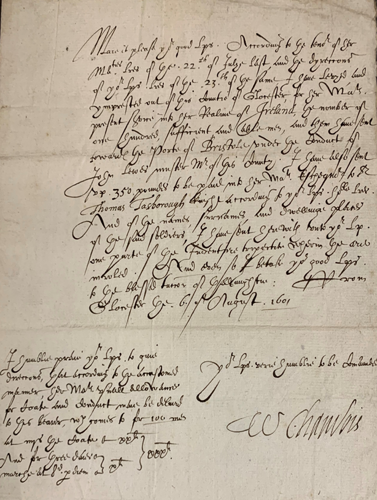
D3552/1
Also known as The Nine Years' War, this was fought in response to the ongoing Tudor conquest of Ireland by an Irish alliance under the O'Neills of Tyrone and the O'Donnells of Tyrconnell. As with previous Tudor rebellions, the county’s involvement was supplying men to serve in the English army. On the 6 August 1601, Baron Chandos of Sudeley wrote this letter to the Privy council informing them that he had “levied and impressed out of this County of Gloucester, for her Majestie's present service into her Realm of Ireland, the number of one hundred sufficient and able men, and them have sent towards the Port of Bristol under the conduct of John Lewes muster Master of this County”. He had also “sent up 350 pounds to be paid into her Majestie's Exchequer“ as well as a list of the “names, surnames, and dwelling places of the said soldiers”. In the separate paragraph bottom left he then tactfully requested payment according to “her Majestie's usual allowance for Coat and Conduct, which comes to for 100 men at iiijs the Coat...£20. And for three days march at 8d per diem...£10 } £30”
English Civil War, 1642-46
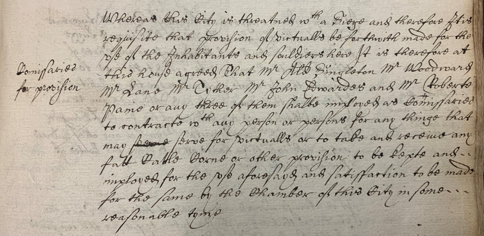
GBR/B3/2
Gloucestershire played an important part in the Civil War, most notably the Siege of Gloucester, 1643, which marked the turning point in the First Civil war, and the Battle of Stow-on-the-Wold, 1646, which effectively ended it. Parliamentary supporters were deemed rebels by the Crown and in early March 1643, Gloucester – as a ‘rebel stronghold’ – realised it was vulnerable and a Royalist Welsh army under Lord Herbert was approaching from the Forest. On 6 March, the City Council ordered that preparations were to be begun to make the city ready for war and for it to withstand a siege. Though the Welsh were subsequently defeated at the Battle of Highnam in a joint action by the city’s military commander, Lieutenant-Edward Edward Massey and Sir William Waller’s Parliamentary army, the city knew it wasn’t the end….
“Whereas this City is threatened with a siege and therefore it is requisite that provision of victuals be forthwith made for the use of the Inhabitants and Souldiers. It is therefore agreed that Mr Ald. Singleton, Mr Woodward, Mr Lane, Mr Tither, Mr John Edwardes and Mr Roberts shall be employed as Commissaries to contract any person or persons for any things that may prove for victuals or to take and receive any fatt cattle, corne, or other provision….”
Barwick Cyphers
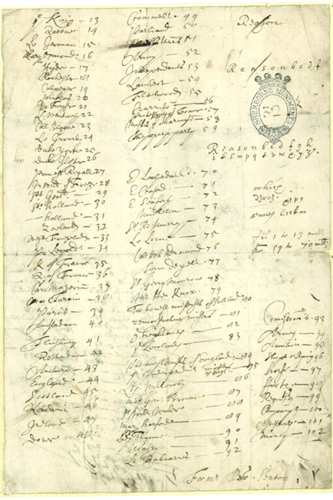
D678/1/F1/32
Throughout the Civil War[s] John Barwick, DD, Chaplain to the Bishop of Durham, and his brother Peter Barwick, were the principal and most trusted secret agents for Charles I. From Durham House in London, John – aided by his brother – sent a stream of coded letters about events in the capital to Charles at Oxford. The letters to and from the King had to be sent in secret and the brothers used a cipher – seen here – that was one of several Royalist ciphers. It is a simple number substitution cipher, where numbers were used to represent whole words or part-words. Here, the word ‘King’ was substituted by the number ‘13’, ‘Queen’ ’19’, ‘Cromwell’ ‘49’ and ‘Parliament’ ‘50’. The brothers continued spying after the King’s execution, communicating with Charles II in exile, but in 1650, John was betrayed by a Post Office official to Parliament, and he had to destroy his ciphers when New Model Army troops were sent to arrest him. Charged with high treason, he was imprisoned in the Tower of London but was released in 1652. He was later appointed Dean of St. Paul’s, while Peter became Physician to Charles II. The link to Gloucestershire is due to the marriage of Sir Ralph Dutton, 1st Baronet of Sherborne, to Mary Barwick, sole surviving daughter and heir of Peter Barwick, which brought the ‘Barwick Papers’ – including a copy of one of their ciphers - into the county. So, from the title slide “…that your ’51’ with the ’13’ is secure….less you be accused of being involved in a ’63’ to overthrow ‘50’!” can be decoded as “…that your correspondence with the King is secure….less you be accused of being involved in a cabal to overthrow Parliament!”
Prestbury Churchwardens Accounts, 1684
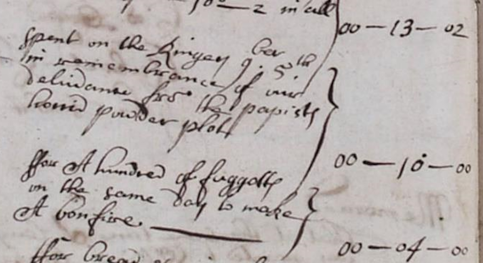
P254 CW 2/1
The Gunpowder Plot was a failed attempt to assassinate King James I of England during the Opening of Parliament in November 1605. The plan was organised by Robert Catesby, a devout English Catholic who hoped to kill the Protestant King James and replace him with his daughter, Princess Elizabeth, and thereby establish Catholic rule in England (his plan half-worked, for Elizabeth’s grandson later became George I). There were 13 plotters in total, the best remembered being Guy Fawkes. After the plot failed, the conspirators were all caught or killed and after a trial the survivors were sentenced to death – by hanging, drawing and quartering (a nicety here was that prior to drawing they were castrated). In January 1606, Parliament passed the Observance of 5th November Act, making public thanksgiving for the gunpowder plot’s failure an annual feature of English life, with church ministers having to hold a special service reading the text of an approved sermon on 5th November. The Prestbury Churchwardens accounts for 1684 records 14s (£83 today) being spent on bellringers and wood faggots for a bonfire to commemorate ‘the papists horrid powder plott’.
Monmouth Rebellion, 1685
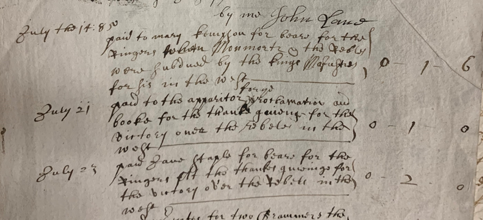
P216/CH/1/6
Also known as the Pitchfork Rebellion or the West Country rebellion, this was an attempt to depose James II, who succeeded his brother Charles II as king in February 1685. It was led by a group of dissident Protestants headed by James Scott; 1st Duke of Monmouth (the eldest illegitimate son of Charles II), who opposed James largely due to his Catholicism and who was exiled in the Dutch Republic. On 11 June 1685, Monmouth landed at Lyme Regis where he had widespread popular support and began a march on London, gathering an army of nonconformists, artisans and farm workers – including a certain Daniel Defoe. Things did not go to plan and by the 5 July, Monmouth was hemmed in around Bridgewater with a Royalist army in close proximity. To try and break out Monmouth decided to launch a night attack on the Royal army at Westonzoyland. The result was the Battle of Sedgemoor; the last pitched battle fought on English soil. The supposed surprise rebel attack failed, and the battle was a total Royal victory in which some 2,700 rebels were killed and 1,400 captured. Monmouth escaped but was caught a week later and executed at Tower Hill on 15 July – it took 5 or 7 strokes of the axe to sever his head. This entry in the Mickleton Churchwardens account show 3s 6d worth of beer (about £21) given to the bell ringers for ringing the church bells in celebration of the victory over the rebels. It also records a shilling paid to the diocesan apparitor (a church official) for a ‘proclamation and booke’ – presumably both containing the official form of words to celebrate the defeat of the rebels.
Glorious Revolution, 1688
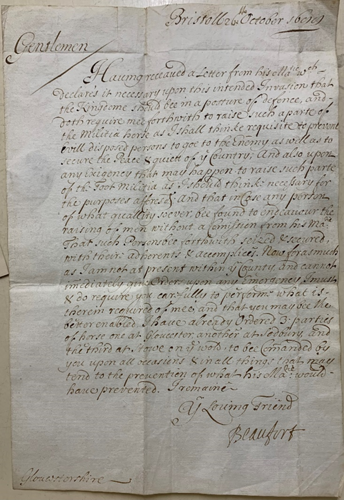
D621/X1
The Glorious Revolution was the series of events that led to the deposition of James II and the installation to the throne of his protestant daughter Mary II and her Dutch husband, William of Orange. The invasion came about due to the need to ‘protect the Protestant religion’ and the threat of a Catholic heir to the English throne (James’ son, James Francis Edward Stuart was Catholic) as well as the possibility that James would ally with France against the Dutch States. William landed at Torbay unopposed with 20,000 men and made his way to London slowly waiting for James’ rule to collapse and for him to flee – which happened within the month. The county’s involvement came from the County Militia and the Duke of Beaufort – who was a staunch supporter of James II. In October 1688, James wrote to Beaufort informing him to gather forces to defend the county. Beaufort subsequently wrote to his officers to raise the Foot Militia ‘upon this intended Invasion’ – ordering them to gather at Gloucester, Sodbury and Stow. He also ordered that as well as raising the regular militia, ‘any person of what quality so ever be found to endeavour the raising of men without a commission from His Majesty that such persons forthwith be seized & secured with their adherents & accomplices’ – essentially conscripting men into the militia against their will.
Oaths of allegiance, January 1715
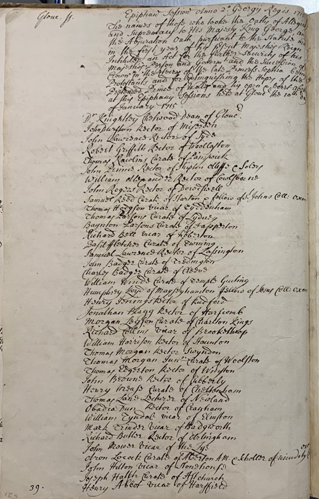
Q/SO/4
Oaths of allegiance were not new – the first was made to King Edgar c959. By 1700 there were two oaths – allegiance (declaration of fidelity to the Sovereign) and supremacy (repudiation of the spiritual or ecclesiastical authority of any foreign prince, person or prelate) – but in 1702, an oath of abjuration, which repudiated the right and title of descendants of James II to the throne was added. After the Jacobite Rebellion of 1715, nobles, MPs, peers and clergy were ‘invited’ to retake the ‘Oaths of Allegiance and Supremacy to His Majesty King George and the Abjuration Oath, pursuant to the statute Intitled "An Act for the further Security of His Majesty's Person and Government, etc’. The county Quarter Sessions Order Books record the signatories over 4 pages at Epiphany (Jan) and Michaelmas (Sept).
A List of Papists in Gloucestershire
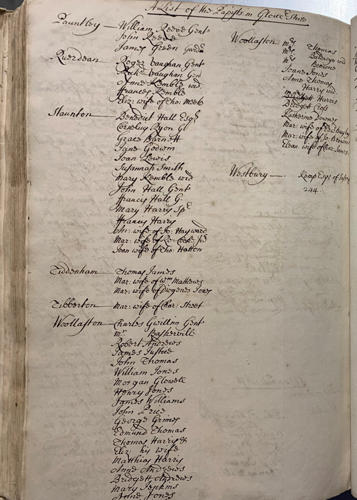
Q/SO/4
As well as the paths of allegiance, the ‘Fifteen’ – as the Jacobite Rising of 1715 became known – also triggered the Quarter Sessions to record the names of known Papists in the county, listed by place in each of the county’s Hundreds.
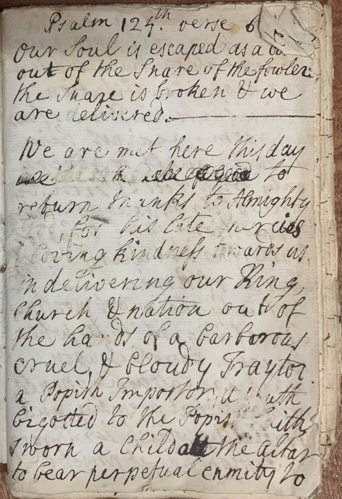
Sermon giving thanks for deliverance from this Popish pretender…
D2078/Box 7/30
After the collapse of ‘The Fifteen’ rising, churchmen all over the country preached sermons from the pulpit giving thanks for the collapse of the rebellion. It isn’t known who wrote this sermon, but it comes from the Dursley area. It gives thanks for the country's deliverance from the "Popish Imposter" and the "suppression of this late unnatural rebellion." It is a vehement anti-Catholic hell-fire speech, and later, one epic sentence describes the Young Pretender as “a youth taught to govern only with a rod of iron, force of arms, excommunications, Inquisitions, fire & faggots and all the artilleries of the church of Rome.”
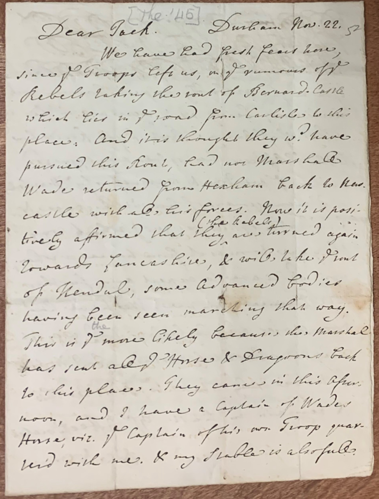
Letter from Thomas Sharp at Durham to his son, concerning Jacobite rebellion, November 1745
D3549/9/1/1
The Jacobite rising of 1745 was an attempt by Charles Edward Stuart (aka Bonnie Prince Charlie) to regain the British throne for his father, James Francis Edward Stuart. It took place during the War of the Austrian Succession, when most of the British Army was fighting in Europe, and although it initially met with some success, it ultimately failed when the Jacobite army was defeated by Government forces at the Battle of Culloden. It proved to be the last Jacobite rising and although often thought of in terms of ‘Scotland v. England’, the reality was that Scots and English fought on both sides. This letter from the Sharp archive was written by Thomas Sharp, Archdeacon of Northumberland, to his son, John Sharp during the Jacobite invasion of England and their march south in 1745. The letter mentions General George Wade, commander of the Government army, whose failure to stop the Jacobites led to him being replaced by the Duke of Cumberland – who was to be the victor at Culloden.
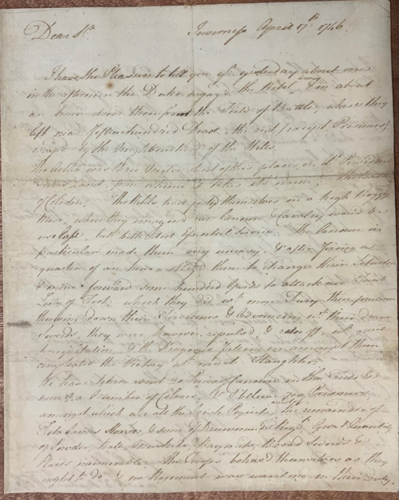
Letter from James Wolfe after the Battle of Culloden, 1745
D1571/F715
Among the Government forces who defeated the Jacobite rebels at Culloden was James Wolfe – who as a major general in 1759, gained posthumous fame for his victory over the French at the Battle of the Plains of Abraham in Quebec during The Severn Years War. When the 1745 Jacobite began, Wolfe was aide-de-camp to Henry Hawley, who temporarily replaced General Wade as commander of the Government forces in Scotland prior to the arrival of the Duke of Cumberland. While on campaign Wolfe frequently wrote to his uncle, William Sotherton of Shipton Moyne and we are lucky enough to hold these letters as part of the Sotheron-Estcourt family archive. This page, written by Wolfe after Culloden is his eye-witness account of the victory. During the battle, Wolfe was stationed with the 4th (Barrell’s) Foot which took part in the fierce hand-to-hand fighting on the Government’s left wing.
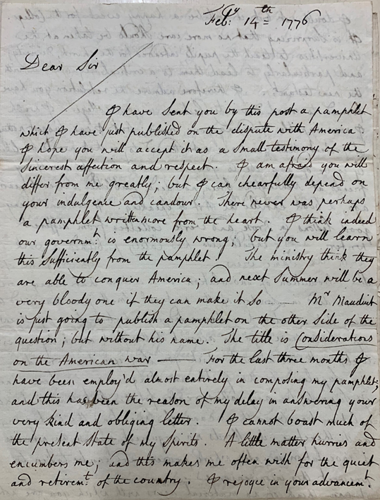
Letter from the nonconformist minister Dr. Price to Dr. William Adams, Master of Pembroke College, Oxford, 14 February 1776
D6/F140
The American Revolutionary War was a rebellion by the Thirteen Colonies that began after the Severn Years War in 1763. Although the American colonies had fought and supported the war, Parliament imposition of new taxes to reclaim wartime costs strengthened American desire for independence. It led to growing political unrest among colonists – culminating in the argument that taxation without representation violated their rights as Englishmen. War broke out in 1775 after a failed British attempt to disarm the Americans led to American victories at the Battles of Lexington and Concord. Like George III, the British public initially hardened feelings against the rebels in the colonies and the consensus was for stronger more coercive measures against the colonists, as it was thought that it was British leniency in regulation that was the culprit for escalating tensions in North America. This letter from the nonconformist minister Dr. Price to Dr. William Adams, Master of Pembroke College, Oxford, questions the government’s warmongering and notes that ‘next summer will be a very bloody one.’ Many British working class however viewed the situation in the North American colonies through a more positive prism – and that an American victory might usher in a new era for reform and an end to their own disenfranchisement.
Letter from Henry Rooke to his brothers Hayman and Charles, giving an account of the capture of Fort Washington during the American Wars, 1776
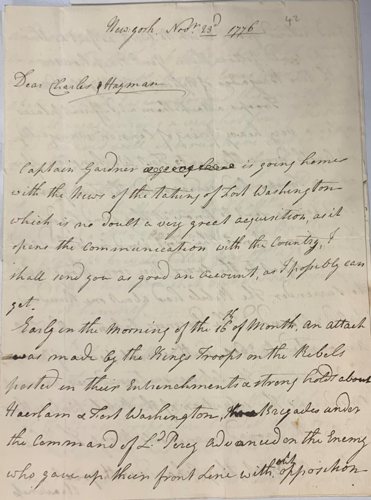
D1833/F2/42
The Battle of Fort Washington was fought in New York on November 16, 1776, and it was a British victory that was one of the worst Patriot defeats of the war. This letter is from Henry Rooke, of the Rooke Family of St. Briavels who were a strong military family. Written to his brothers Charles and Hayman, gives an account of the ‘attack made by the King’s Troops on the Rebels’ on the fort. The battle gained the surrender of Fort Washington, which was located near the north end of Manhattan, so clearing New York of American rebels and allowing the city to become the British military and political centre of operations in North America for the remainder of the war…for all the good it did!
To Thos Lord Ducie from his brother Capt. Francis Reynolds, R.N., 1781
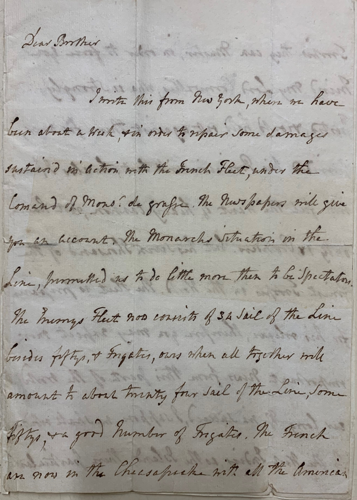
D340a/C28/3
Initially the Royal Navy gave Britain the upper hand but when the French entered the war on the American side in 1778, the tables turned. The Battle of the Chesapeake was a naval battle fought in September 1781 between an outnumbered and outgunned Royal Navy fleet under Sir Thomas Graves, and a French fleet led by the Comte de Grasse. This is a letter written after the battle from Capt. Francis Reynolds, onboard HMS Monarch at New York, to his brother Lord Ducie, describing the action and that "the French are now in Chesapeake with all the American Troops they can Muster.” The battle was tactical draw, but a strategic British defeat as it stopped the navy from reinforcing or evacuating the besieged forces of Cornwallis at Yorktown – ultimately forcing his surrender, Britain losing the war and America gaining its independence.
List of those who went to a meeting of Chartists on Selsley Hill with Thomas John Lloyd Baker as volunteers, serving as mounted special constables, 21 May 1839
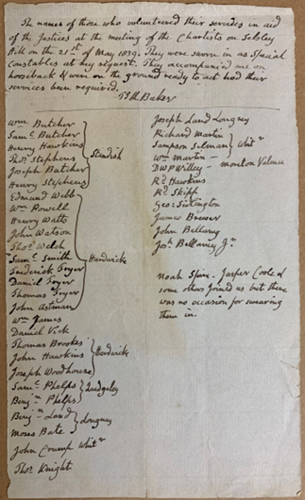
D3549/23/3/31
The Chartists were a political movement that wanted to gain political rights for the working classes and their demands were publicized through meetings and pamphlets. They were so called because of their People’s Charter, which called for a vote for all men (over 21), secret ballots, no property qualification to become an MP, payment for MPs, electoral districts of equal size and annual elections for Parliament. The Chartists gathered much support in working class areas and in Gloucestershire, its stronghold was Stroud – where woollen and cloth mill workers were attracted to the Chartist cause due to their working conditions and low wages. Between 1837 and 1842, there were around 12 large Chartist gatherings around Stroud, but the single largest meeting was on Selsley Hill on Tuesday 21st May 1839 when around 5,000 people met in support of the People’s Charter. Political elites feared the Chartists, viewing them as a dangerous threat to national stability that needed to be controlled but at this time, there was no police force (the Gloucestershire Constabulary did not form until 15 October 1839) so when Chartist meetings took place, the Justices of the Peace appointed special constables. This is a list of those who volunteered to attend the Selsley meeting and were sworn in as mounted special constables by JP Thomas Lloyd-Baker. In the event, all the local meetings passed off peaceably – this was lucky as on several occasions the Army’s 12th Lancers were standing by to help if trouble arose – and the chance of another 1819 Peterloo was high. Chartism did not directly generate any reform, but after 1848, as the movement faded, its demands appeared less threatening and some of the charter points were gradually enacted by other reformers.
Sale particulars for Snigs End Estate and Moat Farm in Corse and Staunton (formerly owned by the Chartist National Land Company)
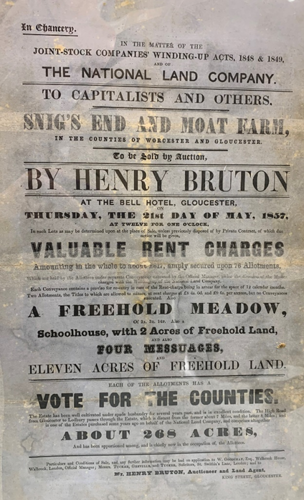
P101a/MI/2/1
The National Land Company was founded in 1845 by the chartist leader Feargus O'Connor, to help working-class people meet the landholding requirement to gain a vote in general elections. The idea was for working people to buy shares in the company, with the money being used to buy land and build cottages with a smallholding. Shareholders would then be chosen by ballot to live and farm in these communities, paying rent which would repay all the subscribers (with interest). Locally, two settlements were created, one at Lowbands in Redmarley D'Abitot, Worcestershire (now in Gloucestershire) in 1846 and the second at Snig's End in Staunton in 1847. For a time after 1848, Fergal O’Connor lived at Snig’s End. At each settlement, the land was divided into smallholdings, each of which was thought sufficient for a family to farm and grow enough food to feed themselves. A total of five Chartist settlements were created and a sixth was planned but never carried out. Sadly, the scheme had lots of flaws (among them the fact that many of the occupants were from towns and had no knowledge of growing food), and the company was wound up by Act of Parliament by 1851 with most of the estates being sold off – as this sale particular advertises. It is claimed that the third Chartist Petition was taken to Parliament in 1848 on a cart made at Snig’s End and pulled by estate horses.
Letters from Second Lieutenant Percival Scrope Marling to his parents during the First Boer War, 1881
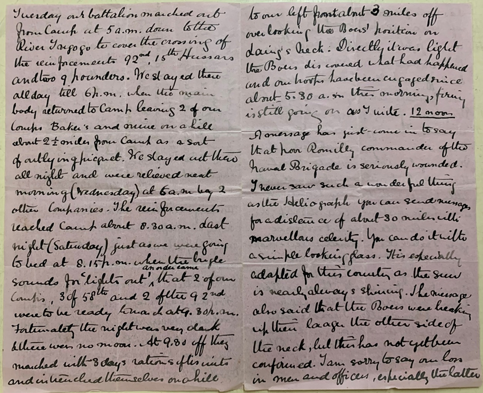
D873/C110
The First Boer War was a brief conflict prompted by discontent following the British annexation of the Transvaal in 1877, after which the Boers (descendants of the Dutch settlers) rose up in revolt against the British Crown. Relying on non-standard tactics, the Boers defeated Imperial forces at two major engagements at Laing’s Nek and Majuba Hill and several smaller ones. Realising that a victory would require substantial troop reinforcements, and a costly, messy and protracted war, the government signed a peace treaty under unfavourable terms. The Battle of Laing's Nek was the last occasion where a British regiment carried its regimental colours into battle. This is a letter from Percy Scrope Marling, a Second Lieutenant in the 2nd Battalion, 60th Rifles, to his grandfather, Sir Samuel Marling, describing the action at Laing’s Nek – where British cavalry and infantry attacks were repelled with heavy losses. Of the 480 men who made the attacks, 84 were killed and 113 wounded – among them many senior officers who were deliberately targeted by Boer sharpshooters. Marling survived the war and went on to serve in the 1882 Anglo-Egyptian War, the Mahdist War, the Second Boer War and the First World War – in October 1903, he was appointed a deputy lieutenant of Gloucestershire, and in 1923 was made High Sheriff.