The port of Gloucester
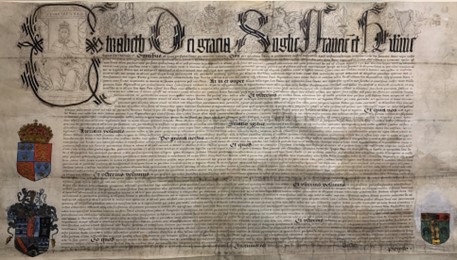
Throughout the medieval period, Gloucester (and the whole of the Severn down to Avonmouth) came under the jurisdiction of Bristol for customs purposes. However, in 1580, after being petitioned by the Mayor and Burgesses, Gloucester received a huge boost when Elizabeth I granted the city Letters Patent that made it an official customs port, removing it from Bristol’s control. This gave Gloucester control over the collection of customs along the length of the Severn and cut Bristol out of the profits to be made from anything heading north of Avonmouth or coming downriver to Avonmouth. It made all the small places along the river – termed ‘creeks’ (which was a customs term rather than a physical one) – such as Gatcombe, Newnham, Berkeley, Tewkesbury and any other places all came under Gloucester’s jurisdiction. Part of the Letters Patent reads:
We have granted… for the convenience of the said city of Gloucester and of the towns of Shrewsbury, Bridgenorth, Bewdley, Tewkesburye, Barkeley and others places granted to the Mayor and Burgesses of Gloucester that all those creeks from the said place called ‘Welsherode’ shall be called and reputed henceforth one of our ports for loading and unloading ships and that the creeks of Gatcombe, Newnham, Barkeley, Tewkesburye and all others from Welsherode shall be creeks pertaining to the said port. And that the common quay of Gloucester, commonly called ‘the Kyngse Kaye’ shall be a lawful and proper place for the loading and discharge of ships, lighters or bottoms.’
Gloucester port book database
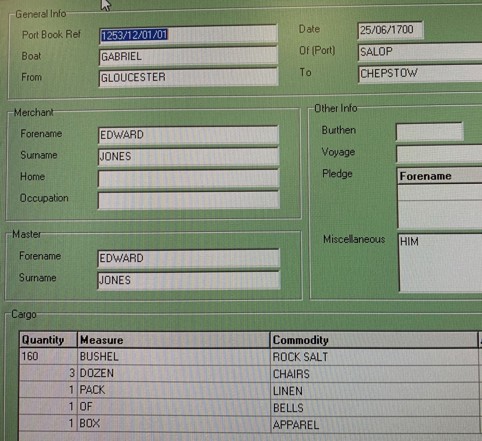
It is from the Tudor period that the first real archival evidence for shipping can be found in the form of the Exchequer Port Books. These record customs duties paid on goods imported and exported at ports all around England and Wales between 1565 to 1799. The actual volumes are held at The National Archives, but the Gloucester Port Book was digitised for an online database (available at GA). It has over 2 million individual pieces of data comprising the names of ships, their owners, masters, cargoes and their voyages – and represents an incredible record of the movement, quantities and types of goods traded in the Severn Valley and with ports elsewhere in England, Wales and Ireland. The screenshot image is a random example, showing the entry for the vessel Gabriel of Salop bound from Gloucester to Chepstow, Edward Jones Master & owner, carrying 160 bushels of rock salt, 3 dozen chairs, 1 pack (probably peck) of linen, 1 bell and a box of apparel (clothes).
Gloucester’s Westgate Bridge, c .1780
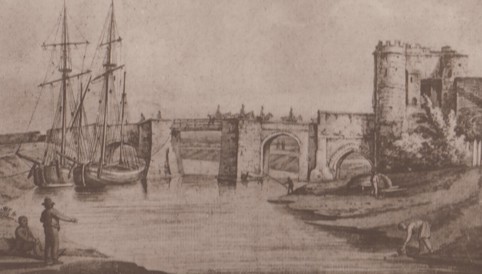
Dated between 1780-1785, this view of Westgate Bridge looking upriver shows two Severn trows moored on the west bank, which was used primarily for moorings rather than for loading/unloading cargoes. On the east bank, there is a riverbank ‘hard’, which was a firm beach or mud slope by water that was convenient for letting boats take ground or for hauling boats out of the water to load/unload them or to build/repair them. In this image there is a small boat being repaired (probably having its bottom strakes re-caulked) on the hard. In the right foreground someone appears to be fetching water or cleaning a pot. A brave move considering the amount of sewage that must have been floating by!
Gloucester Quay and Severn Lock, c.1850
This 1850 view is taken from Causton’s Map of Gloucester and looks southwards from the city quay towards the newly built docks. In the centre is the Severn lock that was used by vessels to enter the docks or leave them. A forest of masts can be seen in the docks. The large warehouse was built by Birmingham corn merchants Joseph & Charles Sturge who handled much grain traffic in and around the port. In the right background, the chimney belongs to an engine house which pumped water from the river into the dock’s basin and the canal to maintain the water level. Gloucester’s river quay can be seen in the foreground – the structure here is an outfall, which is shown in the 1850 Board of Health map for Gloucester. On the left, the tracks are part of the Gloucester & Cheltenham Tramroad, which came into the docks via Southgate Street (where today a short section of track and wagons can be viewed) but also had a branch which went out of the docks onto Commercial Road, turned west towards the Severn lock and then turned right along the Quay.
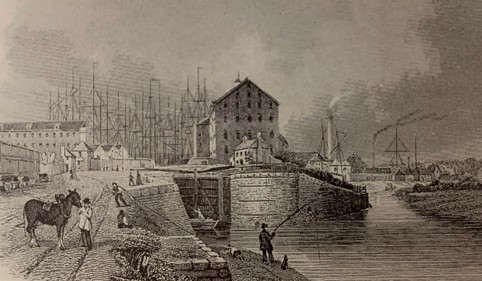
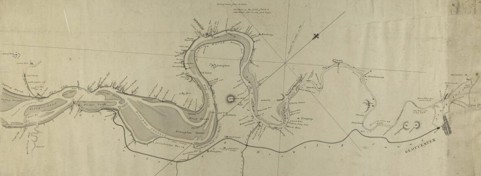
Chart of the River Severn from Berkeley Pill to Gloucester, 1830
This chart of the Severn from Berkeley Pill to Gloucester, and showing was drawn by W B Clegram and also shows Gloucester-Berkeley canal. In 1793, Midlands's industrialists, merchants and influential citizens of Gloucester obtained an Act of Parliament to construct a ship canal from Gloucester to Berkeley to bypass the difficult and dangerous tidal River Severn below Gloucester. The tortuous route from Berkeley on the left can be seen and also the notorious sandbanks, which often shifted opening or closing the main shipping channel, especially from Sharpness around the great horseshoe bend of Arlingham and to Rodley. About Bollow Pool (north-east of Rodley) the river became less dangerous, but it narrowed considerably making it far more difficult for larger craft. The Gloucester-Berkeley canal was eventually opened in 1827 but only went as far as Sharpness in order to save money. At 86ft 6in wide and 18ft deep, it could accommodate craft of 600 tons (with maximum dimensions 190ft long and 29ft wide) and for a time, was the biggest canal in England.
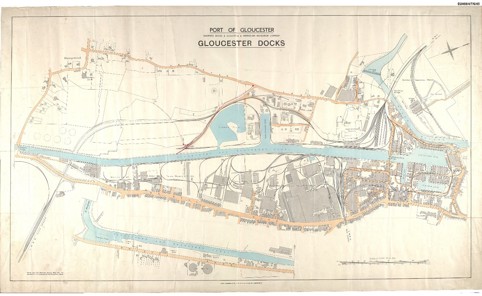
Port of Gloucester - Gloucester Docks
When completed, the northern terminus of the Gloucester-Sharpness Canal was ‘The Basin’ and the ‘Barge Arm’ in Gloucester, which together made a 4.66 acre ‘floating harbour’ where cargoes were transhipped to smaller craft which could then pass through a lock at the north end of the basin to continue up the River Severn to the Midlands. During the following years, several large warehouses were built around the dock perimeter and in 1849, the ‘Victoria Dock’ was opened, adding an extra 1.58 acres. Over time the docks grew, expanding southwards along the canal reaching their zenith in the 1930s by which time the Great Western Railway and Midland Railway had laid lines into the docks. The last major alteration was the creation of Monk Meadow Quay which was built beside the canal above the timber float pond in 1965 for the discharge of timber from motor coasters.
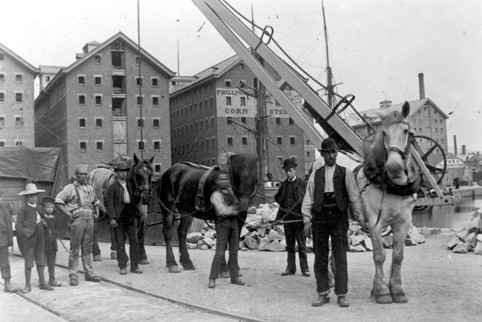
Gloucester Docks, c. 1887
Although seen many times, we make no apologies for including this wonderfully atmospheric photograph in this exhibition. Taken in 1887 from the main basin’s north quay it shows horses hitched to a large, covered wagon facing towards the Severn Lock with warehouses behind (one being Phillpotts & Co, Corn Merchants). The individuals comprise the horse’ grooms, a supervisor (behind the lead horse), a dock yard worker (judging by the grubby clothing) and assorted young onlookers. The horses are hitched in three-in-line – an arrangement known as a ‘randem’, which was used around the docks because there was not enough space to have them in line abreast. The rail lines here served a warehouse behind the camera but were also used to load/unload ships berthed along the quay. The crane is man-powered but later steam cranes were used. Looking at the pile of stones on the quay and judging from the direction of the horse team, they may have been bringing stones into the docks to be loading aboard a ship, but this isn’t known for sure.
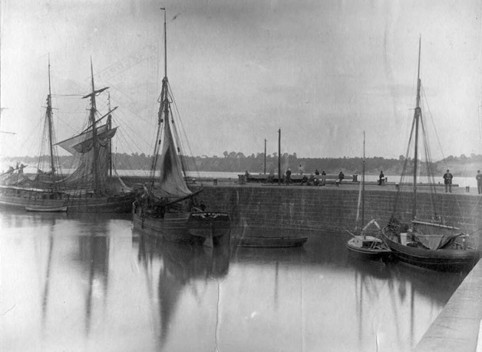
Sharpness old basin, c.1890
At the southern end of the canal was Sharpness. When the Gloucester-Sharpness Canal opened, it ended in a roughly triangular 2.6-acre basin with a sea-lock onto the Severn. The dock basin itself was separated from the canal by another lock – this was needed because when the sea-lock gate was open in the basin (for an hour or two either side of high water) the water level of the basin varied with the height of the tide and if not isolated, this would have affected the whole canal. This photograph shows ships and boats in the basin with the larger ships drying their sails. Although when sailing wet sails were an advantage (the fibres in the sailcloth expanded when wet and caught the wind better) if they were stored damp then they could rot, so drying them in port was common practice. The larger craft here a Severn trows – the indigenous River Severn vessel.
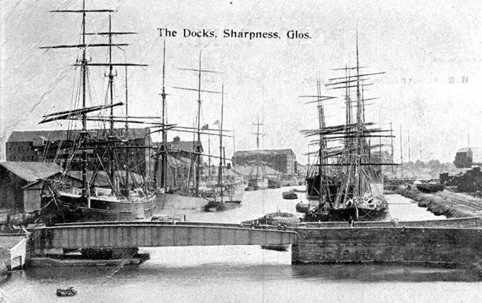
Sharpness new docks basin
By the late 1860s, the increasing size of ships made the entrance at Sharpness inadequate and as a result, a new ‘floating harbour’ was built at a cost of £400,000, which opened in 1874. This added an extra 17.6-acres of open water and had several advantages over the Old Dock in that the new entrance was via a large tidal basin with a lock, which meant that the water level could be maintained in the canal. The entrance was also below Sharpness Point, giving incoming craft more room to manoeuvre in the estuary whilst waiting to enter the port. The space around the new dock basin also allowed new warehouses to be built and, later a large rail network grew up around the port. Taken by the photographer F.J. Brooke of Gloucester in the last decade of the 1800s, this shows sailing vessels, warehouses and the quaysides of docks by Custom House. The docks were well served by railways but in typical fashion for Britain’s competing pre-Grouping railway companies, there were not only two railway lines into Sharpness, but there were even two separate bridges across the dock! This bridge here is the Midland Railway's low-level bridge which came in from the southeast via Berkeley, while the photograph is taken from the Great Western Railway's high-level bridge which came in from the north across the Severn.
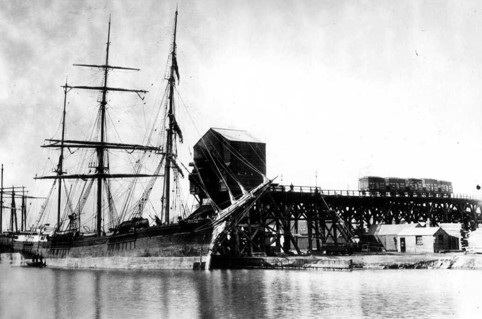
Coal - loading staithe, Sharpness
Forest of Dean coal being brought across from the Forest on the GWR’s Severn Rail Bridge was a vitally important cargo for the new port of Sharpness. To ensure ships could load coal as fast as possible so as not to have too much downtime, a large dual-track coal staithe with a long head shunt was built on the western side of the main basin, which linked to the GWR’s line via its high-level bridge at the northern end of the basin. This photograph shows the barque ‘Wolfe’ loading coal at the coal staithe. The loading process was ingenious and was arranged so that a whole rake of wagons could be pushed up the incline to the top on the left-hand track. At the top of the staithe there was a turntable so that a wagon would be separated from the rake and pushed up to the end, where it was emptied by tipping. It was then moved back onto the turntable which directed it onto the shallow down incline, where it would roll downwards under gravity to the head shunt. Each wagon would be emptied this way and in doing do the whole rake would have been reassembled in the head shunt. Then the whole now-empty rake could be taken out and returned to the Forest collieries.
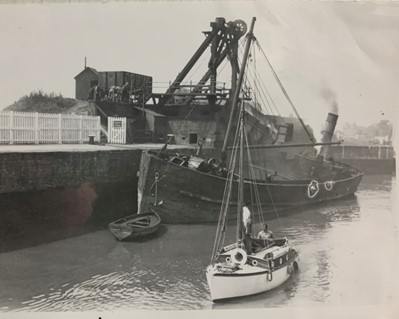
Lydney Canal, 1920
Lydney has been a recognised port since the reign of Henry II in the 1100s, but originally the coastline was around a mile inland and maritime activity took place somewhere near where St. Mary’s Church lies today, on a pill where the River Lyd entered the Severn. By the 1650s, Lydney had a thriving shipbuilding industry with relatively large naval ships being built, but it was short lived because by the mid-1650s an eastward shift in the flow of the River Severn meant that the area south of Naas Point began to rapidly silt up. This forced the shipyard to move south to Cone Pill and since then silting has continued creating to the formation of the ‘New Grounds’ and the current riverbank that exists today. By the 1800s, coal production in the Forest was increasing and new ways to export were being created. In 1810, the Severn & Wye Railway and Canal Company obtained an Act that authorised the building of a canal to the River Severn at Nass Point – linking to a tramway that ran from the Forest’s interior. The mile long canal opened in 1813 and by 1825, the outer harbour basin and locks were completed, and coal loading staithes were built at the northern end of the canal, allowing Lydney to become a thriving coal port for Forest of Dean coal. This wonderful image shows a shows coal from a Crump Meadow Colliery wagon being loaded into the hold of an unidentified steamer. The list would be corrected by trimming the coal in the hold. At its height, Lydney exported over 265,000 tons of Forest coal a year.
Bullo Pill
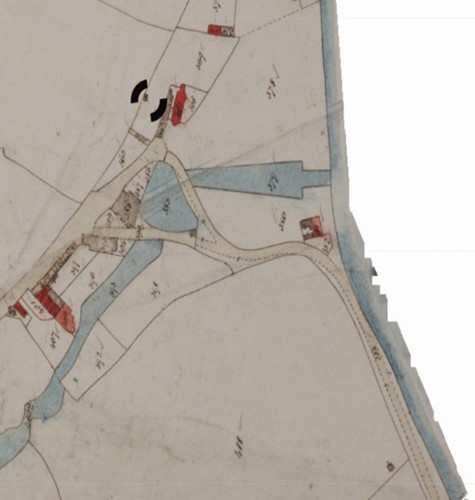
Seen here on the Newnham tithe map of 1839, Bullo Pill was located roughly 2 miles south of Newnham-on-Severn on the Forest bank and was originally a small tidal creek used for boatbuilding. In 1810, the Bullo Pill Tramway Company – which later became the Bullo Pill Railway Company - began to develop it to allow stone and coal from the Forest of Dean to be shipped out. By 1826, the dock was complete, but it was now owned by the Forest of Dean Railway Company. It boasted a basin with a tidal lock, water storage ponds (to maintain water levels in the tidal basin) and southwards along the riverbank, a wharf for loading goods with cast-iron mooring posts. By 1815 it was shipping up to 1,000 tons of coal and stone daily, and it continued to be heavily used until the late 1890s, when shipments declined. The last cargo left the dock in 1926, after which the lock gates eventually collapsed, and the basin silted up. Today the dock is a rather sad sight, full of old pleasure craft (some under repair), scrap metal, old caravans and general industrial storage debris.
Tewkesbury Quay, 1811
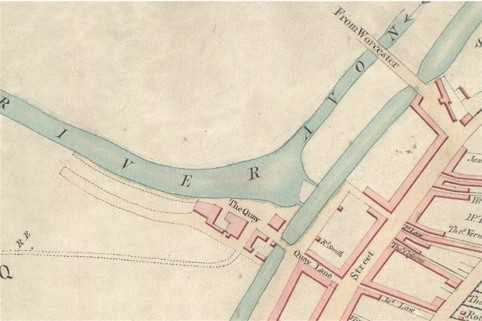
Located close to the confluence of the River Severn and the Warwickshire Avon, Tewkesbury was a natural place for a port. The 1811 inclosure map shows that the bulk of the town’s maritime activity was focussed on the Town Quay, which was situated on the Avon, on a bend about ¼-mile from the Severn. Like Gloucester, the quay was quite long, extending from King John's Bridge at its northern end to Knaves' Acre and Windmill Acre at the northern end of Town Ham. From the Tudor period onwards, there is frequent references to the quay in charters and other documents, such as the Tewkesbury Borough records. Around half of the town’s trade was to Bristol and entries in the borough records show that tolls were being collected at the Quay from the 1400s. Trade continued steadily until the mid-1800s, when the Bristol to Birmingham Railway (formed in 1845 by the merger of the Birmingham and Gloucester Railway and the Bristol and Gloucester Railway) built a branch line from its station at Ashchurch into Tewkesbury which terminated at the quay. Built in 1866, the Borough Flour Mill, now more generally known as Healings Mill eventually occupied most of the quay and the owner, Samuel Healing, was quick to invest in this alternative method of transport for transporting the mill’s output and henceforth the use of river craft to supply coal and grain began to decline.
Newnham-on-Severn ferry
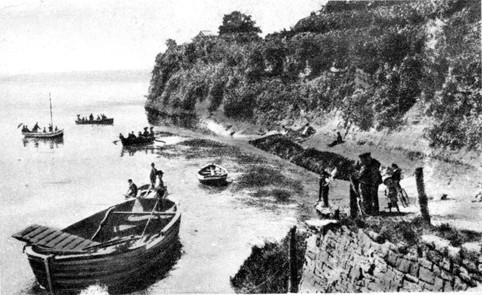
Newnham’s waterfront extended north from The Nab headland past Hulin’s Pill along to Newnham Pill – around 1/3rd of a mile and four pills once existed along this stretch, all of which have been used to moor boats. At the southern end was Newnham Ferry, seen in this image here. It was first recorded in 1238, when the king granted the woman keeping the passage of Newnham an oak for building a boat on hearing the news of the birth of his son. The ferry remained in use until WW2. The headland seen here is The Nab which was once larger and in the 1200s a road ran around its seaward edge which was probably used as a quay or hard. Shipbuilding took place at Newnham and all along the waterfront oak bark, cider, coal and glass - were loaded to be exported to Bristol and Ireland. Around 1750, a Newnham merchant, Robert Pyrke, built a stone quay, with cranes and warehouses, which boosted trade with Midlands’ goods brought down to be shipped to London. Newnham’s river trade dwindled as time passed and ceased completely in 1810 when Bullo Pill to the south opened.
Brockweir Quay and the 'La Belle Marie', c1910
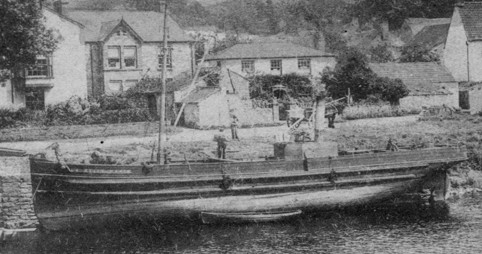
Located on the east bank of the River Wye, Brockweir has been a port since the 1600s and probably much longer. During the 1700s and 1800s it was a transhipment port, where goods brought down in barges from Herefordshire were put in larger craft, usually trows of 60-80 tons, for carriage to Bristol. It boasts a large stone quay – partially visible behind the steamer here – of which nothing is known of its origins. Surviving records indicate that almost all inhabitants of the village were watermen and life was seemingly entered on beer houses, skittle alleys, and cockfighting and it was said that it had the reputation of a 'city of refuge' for lawless elements. The vessel here is the La Belle Marie, a wood twin-screw steamboat of 31 tons which was built in Gloucester by Miller & Son in 1866. After a long career as a pleasure launch at Evesham, a tug at Bristol, and a ferry at Penarth and Portaferry in Ireland, she was bought by James Dibden of Brockweir around 1905. He ran her as Brockweir’s regular market boat. These craft could be found in many rural locations and generally took on local produce and shipped it down to larger places – in this instance Chepstow or to Bristol. It remained in use until around 1914 and was later broken up although some of her remains can be seen upstream of Brockweir and one of her propshafts and propellers used to be on the wall at Brockweir’s Quay House.
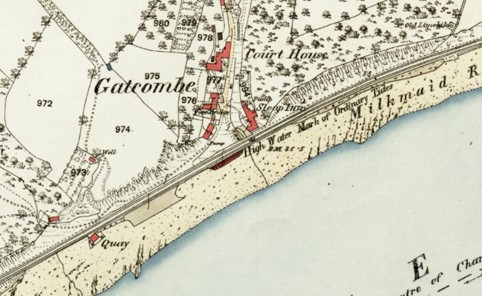
Gatcombe
On the Forest side of the Severn, Gatcombe was the main outlet for Forest oak bound to Plymouth and Milford Haven for naval shipbuilding in the Napoleonic Wars – but it had been important since Tudor times and the Red House – seen here as The Sloop Inn - was once allegedly home to Sir Francis Drake, when he was also involved in Forest timber for the navy. Gatcombe had a large stone quay, pier and a slipway but in 1850 the GWR’s South Wales Railway was built across the riverside frontage, destroying all except the quay which silted up. Although the railway built an arch to allow fishermen and boat owners access to the River Severn, trade quickly died out.
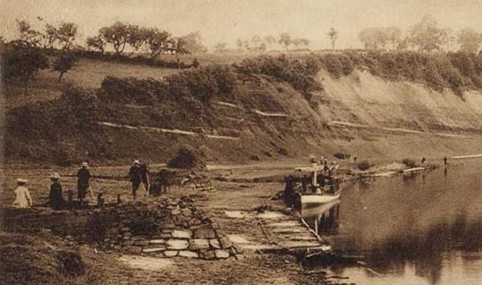
Ferry at Wainlodes, c. 1910
The Gloucester customs accounts record landing places and wharves at Awre, Frampton, Minsterworth, Westbury and Elmore. Other places were also used – this photograph of Wainlodes shows one of the regular river steamers that acted as ‘long ferries’ carrying passengers up and down the Severn (and also the Gloucester-Sharpness canal) on daytrips and on regular services. The ferry here is alongside a stone-built quay. Several day trippers can be with including a photographer with stand and camera. It was taken by the Gloucester photographer A H Pitcher of College Green, sometime around 1910.
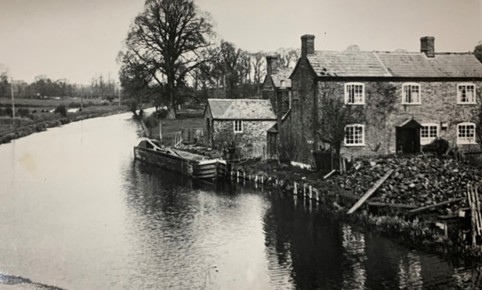
Whitminster Quay, c.1910
The Gloucestershire canals also had quays and basins. The largest was Brimscombe Port, where a shipyard and warehousing existed to serve the Thames & Severn Canal. Although on a smaller scale, the Coombe Hill Canal near Cheltenham terminated at a basin with warehousing. There were often quays or wharves at smaller places along canals and the Stroudwater Canal had a quay at Whitminster, located by the Bristol Road Bridge. As can be seen in the photograph here, this wharf was relatively small, just long enough to accommodate one or two narrow boats or barges. It is likely that dozens of these places existed or were used, primarily for bringing in coal or stone for local distribution. The ‘pile’ of stones or cut firewood on the right here may well be material that has either been delivered or is waiting to be taking out.
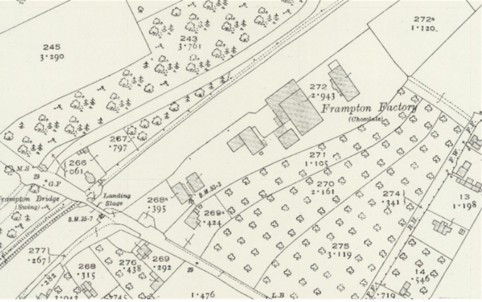
Cadbury factory, Frampton-on-Severn
In 1915, Cadbury Brothers Ltd – who liked using canals to transport their goods – acquired land under the Defence of the Realm Act to build a milk processing factory on the wharf at Frampton. It opened in April 1916 and milk from the Vale was brought into the factory where it was pasteurised, then mixed with cocoa beans and sugar which was brought up the river and canal to Frampton in barges from Bristol, to make ‘chocolate crumb’. This was transported in narrowboats onwards to Gloucester, then via the River Severn, and the Staffordshire & Worcester Canal to Cadbury’s site at Bournville in Birmingham. By 1917, as well as chocolate, the site was making condensed milk and cheese for the military, and by 1918, it was supplying pasteurised milk for Birmingham. It remained in operation until closing in 1982.
Monk Meadow Dock, Gloucester
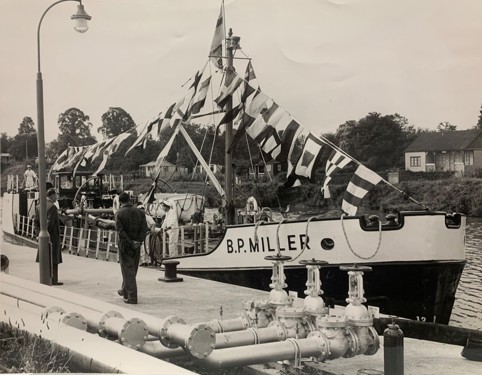
One specialist quay complex was the Shell Mex and BP Quedgeley tank farm at Monk Meadow Dock in Gloucester. Built during 1941-42, as part of the Government pipeline and storage system, it was known as Gloucester AFD (Aviation Fuel Depot) and received fuel by road, rail but mostly by tanker/barge. In 1959, it was transferred from the Air Ministry to the Ministry of Power and then to Texaco in 1971. It closed in the early 1990s after the end of the cold war along with the rest of the GPSS depots on the government’s national North/South Pipeline. This photograph from the Gloucester Journal was taken in 1960 and shows one of a fleet of small coastal tankers which supplied fuel to the site. This vessel is the B.P. Miller, which was built by Wallsend in 1956 as a coastal tanker and was owned and operated by Shell-Mex & B.P. Ltd. She is seen here dressed overall for an event.