
Blacksmith
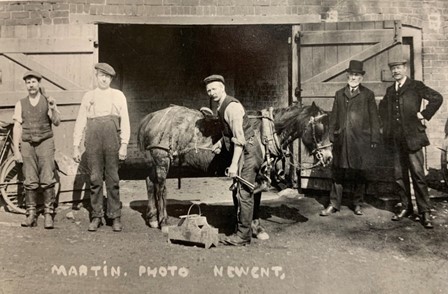
GPS/225/13
Most villages and hamlets had their own smithy – often more than one, depending on the community's size. This is blacksmith Bill Cleeton, working at his forge in Clifford’s Mesne c 1910.
Clarkson Steam Bus, Cirencester and District Motor Omnibus Co.
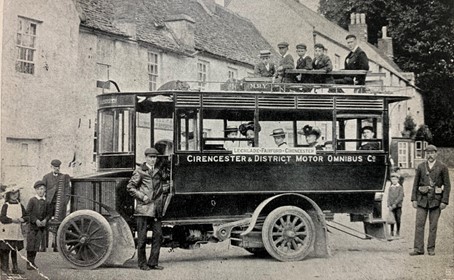
GPS/611/46
This is a Clarkson Steam Bus of the Cirencester and District Motor Omnibus Co. bus around c1904. These interesting vehicles were made at the Moulsham Works, Chelmsford and used paraffin as fuel. The company ran routes between Lechlade, Fairford and Cirencester from 1904 until WW1. Single decked, they had 14 seats (12 inside and 2 with the driver) and were marketed as being “entirely free from smell, noise, and vibration.“
1921 Arrol-Johnston 2413cc Saloon/Tourer
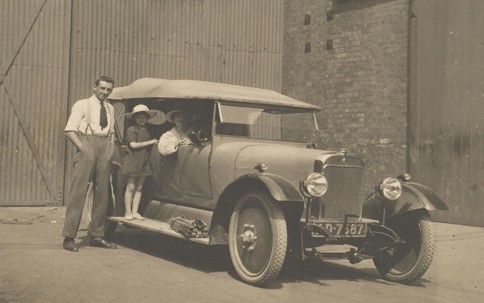
D12131/1
This is a 1921 Arrol-Johnston 2413cc Saloon/Tourer. The firm was a Scottish car maker from 1896 to 1931 and are credited with producing the first automobile made in Britain. This vehicle was advertised as an ‘All-Weather car’ – it was effectively a light saloon with the soft-top up, and a touring car with the soft-top down. It’s shown outside the Fielding & Platt works in Gloucester and the man is probably either John or Jack Fielding.
Winnie. H tanker-barge, Gloucester-Sharpness Canal, c1960
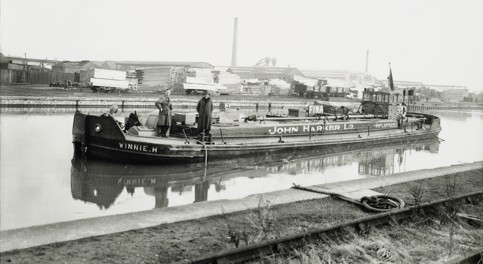
SRprints/GL22/103GS
Though shipping on the Gloucester-Sharpness canal and the upper River Severn declined rapidly in the post-war period, tanker traffic on the Gloucester-Sharpness canal remained a regular sight. The tankers of John Harker Ltd carried fuel on the Severn in 1929 until 1975 – here the tanker barge Winnie H is coming alongside at Monk Meadow Dock, Gloucester. Built in 1935 at Harker’s Yard at Knottingley (West Yorkshire) as a dumb barge, she was converted into a powered craft in 1950 – her fate is unknown.
Donkey cart, Thornbury Castle, 1881
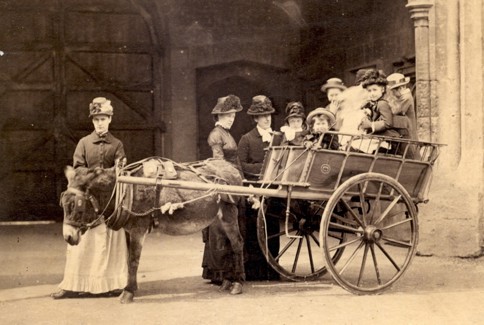
D4764/3/1
Donkeys were frequently used for local transport where a horse was considered excessive. This is a donkey cart with its child passengers outside Thornbury Castle in August 1881.
Minchinhampton fire brigade
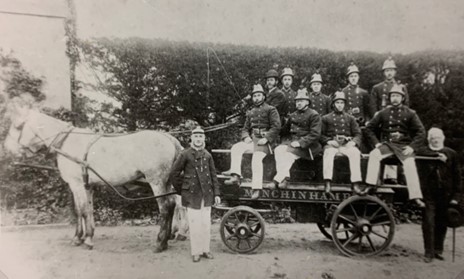
D9746/1/2/91
This is the Minchinhampton Fire Brigade with their horse-drawn steam-powered fire engine. Minchinhampton established a fire-brigade very early – this isn’t the fire pump-appliance but an accompanying wagon used to carry the firemen that followed the fire-pump to the fire.
Basket weir, Severn Estuary
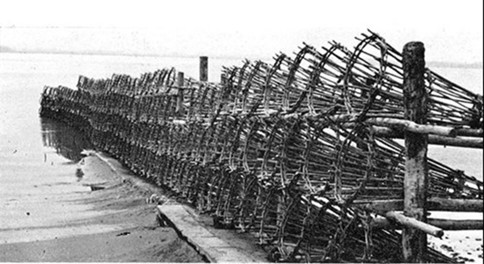
MR1/43GS Gloucester City Museum
Fixed-trap fishing using ‘fish-weirs’ have been used on the lower stretches of the Severn Estuary for at least 4,000 years. The most common form of fishing in the county were the ‘Fixed Engine’ fish weirs – aka basket weirs and hedge weirs – found on the Severn Estuary from Awre down. These funnel-like structures faced upstream and could catch salmon down to shrimps. Each rank was licensed by the County Quarter Sessions. This photograph shows a typical basket-weir on the middle estuary. They were used because they were more robust than nets which would be damaged by the strong tidal currents of the river. They were also less labour-intensive than nets. Fish weirs had a common construction, utilising hazel and willow withies (small flexible stems from the tree) to form a cone or funnel-like traps called ‘putchers’ or ‘putcheons’ about 2m long and 1m in diameter (at their widest point). These funnel-traps were set into a fence-like frame made of elm. The materials used to make the traps were all sourced locally, often being obtained from riverside tree plantations. These plantations were actively managed to provide a renewable source for these materials. The traps generally faced upstream so that they caught fish on the ebbing tide. These were more effective because to escape the trap the fish would have to try and fight against the tidal flow. A basket-weir could hold from as few as 10 putchers to as many as 2,000. A typical catch would be 1 or 2 fish per tide.
Hedge Weir, Severn Estuary
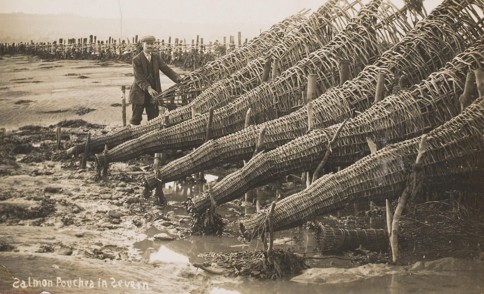
D4764/4/31
This photograph shows a hedge-weir on the lower estuary with a fisherman. These were used on the lower reaches of the estuary – typically from Lydney downwards to as far south as Minehead. These traps differed from basket-weirs as they used barriers called ‘hedges’ set in a large V-shape with a gap at the apex of the ‘V’. The hedges were made of hazel or elm uprights with interwoven hazel and willow withies. Stones were often piled up along the base to reinforce the barrier while on the extreme lower estuary the barriers were made of stones and were more like low walls. The traps or putts were set in the gap of the ‘V’. These putts were also much large than on typical basket weirs. They were made of three sections: the front forewheel, a middle kype and a narrow putt – which was similar to a typical putcher. The latter could be made with a very tight weave and could catch flatfish and even shrimps. These traps were secured in the gap in the ‘V’ by stout stakes. Like the basket weirs, they worked by funnelling fish (heading downriver on the ebbing tide) along the barriers and into the baskets. These weirs could have from 1 to 20 traps, but four or five was a typical number.
Lave net fisherman and salmon
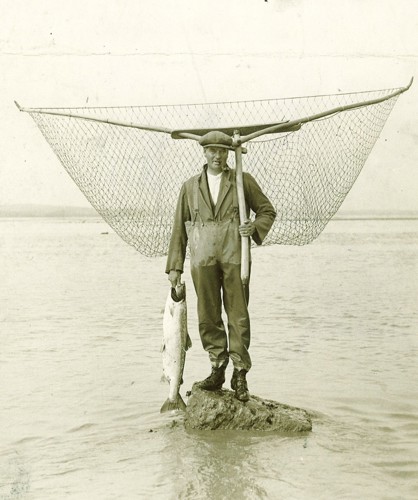
D4764/4/31
From Lydney downwards to Chepstow, lave-netting was practiced. A lave-net is a triangular shaped net fixed to a Y-shaped frame that is used to catch salmon. Lave-netting takes place at low tide on the middle reaches of the estuary. It was a solo fishing method that required fitness and good local knowledge of the river. The fisherman would wade out into the shallows as the tide ebbed and wait until he spotted the ‘run’ of a fish. This was a line of ripples that appeared when a fish moved from shallow to deeper water. The fisherman would then run to get in front of the fish and dip the net into the water to catch it. Alternatively, the fisherman would find a suitable gap in two rock reefs and place the newt between them on a fast-ebbing tide. Lave-netting was a selective fishing technique because small fish could be released unharmed. In this photograph, the fisherman is standing on a rock that marks a parish boundary.
Rogers’ Fun Fair Minchinhampton, 1925
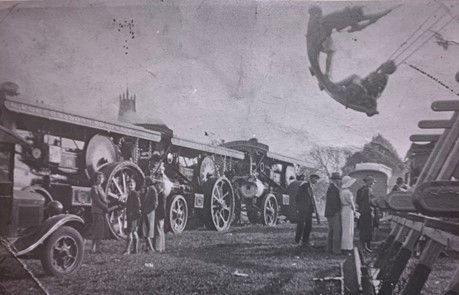
D9746/1/2/96
Noisy, brash and bright, you either love fairs or hate them. This is a photograph of Roger's Fair on Minchinhampton Common in 1925. The three traction engines were Showman’s Engines that as well as towing the rides from place to place, were equipped with large dynamos that were used to generate electricity to power the rides.
Haymaking at Copsegrove Farm, Bisley.
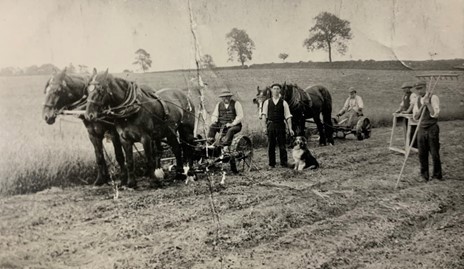
D9746/1/9/369
Haymaking on a farm was a vital job as it created fodder for feeding farm animals in wintertime. Prior to the introduction of mechanical mowers, scythes were used to cut the grass. Horse-drawn mowers made the task faster, but the windrows (the lines of cut hay) still needed human management – note the wooden hay rake in the hands of the farmhand on the right in this view of cutting hay at Copsegrove Farm, Bisley.
Hay baling, Bisley, 1917.
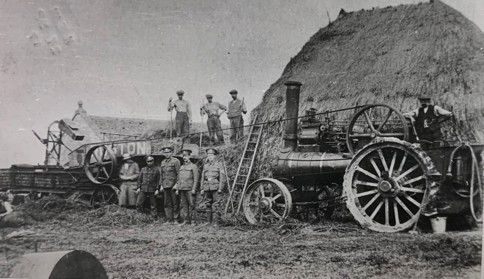
D9746/1/9/372
By WW1, mechanical hay balers had been introduced – here a Ruston mechanical baler is being driven from a traction engine at Bisley in 1917. With so many horses on the Western Front, feeding them was critical to the war effort and so haymaking was of national importance. During WW1 a quarter of all the cross-channel shipping going from England to France and Belgium carried hay for horses. Because the hay harvest was so vital, the War Office soldiers were released from service – note the soldiers here helping to bale the hay.
S. Browning & Sons of Stonehouse Threshing machine
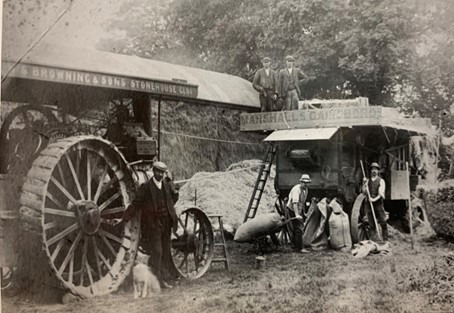
D9746/2/361/14
These images show the Marshall threshing machine of W S Browning & Son’s of Stonehouse in operation. Powered by steam, threshing machines revolutionised the harvest – stooks of corn were fed into the thresher, which separated the grain from the stalks and husks, letting the grain fall out to be bagged, while straw was carried to the top of the machine to allow it to be put onto a rick. They heralded the start of the agricultural contracting business but also triggered the wave of industrial unrest known as the Swing Riots.
Woman & pony, Winchcombe
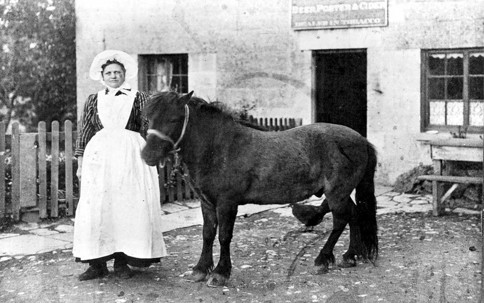
GPS/368/139
Horses were the lifeblood for transport well into the 1920s. This photograph shows a woman in apron and bonnet with a pony outside the Royal Oak in Winchcombe. Sadly, we know nothing else about this image.
Lower Slaughter Mill
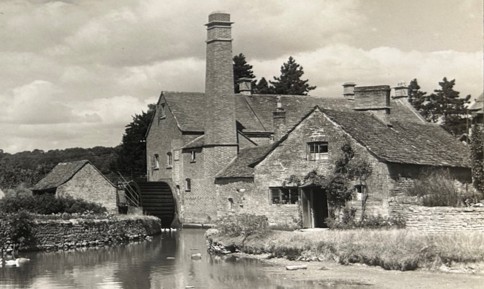
GPS/296/9
Larger villages often had larger mills – as at Bibury and Lower Slaughter – with large mill ponds or complex water management systems. Bibury mill had a reservoir in Ablington, which fed the mill via a ¾ mile (1.2km) long leat, while Lower Slaughter mill had a 1.3-acre (5,200 sq. m) mill pond. Many mills later installed steam engines – hence the chimneys – for several reasons. Most were used as auxiliary power sources to help mill corn in times of low water levels. In this role they could be used to pump water into a mill pond or mill leat to enable the waterwheel to function. However, they could also be used to power the mill machinery to enable the mill to grind corn faster. In this guise they were also used to try to allow water mills to compete with steam powered mills.
Sheep market, Chipping Campden, c1910
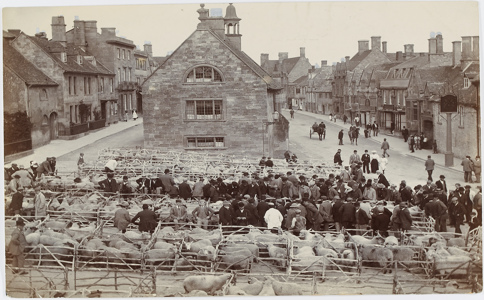
GPS/81/83
As a rural county, markets were common - this is typical, Chipping Campden’s sheep market, taken around 1910. Like most animal markets, it’s organised chaos!
Gloucester Cattle Market
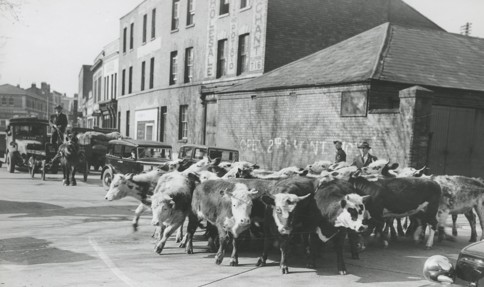
GBR/L6/23/B3713
These cattle being driven into Gloucester’s cattle market in what is now King’s Square in the 1930s. We’re not sure about precise location although it is somewhere on what was Market Parade.
Forest of Dean Freeminers
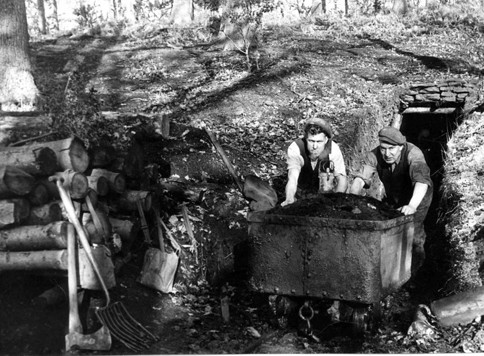
D3921
The Forest of Dean has a rich industrial history which is a direct result of its geology, lying in a basin formed by carboniferous strata that has fields of coal and iron ore. Coal outcrops in the Dean were traditionally mined by short drifts and by small pits, and by 1464 the Crown was regulating mining in the Dean through the office of Gaveller, with the role of deputy gaveller still active today. In 1668 the Reafforestation Act confirmed the miners’ traditional privileges in law, when the right or freedom to mine was restricted to native residents of St. Briavels hundred, a requirement still in place today. This was reinforced with the Dean Forest (Mines) Act 1838 stated that “All male persons born or hereafter to be born and abiding within the said Hundred of St Briavels, of the age of twenty-one years and upwards, who shall have worked a year and a day in a coal or iron mine within the said Hundred of St Briavels, shall be deemed and taken to be Free Miners." The freeminers registered to work a ‘gale’, which specified the place and mineral they could extract, although these drift mines – as they are known – were notoriously cramped.
.
Cannop Colliery, 1932

D7837/1
As well as drift mines, deep mines were opened – this is Cannop Colliery in 1932 (now the Forest of Dean Cycle Centre) and it was Dean’s largest. It opened in 1912, and by 1930 employed 1,000 men, extracting 1,000 tons of coal a day - although the downside was that it also had to pump out 3 million gallons of water! When coal was nationalized in 1947, British Coal took over all the deep mine collieries in the Forest, but not the small free mines. Cannop closed in 1960 – with the cost of pumping water out being a major factor – and the last deep mine in the Forest, Northern United Collery, closed just 5 years later on Christmas Day 1965.
Woman & pigs, High Street, Chipping Campden
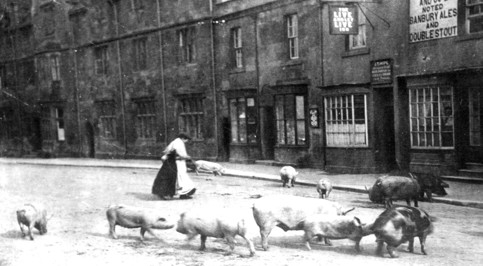
GPS/81/190
Gloucestershire is famous for our Old Spot pigs, a breed that originated in the orchards around the Vale of Gloucester. This wonderful photograph shows a woman herding pigs in the High Street of Chipping Campden beside the ‘Live and Let Live Inn’. It is likely that the pigs were being taken to the market – but you wonder what chaos they caused on the way!
P.C. Stafford & family, Withington Police Station, 1906
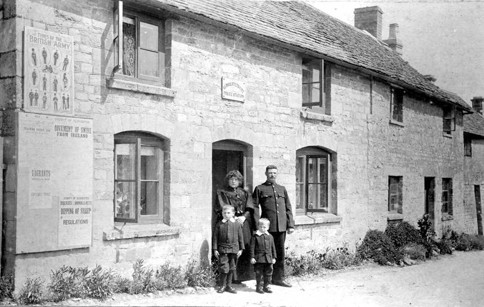
Q/Y/6/2/4
Gloucestershire Constabulary came into existence at one o’clock on Tuesday 15 October 1839 – just before the Wiltshire force. Many police officers lived with their families at their country stations. This is P.C. Stafford with his family standing in doorway of Withington police station in 1906. Notice the posters advertising joining the British Army, the Vagrancy act, and agricultural regulations on the dipping of sheep regulations and movement of sheep from Ireland.
Punch & Judy Show, Stroud, c1900.
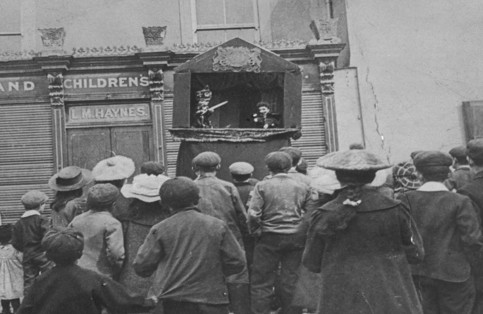
GPS/320/6
Punch & Judy were originally intended as shows for adults, but they changed into children's entertainment in the late Victorian era – here a crowd of children are being entertained in at Stroud around 1900. One reason for the change was that other members of the show's cast – the Devil, the hangman and Punch's mistress ‘Pretty Polly’ – were seen as inappropriate for youngsters!
GWR Express passing Churchdown Station

SRprints/70.24GS
Today, Gloucestershire’s railways are a shadow of their former selves. However luckily railway buffs have preserved much of the county’s old network, its infrastructure and workings in photographic collections. This is one of these images – a photograph of an unidentified GWR 4-4-0 3800 County Class locomotive hauling an express passenger service at speed on the up line through Churchdown station. You can almost feel the speed and the noise! Churchdown railway station was situated on the main line between Gloucester and Cheltenham Spa. After one temporary station opened in August 1842 a new permanent station opened on 2nd February 1874, being the joint property of the Midland Railway (successor to the Birmingham & Gloucester Railway) and the Great Western Railway, who had shared the line since 1847. At its height there were two island platforms with passing loops and four central tracks running through the station (to cope with wartime traffic) although the station never had any goods sidings. The station closed on 2nd November 1964, as part of the Beeching Axe. Little remains of the station today
Gloucester Co-operative Society Shop
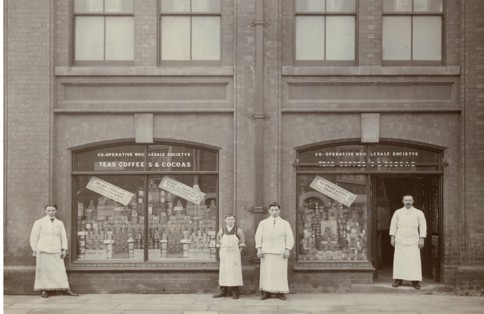
D2754/1/8/1/1
The local Co-operative Society shops began forming in the 1860s. This is one of the Gloucester Co-operative Society shops – as well as the tea, coffee and cocoa advertised in the window, these shops sold bread, flour, oatmeal, sugar, butter, milk, tobacco plus coal and candles.
Steeplejacks, St John’s Church, 1910
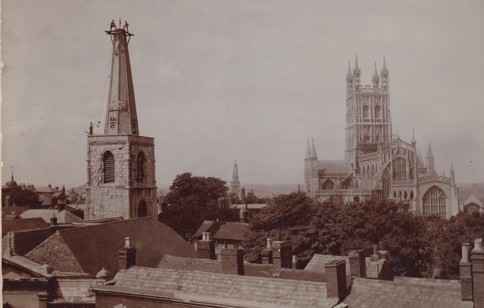
SRprints/GL15.20
Steeplejacks were used for all high-level work, but especially for repairs of church steeples, which were frequently damaged by lightning and storms. This stunning image shows the removal of top of St. John's church spire in 1910. The work was carried out by W. Larkins, steeplejacks of Bow, London – note the advertising banner! Established in 1897, Larkins was among the earliest steeplejack companies registered in the UK and is still in existence today. The top of the spire is today in St. Lucy’s Gardens behind the church and locally, it’s nicknamed the ‘the spire of the Church that sank into the mud’.