
Sport in the Archives—"All Shaped Balls!"
 SR34/37655.29GS
Gloucestershire has a long heritage of sport from one of the greatest cricketeers of all time, to incredible rugby players and even a ski-jumper! This presentation will look at how sport is represented in the documents held in the archives, so prepare to give those balls a good thrashing, chase that cheese and when the final whistle blows, we’ll retire to the snug for some traditional pub games!
Captain Dover’s Cotswold Olympics, Chipping Campden
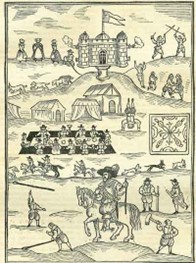
These were started in 1612 by lawyer and soldier Robert Dover after gaining royal permission by King James 1. The games took place at Whitsun on a hill above Chipping Campden - now known as ‘Dover’s Hill’. Events included horse-racing, coursing (the best dog winning a silver collar), running, jumping, dancing (by maidens and Morris men), sledgehammer throwing, fighting with swords and quarterstaffs, spurning the barre (caber tossing), pike drill, wrestling and shin-kicking. They attracted both rich and poor and were renowned for feasting and fun as well as sport! A castle façade was built for show, tents and tables were erected for the gentry, while cloths were spread on the ground for the commoners. The games ceased during the Cromwellian era, but were revived at the Restoration. Sword fighting was later dropped after one person lost three of his fingers and cut the nose off his opponent in return! In 1852 the games ended because they had become too rowdy – but in 1965 they were revived and have taken place every year since. In the 2012 Olympic Games bid for London, the British Olympic Association recognised Dover's Games as "the first stirrings of Britain's Olympic beginnings“. Shakespeare immortalised Dover’s Games in the Merry Wives of Windsor when Justice Shallow (a Gloucestershire landowner) names 'Will Squell, a Cotswold man' and Master Page's fallow greyhound, who was ‘out-run on Cotsale.’
Bibury Race Course, Aldsworth, 1811
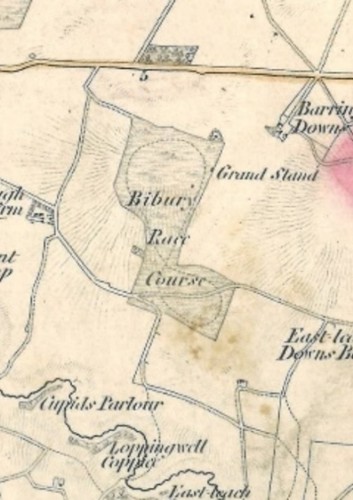
OS One-inch 'Old Series', 1811, Sheet XLIV
Horse-racing has been going on in the county since the 1600s. The first horse racing club was the Bibury club, an exclusive club that held meetings in the village – over 140 years before racing began at Cheltenham! Around 1775, with help from patrons Lord Courtenay, Lord Sackville and General Grosvenor, the club laid out a racecourse on the downs east of Aldsworth. The first three-day meeting was in March 1792 with the main race, the Bibury Sweepstake, being won by Courtenay’s horse, Daisy Cutter. In 1801, a grandstand was built on the site and the following year, the Prince of Wales attended a four-day summer meeting there. Racing continued until 1848, when it ceased having been eclipsed by Prestbury Park in Cheltenham.
Fred Archer, Champion jockey
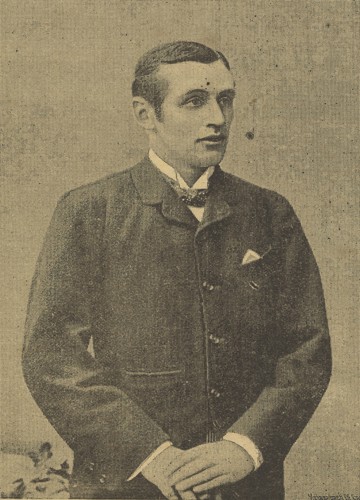
SRPort/Archer/2/GS
This is Fred Archer, a Victorian flat race jockey often described as the greatest all-round jockey of all time. Born in 1857 in Cheltenham, his first official win was at Chesterfield in September 1870, and he went on to ride 2,748 winners from 8,084 starts, setting records for the number of Champion Jockey titles (13) and the number of wins in a season (246) which remained until well into the 20th century. His personal life was more tragic and struggling with his weight and the death of his wife Rose during childbirth, he committed suicide at the age of 29.
Opening game at Kingsholm, Gloucester Rugby Football Club, 10 October, 1891
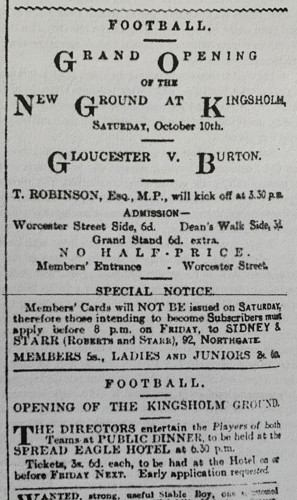
Gloucester Citizen, October 1891
Rugby has a heartland in Gloucestershire – where would we be without our beloved ‘Cherry & Whites’ and ‘Fortress Kingsholm’! The club itself was formed in 1873 after a meeting at the Spread Eagle Hotel which the Gloucester Journal reported: "A football club has been formed in this city – the season's operations begin at The Spa on the first Tuesday in next month." The first ground was at The Spa in Gloucester, but in 1891, the club left The Spa after acquiring grounds from the Castle Grim Estate at Kingsholm for £4,000 and ever since, home fixtures have been played here. The club went professional in 1997, and have been in the top-tier of English domestic rugby ever-since….
TEEK Cartoon for ‘Gloucester v. Llanelly, October 1927
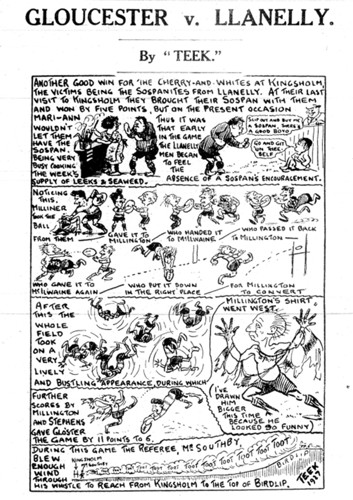
Gloucester Citizen, 15 January 1927
Between 1922 to 1929, cartoons by ‘TEEK’ were a feature of The Citizen Sports Edition. Teek clearly had a good understanding of the game and – not least – was a great cartoonist. He routinely attended the matches at Kingsholm, whether it was the first team or Gloucester A which was playing, but apparently never went to the away matches. He had an excellent knowledge of the Gloucester teams and clearly enjoyed poking fun at individual team members – which might suggest that he was on good terms with them. He routinely lampooned the ref or the touch judges. However – no-one knows who he was – although recent research has suggested one possibility – Henry Comer Teek, who lived in Cheddar.
W. G. Grace, Gloucestershire and England cricketeer

C8/25718GS
The first record of cricket in Gloucestershire is of a game that took place in Gloucester in September 1729. From then, little is known until the formation of a club called the Cheltenham and County of Gloucester Cricket Club in 1863, which in 1870, was replaced by Gloucestershire County Cricket Club. The County’s most famous player was W G Grace, widely held to have been one of the sport's all-time greats. His first-class career spanned a record-equalling 44 seasons from 1865 to 1908, representing England, Gloucestershire, the Gentlemen, Marylebone Cricket Club (MCC), and the United South of England Eleven (USEE). A right-handed batsman and bowler, he was highly competitive and qualified as a medical practitioner in 1879, but in later life, played golf, bowls, and curling!
Cheltenham Cricket Festival – Gloucestershire V Australia, August 1926
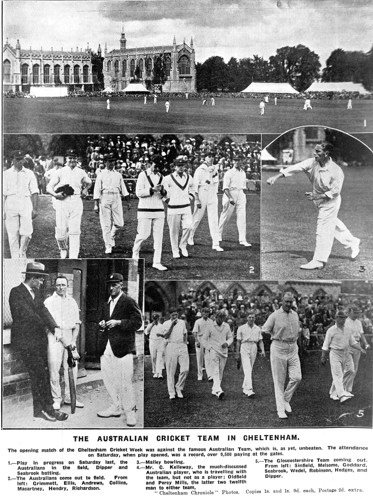
Cheltenham Chronicle & Gloucestershire Graphic, 14 August 1926
Although the county cricket side made its home ground in Bristol (and, annoyingly, still does today) it used to tour around the county, playing at venues in Cheltenham, Moreton-in-the-Marsh, Gloucester and Stroud – today only Cheltenham remains. Beginning in 1872, the Cheltenham Cricket Festival – held on the grounds of Cheltenham College – is the longest running Cricket Festival in the world and is still a sell-out every year. As well as County games, 50-over matches and the newer T20 games, it has hosted touring international sides, Women’s ladies matches and youth teams.
Gloucester v Cardiff Association Football at Cheltenham, September 1936
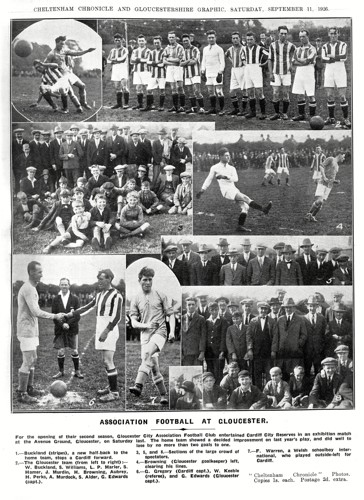
Cheltenham Chronicle & Gloucestershire Graphic, 11 September 1936
Although overshadowed by rugby football in Gloucestershire – association football has been played in the county for a long time. It became formal in 1886, with the founding of the Gloucestershire FA at the Full Moon Hotel in Bristol, with Dr. W.G. Grace as President. Today, the association supports over 2,000 teams and 20 affiliated leagues, including the professional FA league sides of Cheltenham Town and Forest Green Rovers and non-league semi-professional sides like Gloucester City AFC.
First women's football match in Cheltenham, December 1922
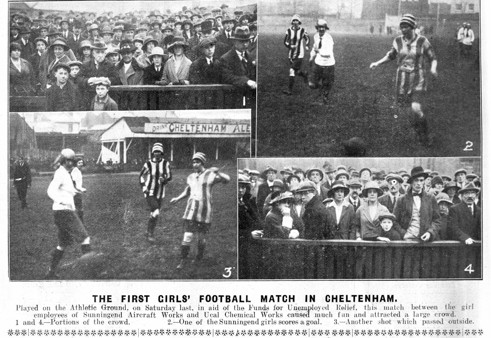
P297/CW/2/1
Today, women’s football is a popular, high-profile sport but 100 years ago it was very different, dividing public opinion and generating a lot of heated discussion. In December 1922, Cheltenham's committee for the unemployed arranged the first ever women’s football match in the town between H H Martyn’s Sunningend Aircraft Works and UCAL Chemical Works (United Chemists’ Association Ltd). A large crowd watched the game which ended in a 3-nil win for Martyn’s!
Gloucestershire v Australia Bowling Match, June 1922
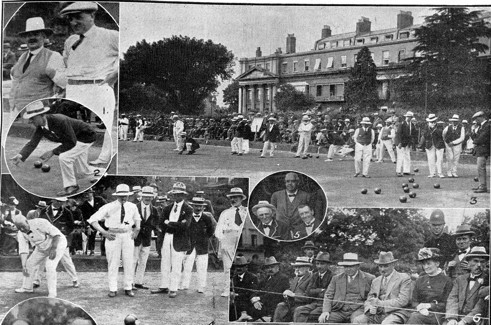
Cheltenham Chronicle & Gloucestershire Graphic, June 1922
Played since the 1400s, bowls uses flat greens or crown greens (which have a raised centre) - the two versions arose due to the nature of the bowling greens; wealthy players had greens on large flat lawns, while poorer folk played on rougher common ground close to inns and taverns, which later became crown greens. There were several bowling greens in Gloucester and Cheltenham from the 1700s onwards and others followed around the county. The Gloucester Bowling Club was founded in 1897 as the Park End Bowling Club by customers of the Park End Hotel, Park End Road, where they had a green. Cheltenham Bowling Club began a few years earlier in 1883 at the Winter Gardens, but games were being played at Suffolk Square by 1855, which became the club’s home in 1917. As well as local sides and county matches, international games were also played – seen here with Gloucestershire taking on Australia at the Ashburne Green on Suffolk Square in Cheltenham in 1922. The result was a win for Gloucestershire, the final score being 121:105 in favour of the county.
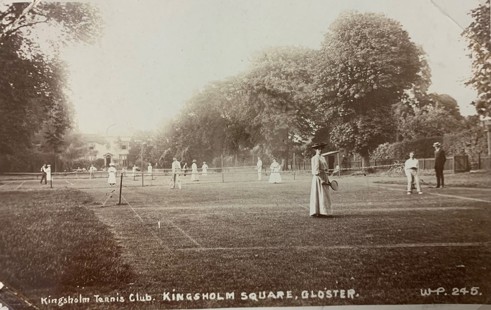
Kingsholm Tennis Club, Gloucester, c1897
SR34/37655.29GS
Tennis was one of the few sports where women could play from its earliest days and so, it was always very popular. The provision of parks in towns meant that tennis courts could be established quite easily – this is the Kingsholm Tennis Club that was formed in the 1890s. Its home was Kingsholm Square and as well as courts, it had a club room.
Hockey Matches, Cheltenham Ladies College, 1910
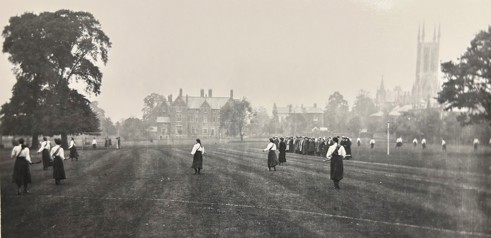
GPS/78/56
Field hockey first appeared in England in the 1750s – primarily in girls' schools, but it wasn’t until the first half of the 1800s that it became firmly established – with the first club being formed in 1849 at Blackheath in south-east London. This photograph shows two matches being played at the Cheltenham Ladies College around 1910.
Men’s hockey match, Chipping Campden, undated
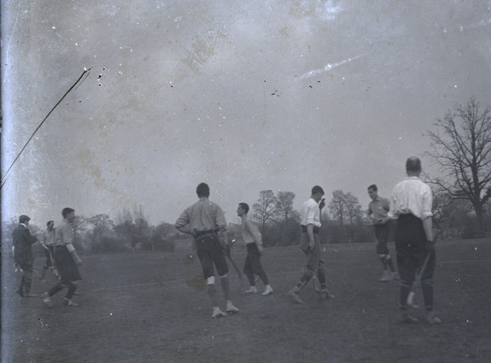
D11554/1734
Men also played – though the one time we played it at school it was abandoned after the second ambulance was called! This photograph shows a men’s game of hockey being played on an unknown date and at an unknown location – but probably somewhere around Chipping Campden, as this was where the photographer, Jesse Taylor, photographer and clockmaker lived.
Bill for golf clubs and balls

D2700/QJ3/3
While modern golf originated in 15th century Scotland, its origins may date back to the Romans – their game of paganica used a bent stick to hit a small ball. The earliest reference to golf in the archives in Gloucestershire that we know of is from the Badminton records recording the purchases of golf clubs and balls in Michael Aiskew's cash account in 1733. This entry shows two purchases of golfing equipment – in today’s money, the two amounts, 17s, and £1 2s, are around £100 and £130 respectively. We don't know how many clubs or balls this was for but was presumably a set, which today can cost anywhere from £150 to £2,000 and beyond.
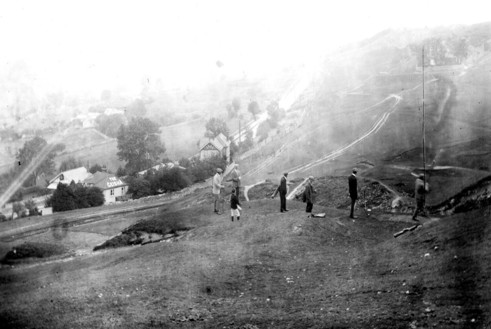
Cleeve Hill Golf Course, c. 1910
GPS/46/66
By the late 1880s, there were numerous golf clubs in the county – this is golf being played on Cleeve Hill c1910 – it was the home of the Cheltenham Golf Club from 1891. Unlike more modern golf links, the terrain looks to have significantly more and larger hazards! In the background can be seen The Geisha Tea House café, famous for having its name on its roof. Cleeve Hill was a popular destination for Cheltonians – be they golfers or not – and several amenities opened to take advantage of the trade. As well as The Geisha (where they could also book rooms to stay for the weekend), there was Mrs Hobley’s Cosy Corner Tea Lawn and the Cleeve Hill Café. Whether any of these acted as the ‘19th Hole’ for the golfers isn’t known.
Arthur Davis, champion cyclist and village blacksmith, c. 1910
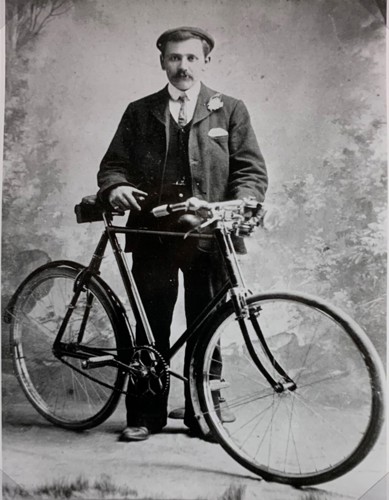
D9746/7/144
Perennially popular for daily use – bicycle racing was also popular. However, bicycling races were also popular. This is Arthur Davis, champion cyclist and village blacksmith. According to the 1927 edition of the Kelly’s Directory, Arthur lived in Bisley. At this time, there were specialist racing bikes being made – notably by Raleigh, BSA, and Rudge-Whitworth in the UK. This machine has the look of an ordinary road bike, primarily because racing bikes had smaller diameter tubes for the frame and didn’t usually carry a horn or an air-pump (this is the silvery object attached to the saddle post down frame). As far as we know, racing bike clothing was also non-specialised and was just ordinary days clothing – on the plus side, at least this means that there isn’t a piece of Lycra in sight!
Rowing
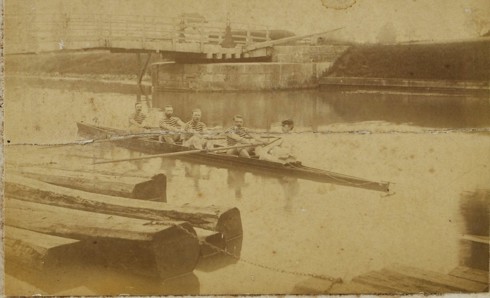
D12131
Rowing has been popular for many years – mostly taking place on the River Severn and the local canals – especially the Gloucester-Sharpness canal. This – sadly rather faded photograph – is from the Fielding & Platt archive and shows one of their coxed-four rowing teams, probably at Hempstead Bridge, in 1875 or 1878. Note the timber baulks on the bottom left.
Croquet
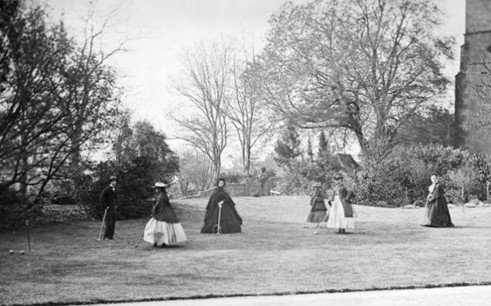
D13194
Introduced from France at the Restoration, croquet became highly popular as a social pastime for both sexes in the mid-Victorian period – one reason may be that Edwin Budding of Stroud invented his lawnmower around the same time, making creating flat pitches easier. In 1868, the first official croquet all-comers tournament was held at Moreton-in-Marsh – the same year that the All-England Croquet Club was formed at Wimbledon, London. This is the croquet lawn at Kemerton Upper Court in 1861 – looking at the undulations it’s safe to say it looks quite challenging!
King’s School Sports Day, Gloucester, June 1926
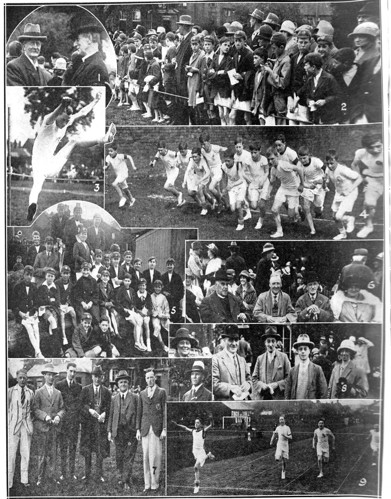
Cheltenham Chronicle & Gloucestershire Graphic, June 1926
Most of us will recall the sheer hell that was athletics at school – the pain of being forced to run anything over 100m, the ignominy of sports day and not forgetting the long jump and high jump sandpits filled with interesting deposits from local cats! However school sports days have a long tradition – this montage was taken in June 1926 and shows sports day at King’s School, Gloucester.
Fielding & Platt Family Sports Day, c. 1960
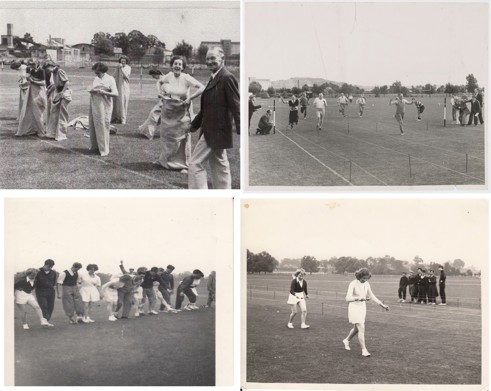
Fielding & Platt archive
Today sports days tend to survive just at schools (for teachers’ enjoyment and pupil punishment) but in the past; to foster a sense of camaraderie, many local firms laid on sports days to entertain its workers – such as Fielding & Platt here. As well as so-called serious events – such as running and tug-of-war – many other fun events were laid on, including the ‘egg & spoon race’, ‘three-legged races’ and ‘sack racing’.
Swimming
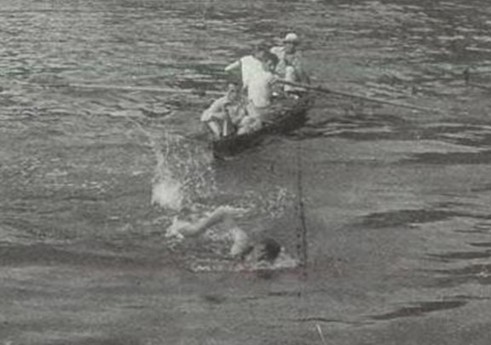
Cheltenham Chronicle & Gloucestershire Graphic, August 1908
Swimming began to be popular from the 1700s – the National Swimming Society was founded in 1739 while the first indoor pool, the ‘Bagnio’, in Goodman’s Fields, London opened in May 1742, with a heated pool for gentlemen, for swimming and cleaning. At this time and for many years afterwards, swimming was deemed a life-saving skill rather than recreation and, with no public baths, it took place in the sea, rivers or lakes. Apart from children playing in ponds and rivers, swimming was almost only always undertaken by the upper classes, who had more free time. As always, it was the public schools that were the most active – this is A. Smith winning the Cheltenham Boy’s College half-mile swimming race in the River Severn in August 1908. The Severn was used because the college had its rowing pavilion on the river at Lower Lode.
Annual Reliability Trial, Sutton Coldfield & Mid-Warwick Automobile Club, 1913
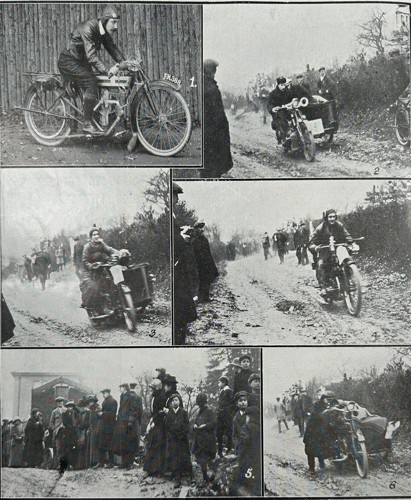
Cheltenham Chronicle & Gloucestershire Graphic, February 1913
As soon as motorcycles and motorcars appeared they were raced! Motorcycles took the lead as the first cars were too fragile – this montage shows motorcycles of the Sutton Coldfield & Mid-Warwick Automobile Club on their annual reliability trial to Cheltenham. Over 200 competitors took part, and Cheltenham was the end destination. The main challenge on the trial was an ascent of the still notorious Gambles Hill Lane opposite the Rising Sun Inn on Cleeve Hill! Well over half the machines entered failed the hill climb (although they were permitted to continue the rest of the trial) and the ultimate winner was Mr W. Gibb of Gloucester riding a Douglas 2¾ h.p. motorbike.
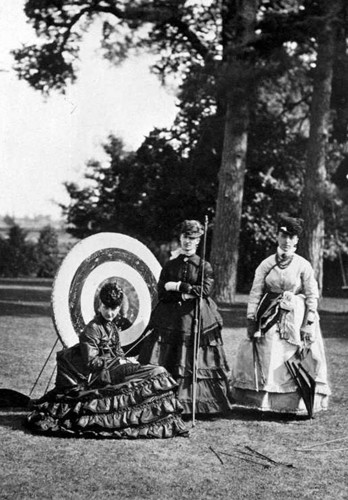
Archery at Forthampton Court, 1870
GPS 146/64
Archery was a widespread aristocratic sport, which had been revived during the romantic period and was felt suitable for both women and men. Photographed in 1870, this is Mrs J R Yorke, Mdm. de Brienen (a well-known semi-professional archer) and Mrs Langhorne practicing archery in the gardens of Forthampton Court. Given the restrictions on movement caused by the volume of material in dresses and petticoats and (no doubt), the formidable corsets underneath, archery was one of the few sports in which ladies could participate. Even then, it can have been neither easy nor particularly comfortable – especially with the length of the bows, which were much longer than those used today.
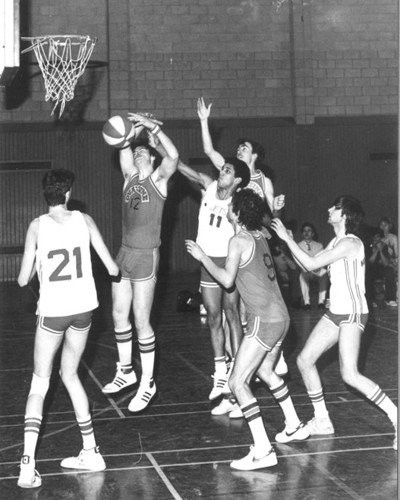
Basketball Match, 1983
D10638/1/1983/15
Basketball was invented by the Canadian Dr. James Naismith in 1891 in Massachusetts and, perhaps surprisingly, it has a long history in Britain, being introduced by the YMCA between 1892 and 1893. World Wars I and II further spurred its popularity, especially after US troops arrived in Britain. In Gloucestershire, the county Basketball Association organises a league system, with two Divisions and two cup competitions. In 2021, two professional sides, Gloucester City Kings and Gloucester City Queens were formed to play in the UK’s National Basketball League.
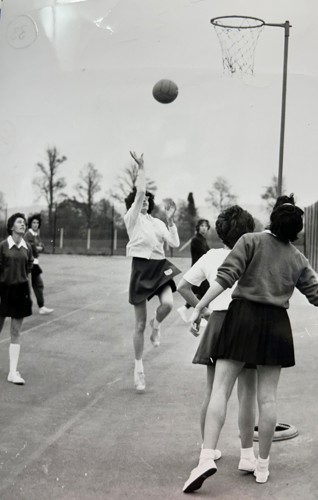
Gloucester v Cardiff Ladies Netball Match, 1961
D10638/1/1961/47/33
Originally called ‘women's basketball’, netball began in 1895 as a UK version of basketball - after a teacher misread the latter’s rules and thought players had to stay in zones, so she restricted running and dribbling, so creating a sport suited for women's attire at the time. This is a Ladies Gloucester V Cardiff match in 1961 – note there are no bibs with positions on! In 1956, the Gloucestershire County Netball Association was formed with a county league following in 1972 – it is still running today. Netball is one of the few sports created exclusively for women, and it remains popular, being played on indoor and outdoor courts, especially in schools.
Cheese-rolling, Cooper’s Hill, Brockworth
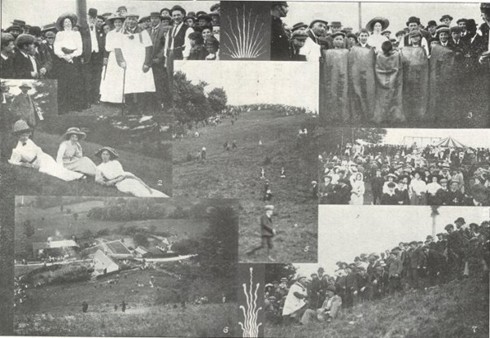
Cheltenham Chronicle & Gloucestershire Graphic, May 1911
Cheese rolling is a hugely popular annual race held at Cooper's Hill, near Brockworth that involves people chasing a 6-8lb/3-4Kg Double Gloucester cheese down the 200-yard-long hill. The first written evidence is in a note sent to the Gloucester town crier in 1826, but even then, it was thought to be at least six hundred years old. One theory suggests it is linked to enforcing common law grazing on the hill – which was celebrated as the ‘Cooper’s Hill Wake’. There are three men’s races and one woman’s race – said to be because men are stupider than women! This photomontage is from the 1911 races – note starter and cheese releaser on the bottom right photograph. On the top right – if the whole thing wasn't difficult enough – is the starters for the Boy’s Sack Race!
Gumstool Hill, Tetbury, 1902
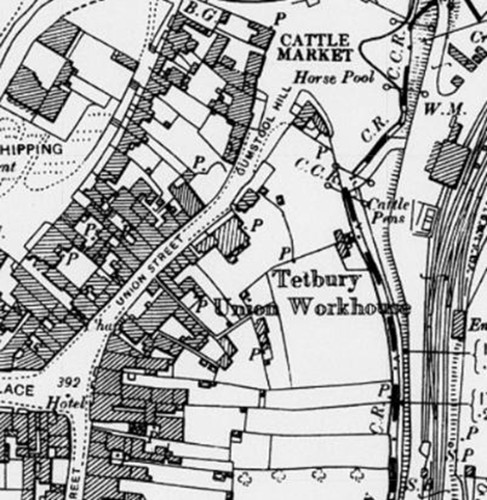
1902 2nd edition OS map reproduced courtesy of the Ordnance Survey
Gumstool Hill in Tetbury is the venue for the annual Tetbury Woolsack Races. Thought to originate in the 17th century, these involves competitors drinking beer then running up the steep Gumstool Hill in Tetbury carrying a sack of wool! The men’s woolsack weighs 60-pound (27 kg) and the women have 30 pounds (14 kg)! An official race day has been going for over 30 years on Whitsun Bank Holiday and world records are entered in the ‘Guinness Book of Records’. The race events are complemented by a street fair featuring varied stalls, a funfair, musical entertainments and roving entertainers.
Bourton-on-the-Water Annual River Football Match, 1902
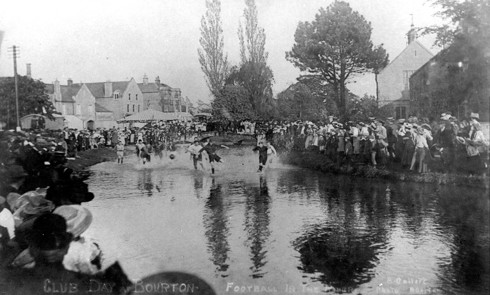
GPS/55/31
Little is known about the history or origins of this football match other than it began around 1900 – this photograph was taken in 1902.
It is a football match played in the river Windrush and takes place every August Bank Holiday as part of the village fete. It is contested between two 5-a-side teams from the Bourton-on-the-Water Football Club, with one team from the 1st XI and one from the 2nd XI. The game is 15 minutes each way with no rules apart from the rule that players will splash the crowd at every opportunity.