
Tales from the Riverbank
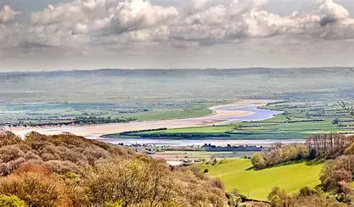
Water mills have been a feature of our landscape for centuries and are part of our national psyche – just think John Constable’s atmospheric mill paintings. In Gloucestershire, water mills were commonplace thanks to our large number of rivers and they frequently occupied picturesque locations – today they are considered valuable real estate, even though most have lost their waterwheels and machinery. As well as their well-known purpose, that of grinding corn into flour, there were many different types of mills – cloth & fulling mills, flock mills, paper mills, sawmills, bone mills and stick mills – although this presentation will focus on corn watermills (the others will be covered in a future Secrets Revealed), so let’s begin the daily grind…..
The Rivers and Steams of Gloucestershire, GTNC, 1976
B137/41206
Gloucester is blessed with around 1,532 rivers, with many being large-volume or fast-flowing which were suitable for watermills. These waterways have (or had) a good mix of habitats. The most important past work looking at the county’s riverine environments was a 1976 report by the Gloucestershire Trust for Nature Conservation (a forerunner of today’s Gloucestershire Wildlife Trust) – which looked at 25 of the county’s rivers and river systems, examining plants, aquatic invertebrates, birds – animal and fish life was not able to be surveyed in detail, though those seen were noted. One of the report’s key conclusions was that ‘Pure water is a fundamental requirement if wildlife is to flourish’. At this time – a full 50 years ago – the ‘Big Four’ Cotswold rivers; the Coln, Churn, Leach and Windrush were all found to be outstanding in all aspects of their wildlife and environment.
Henwood Mill, Sapperton, 1881
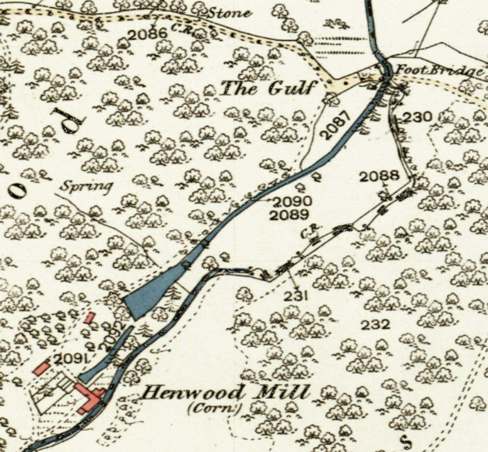
1881 1st Edition OS 25-inch map, reproduced with the acknowledgement of the Ordnance Survey
The most important consideration for most mills was seasonal water fluctuation – where there could be too much water in winter and too little in summer. To alleviate this most mills had some form of water management – usually by damming their rivers to make mill ponds or creating man-made channels called ‘mill leats’. Leats took water from an upstream section of the river and carried it to the mill – as seen on this map showing at Henwood Mill near Sapperton on the River Frome. Mill leats could be quite long, and they often ran along contour lines, utilising weirs to help ensure that they held a steady volume of water.
Arlington Mill Leat & River Coln
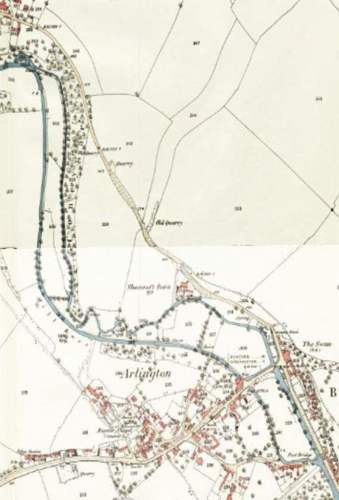
1881 1st Edition OS 25-inch map, reproduced with the acknowledgement of the Ordnance Survey
On this 1881 OS map, the mill leat for Arlington Mill is the left-hand blue line, the River Coln is on the right. A mill leat consisted of three parts:
Head Race: This was the upper section of the leat that channelled water to the mill – these could start some distance away from the mill.
Sluice Gates: These were used to control the head race water flow, and some leats had more than one set of sluices, placed at strategic places to manage water levels, and prevent flooding.
Mill Race: This was the section where the water flows onto the waterwheel.
Tail Race: The lower channel that carried the used water away from the wheel and back to the main river.
Coberley Mill, Coberley, 1881
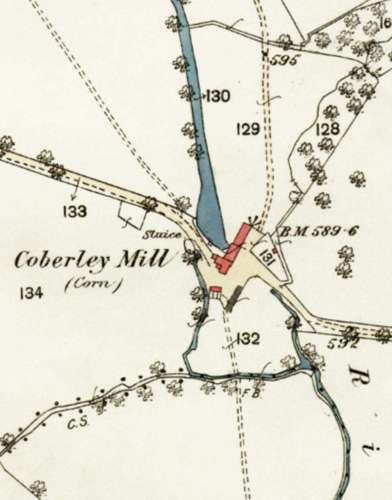
1881 1st Edition OS 25-inch map, reproduced with the acknowledgement of the Ordnance Survey
The highest mill on the River Churn, Coberley, didn’t need a leat, but instead, the river was dammed to create a millpond. A sluice controlled the millpond’s level and the mill’s tail race rejoined the river about 100yrds (100m) downstream. This method of water management became common practice for many mills.
Sluice gates & mill pond at Brookhouse Mill (Savory’s Mill), Painswick
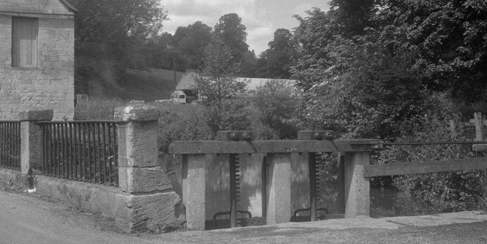
Courtesy Gloucestershire Society for Industrial Archaeology
Sluice gates were used to control the flow of water into the mill leat and/or mill pond but also from these into the mill itself. They acted as a ‘starter’ for the mill, as when opened, they allowed water to flow into a channel (the launder) and onto the mill wheel, starting to turn it. Millers had a control wheel in the mill which governed the amount of water flowing into the mill wheel and therefore its speed, which in turn regulated the speed of the mill’s grinding wheel.
South Cerney Mill & water meadows, 1745
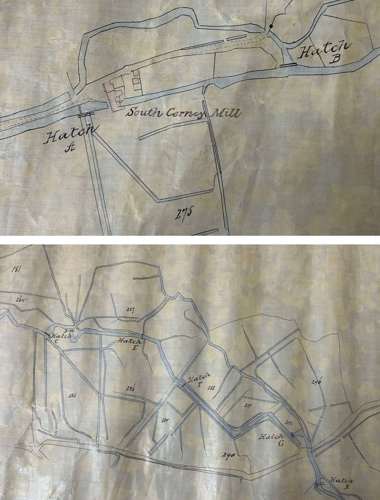
D3495/item 14206
Some mills were part of more complex water management systems - South Cerney Mill is an example, being at the heart of a series of water meadows. The upper plan shows the mill while the bottom plan shows some of the water meadows which were situated to the right of the mill. Water meadows were a historic agricultural practice that used a network of channels, ditches and sluices to ‘float’ or ‘drown’ the land with a shallow layer of flowing water (typically 1” (25mm) deep). The ‘hatches’ shown on the plan are the sluice gates that enabled and controlled the flooding. This springtime practice warmed the grass and deposited nutrient-rich silt onto the soil, stimulating early grass growth – known as ‘early bite’ – and it allowed farmers to keep more livestock through the winter months which would otherwise have had to have been slaughtered.
Sea Mills tide mill, Berkeley, 1881
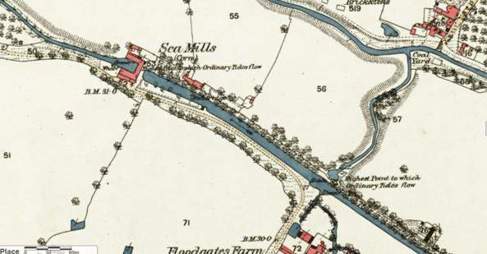
1881 1st Edition OS 25-inch map, reproduced with the acknowledgement of the Ordnance Survey
A tide mill is a water mill driven by the natural rise and fall of coastal tides. By building a dam across a tidal inlet or estuary, a mill pond fills up through one-way gates at high tide and releases the trapped water over a water wheel during low tide. In Gloucestershire, tide mills were found at Westbury-on-Severn and Berkeley. As the name implies, Sea Mills mill at Berkeley was a tide mill. It was located on the Little Avon, a tributary of Berkeley Pill at the ‘Highest Point to which Ordinary Tides flow’, so was perfectly suited to using the power of the tide to function. It was founded around 1753 for processing hemp or linseed oil, but it later operated as a corn mill run by Joseph and Jonah Hadley. By 1902, the mill had been equipped with a steam engine and had a prominent brick chimney. Around the turn of the 20th century, it ceased operating as a mill and became a foundry – with the millwheel helping drive pumps supplying air to the furnaces.
Grant relating to ‘Cernay Mill’, Manor of Rendcomb, c.1200
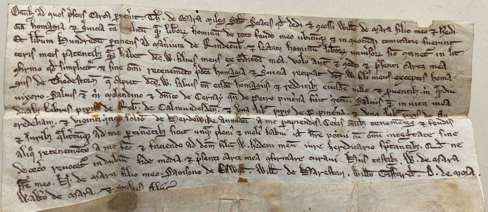
D326/T88/1
The earliest reference to mills in the archives of Gloucestershire (aside from Domesday) is in the archive of the Guise family of Elmore, Highnam and Rendcomb. It is a grant dating from circa 1200 pertaining to the Manor of Rendcomb and was made between the Lord of the Manor, Thomas de Mars, Knight, to his son and heir, William de Mara, giving the later homage and service from various properties, excepting the homage and service from a mill in ‘Cernay’, then in the hands of Peter Pincerna. The grant probably refers to a forerunner of the mill in North Cerney known as ‘Manor Mill’. The current former mill and miller's house was built in the 1750s in a classic 'L'-shaped plan that housed the mill at the south gable end. Where the head race ran through the mill, it passed under a segmental-headed stone arch. The mill machinery was moved to Arlington Mill in 1960 and today the mill is a private house.
Gift of the mill of Frompton, Alice Abbess of the convent of Godsow to William de Frompton, 20 July 1304
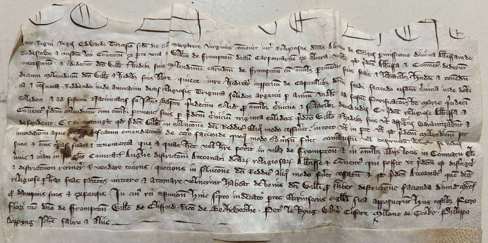
D149/T130
The earliest deed for a mill in the archives is this deed from 1300 that relates to Frampton mill – then known as ‘Frompton mill’. It was owned by Godstow Abbey in Oxfordshire, and the deed or gift was made between Alice, Abbess of the convent of Godstow to William de Frompton on 20 July 1304 for an annual rent of 30s (about £1,100) today. There were eight witnesses: Peter Flory Lord of Frompton, William de Clifford, Richard de Becheworthe, Peter le Kyng, Walter Cissore, Milo de Stoke, Phillip Doppyng and John Smith (Faber).
Todenham Mill, Homestallend, Todenham manor, 1593 & c.1600
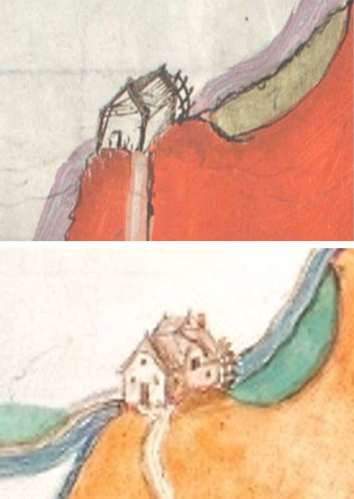
D1099/P1 & P2
The earliest map showing a mill in the archives is this enclosure map of Homestallend, part of the manor of Todenham, which dates from 1593, and shows the village mill in elevation. The upper image is the earlier map, while the bottom one shows it after it was redrawn sometime in the 1600s with more detail. The name Todenham comes from Old English and means ‘Teoda’s water meadow’. Teoda being the name of the landowner at the time the land became recognised as a settlement, and ‘hamm’ refers to the low-lying land bordering the Knee Brook. By the mid-1200s the mill, with a fishpond, was part of the demesne of the manor, and from c. 1400 it was farmed with the manor. In the later 1400s the mill, located to the north of the village, was called Homestall Mill, and later Todenham Mill. In 1769 the mill was leased and by 1777 it had been sold to William Solloway, whose family owned it into the 1800s. In 1860, it was sold back into the manor and was run as a mill and a bakery. These closed sometime around 1904 and by the early 1960s, the mill buildings were in ruins.
Stapelton Water Mill machinery, 1766
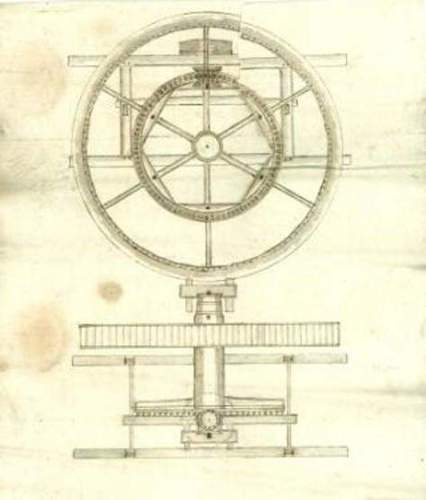
D2700/QP4/5/2 – courtesy of His Grace The Duke of Beaufort
This is a plan of some of machinery and an estimate of costs for building and installing it in an existing corn mill in Stapleton on the Duke of Beaufort’s estate in 1766. Sadly, not itemised, the cost was estimated at £110 – approximately £16,000. Watermills were a complex mix of buildings and machinery – all designed to take the potential energy of water to turn a mill wheel, rotate this motion through 90° and then drive millstones. The main machinery comprises the axle (which carries the waterwheel at one end and the pit wheel at the other), a pit wheel (a toothed gear wheel that speeds up the rotation from the water wheel), a wallower (a toothed gear wheel that changes the rotation from horizontal to vertical) and an upright shaft (which turns the stone grinding assembly). This rather obtuse drawing shows the waterwheel, pit wheel, wallower and a set of millstones in elevation (top) and plan views (bottom).
Stanway Mill millstones & hopper
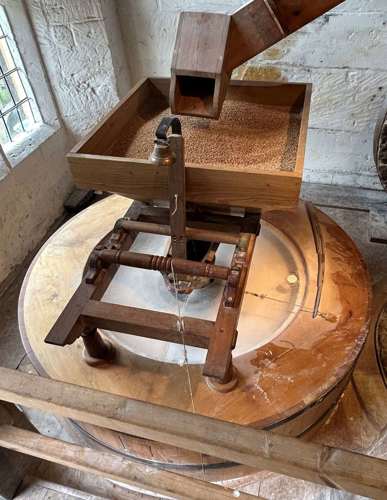
Author’s image
A mill has two millstones, a bottom or bedstone with a concave-rim and an upper or runner stone with a convex-rim, both being held in a circular wooden ‘tun’. Above them is a ‘shoe & damsel’ and a hopper. Whereas the bedstone is fixed, the runner rotates – driven by a cross-shaped iron millrind in the centre (eye) of the stone, which in turn was attached to the vertical shaft. The mechanism works as follows: Grain falls into the hopper via a grain chute where it is fed into the eye of the stones by the ‘shoe & damsel’. In this assembly, the ‘damsel’ is a rotating vertical camshaft that rhythmically taps the ‘shoe’, which shakes, allowing a steady trickle of grain down the shoe into the eye of the runner. The runner rotates at about 80rpm and grains are forced into the tiny gap between the stones, where they are cut, then crushed, to form flour, which is then expelled via furrows in the stones, where it is collected. When the hopper empties, the mechanism rings a bell, informing the miller that the hopper needs refilling.
Sold & Composite millstones (Stanway Mill & Dean Heritage Centre)
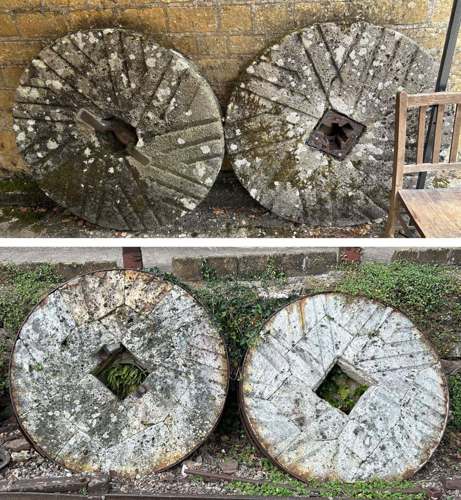
Author’s Image
There are two main types of mill stones:
-
Solid – these stones are carved from one piece of stone.
-
Composite – these are made from pieces of stone glued together and held in place and iron or steel band.
Both types have furrows carved into their surface to allow flour to exit. As the hard wheat eventually causes the stones to wear, so the gap between them can be adjusted using a screw-device called the Tenterer. This can also be used to adjust the coarseness of the grind – making it finer or coarser as required. The best stones were French Burr millstones, prized as they produced a very fine, white flour - in contrast, British Millstone Grit stones left gritty residues in the flour, and German Cullin stones produced a dark dust that discoloured the flour. The French Burr stones were formed from silica-rich chert rock dug from quarries south of Paris. The rock could only be extracted in pieces, which then had to be shaped and cemented together to form a circle. These stones broke open the grains more cleanly, allowing the bran - the outer shell of the grain - to be separated more easily producing a fine white flour, which was deemed less likely to be adulterated and therefore healthier.
Cost of millstones, Badminton Estate 1787

D2700/QP/3/4/6 - courtesy of His Grace The Duke of Beaufort
Millstones were expensive – this is an entry from the archives of the Duke of Beaufort’s estate at Badminton for a pair of millstones for one of their mills in 1787, which cost £20 – about £1,500 today. In the 1800s, the cost of a pair of millstones typically ranged from about £4 to £12 for domestic British Derby Peak gritstone (about £240 to £750). However, premium imported French Burr stones cost significantly more, reaching up to £40 per pair (around £2,400) depending their on size and quality.
Cost of building a mill at Broomhill, Badminton Estate, 1787
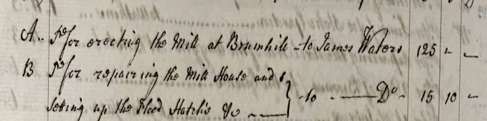
D2700/QP/3/4/6 - courtesy of His Grace The Duke of Beaufort
Mills were an expensive investment. This is an entry from the accounts of the Duke of Beaufort’s estate at Badminton for building a new mill at Broomhill, on the north bank of the River Frome in 1787. It includes erecting the mill and repairing the mill house – suggesting the new mill was replacing an earlier older one – and setting up the ‘flood hatches’ – which were probably the sluices for a mill pond or leat. The cost was £140 10s – about £11,000 today.
Accounts for iron fittings and estimates for repairs, Shipton Mill, 1832
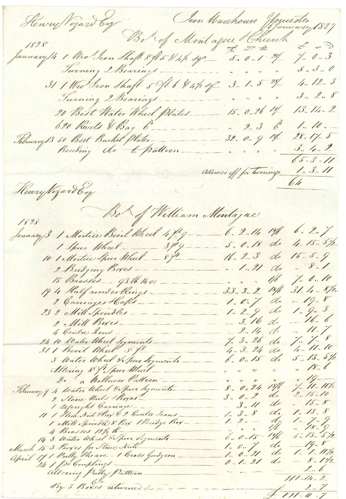
D1571/E323
Watermills required regular maintenance - this is a bill for parts bought for Shipton Mill from William Montague’s ‘Iron Warehouse’ of Gloucester in 1828. Among other things, the list includes: an axle shaft, bearings, a vertical shaft, spur wheels & ‘bevil wheels’, a set of waterwheel plates and ‘best bucket plates’, several waterwheel segments and sundry items such as gudgeons, stone nuts (a type of spur wheel), boxes and brasses (probably bearing shims). The cost of these parts came to £111 11s 7d – about £7,600 today.
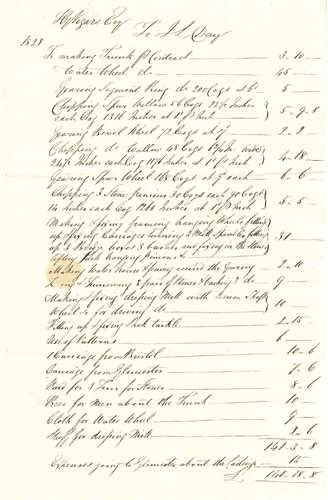
Wooden items for Shipton Mill, 1828
D1571/E323
This bill for Shipton Mill is for wooden parts, all of which were supplied by J. L. Day. It lists the following items: trunk (probably the Launder – the chute carrying water to the top of the waterwheel), the waterwheel (at a cost of £45 - £3,100 today), 476 Gear cogs for various gear wheels, a Spur wheel with 168 cogs, a spare wallower with 48 cogs, making a mill crane (used to lift and turn stones), making and fitting framing and also for making ‘fencing’ around the machinery. It also includes carriage of parts from Bristol and Gloucester (£61 today) and although the workers didn't get food – they did get liquid refreshments as one entry lists: ‘Beer for men about the trunk…..10s’ (£34)
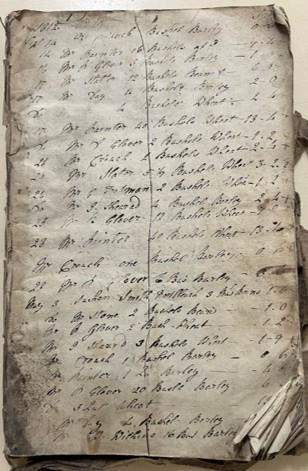
Milling accounts, Chedworth Mill, 1812
D182/V/12
In the Medieval, most milling was done by ‘toll’ – where peasants did not pay coin to grind grain but instead the mill owner took a percentage of the flour as payment. As time passed, coin became the norm – but millers however do not appear to have been the most diligent or tidy record keepers! This page from Chedworth Mill records the amounts ground in April and May 1812. It records the date, the customer’s name, the quantity (in bushels), the type of grains (wheat, barley or beans) and the price charged. Barley appears to have been charged at around 6d per bushel, while wheat was around 11d a bushel and beans were 8d – although these prices varied; presumably due to a time factor. For this mill, the charges weren't enough for the owner, Robert Sly, later went bust!
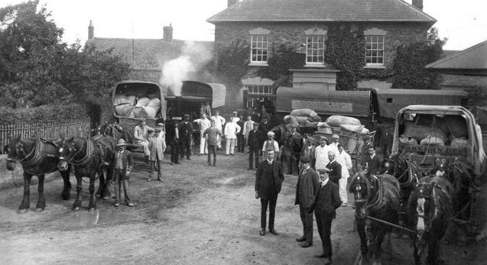
Flour awaiting transport, Draycott Mill, Cam, c.1910
GPS/69/14
This photograph shows the Workman Brothers’ Draycott Mill at Cam, c.1910 with sacks of flour being readied for distribution. Flour was commonly packaged in heavy woven cotton or hessian/burlap sacks holding 50lbs to 240lbs (23-108kg) of flour, or smaller unbleached cotton or sturdy paper bags for retail grocers. The transport includes a pari of steam lorries plus horse-drawn waggons. The mill closed in 1939 but wasn't demolished until 1989 – today it’s part of the Draycot Business Estate.
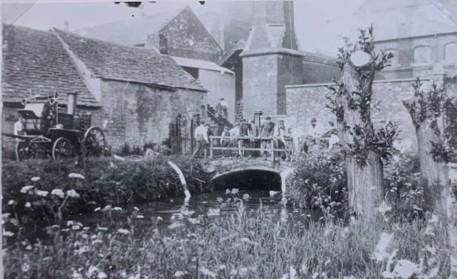
Fire at Grist’s Mill, Woodchester, 1939
D9746/1/2/19
For most of history, fires in watermills were almost unknown, mainly due to the relatively slow movement of the mill machinery and irregular short working that most mills undertook. However, from the late 1850s at least 76 mill fires occurred in Gloucestershire, most of them destroying the mills and their machinery – this photograph shows Stroud fire brigade tackling a fire at Grist’s Mill in 1939. The reason for the increase in fires was simply that was that as mills worked longer hours, had more sets of machinery, ran faster and stored larger quantities of grain and flour products, fires became more common – primarily due to overheating shaft bearings. The addition of steam power in the 1800s added more risk as putting a furnace close to combustible material was literally an accident waiting to happen.
Grant relating to ‘Cernay Mill’, Manor of Rendcomb, c.1200
Author’s image
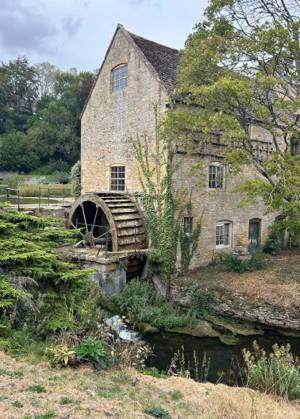
Gloucestershire is fortunate in having several iconic mills that still survive, including some that still have their machinery and waterwheel and some that are still working mills. These include Hartpury Mill, Barrett’s Mill (Cheltenham), Arlington Mill (Bibury), Abbey Mill Tewkesbury, Lower Slaughter Mill, Donnington Mill and Stanway Mill. This is Donnington Mill, which was first recorded in 1291 when it was part of the Broadway Manor estate. Like many Cotswold mills, it was first a fulling mill (for processing wool) but was converted into a corn mill around 1580. It is now a brewery in a Grade II listed Cotswold stone building. It is perhaps the most attractive quintessential Cotswold mill, with a high breast-shot wheel (described as a ‘three-quarter-shot breast wheel’), large(5-acre) mill pond, a tail-race and overflow spillways. The waterwheel still works, driving pumps and other machinery for the brewery.