Tall Stories: introduction
Gloucestershire has been the home of and inspiration for numerous authors and storytellers over the years, some well-known others less so. This online exhibition will look at some of those who have made our county such a glorious place, such as Gurney, Harvey, Moore and Lee as well as others. We will also look at the county’s other literary connections, ranging from weary ways, rabbit holes, pirates, cricket pavilions and even a ring of power.
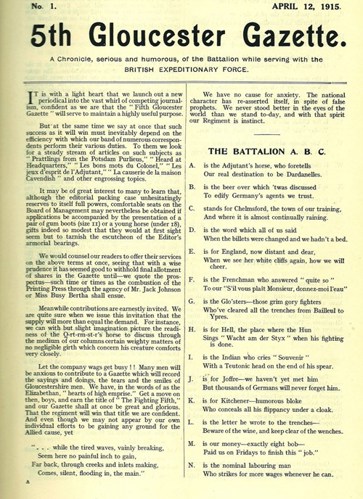
5th Gloucester Gazette, 1915
Frederick William Harvey, the 'Laureate of Gloucestershire' came to national attention when his poetry describing Gloucestershire, written when serving in the First World War, captured the public imagination. First published in 1916, his poetry described the humour and tragedy of wartime army life. He later combined writing with a legal career and became a popular broadcaster at the BBC, being an accomplished singer and lecturer. He was a passionate advocate for the Forest of Dean and its people, where he was widely loved for his generosity and kindness. When WW1 was declared, Harvey was eligible for a commission but instead he joined his local Territorial army battalion – the 5th Battalion, Gloucestershire Regiment – as a private. His writing skills first came to the fore when he became a founding member and key contributor to the WW1 trench newspaper, The 5th Gloucester Gazette. Contrary to public opinion, the Gazette was actually the first trench newspaper, being published on 1 April 1915 whereas the more famous The Wipers Times & Salient News, wasn’t published until 12 February 1916.
Gloucestershire Archives reference D12912/8/1/1
Baptism of Ivor Gurney, 24 September 1890
Ivor Gurney was born at 3 Queen Street, Gloucester, on 28 August 1890, the second of four children to David Gurney, a tailor, and his wife Florence, a seamstress. He was baptised at All Saints Church in Gloucester on 24 September 1890. He showed musical ability at an early age and in 1900 won a choral scholarship at Gloucester Cathedral, which also brought a place at the King’s School (where he met F W Harvey). He sang as a Gloucester Cathedral chorister from 1900 to 1906, when he became a pupil of Dr Herbert Brewer at the cathedral, meeting a fellow composer, Herbert Howells, who became a lifelong friend and Ivor Novello, another of Brewer’s pupils.
Gloucestershire Archives reference P154/1/IN/1/1

Portrait of Ivor Gurney
Gurney began composing music at 14 and in 1911 he won an open scholarship to the Royal College of Music. One of Gurney’s teachers was Sir Charles Villiers Stanford, who famously said that of all his students – Vaughan Williams, Gustav Holst, and dozens more – Gurney was potentially ‘the biggest of them all. But the least teachable’! Gurney was a naturally exuberant personality, but he was troubled by mood swings and in 1913, he suffered his first mental breakdown. When WW1 broke out Gurney tried to enlist with his friend F W Harvey in the 1/5th Glosters but was rejected due to poor eyesight – however he tried again in February 1915 and was accepted as a Private in the 2/5th Glosters. At the front, he began writing poetry and music – including that for Harvey’s poem ‘In Flanders’, which he’d seen in the 5th Gloucester Gazette – and was in the process of writing his first book, Severn & Somme, when in April 1917 he was wounded in the shoulder. He recovered quickly and on his return was transferred to a machine gun battery at Passchendaele but on 17 September, during the Third Battle of Ypres, Gurney was gassed at St. Julien and invalided back to Britain but subsequently his mental health soon began to decline again.
Gloucestershire Archives reference D10500/5/10/2
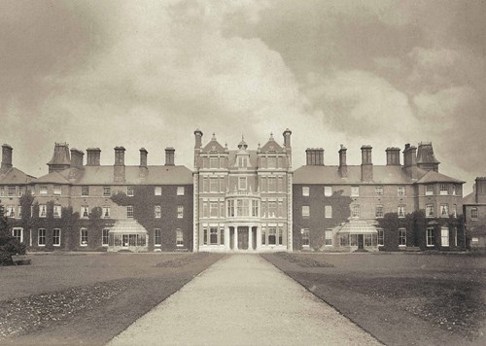
Barnwood House Hospital
After his discharge from the Army in October 1918, Gurney returned to Gloucestershire and although he initially seemed happy, his mental health continued to decline and in September 1922, after a medical intervention, he was certified insane and admitted to the private Barnwood House hospital in Gloucester. At one point he made a desperate night-time escape from Barnwood, smashing a window and cutting his hands in the attempt, and running off in his pyjamas. He was recaptured by the police, but it was decided that he must be confined somewhere well away from Gloucestershire, so in 1922 he was transferred to the City of London Mental Hospital at Dartford in Kent. He continued writing songs until 1926, but their quality diminished; his poetry, however gathered strength and his best war poems belong to these asylum years. He died of tuberculosis on Boxing Day, 1937, aged 47 and was buried at Twigworth on 31 December. His friend Will Harvey walked from the Forest of Dean to attend and dropped a sprig of rosemary – for remembrance – into the grave.
©Courtesy Barnwood Trust
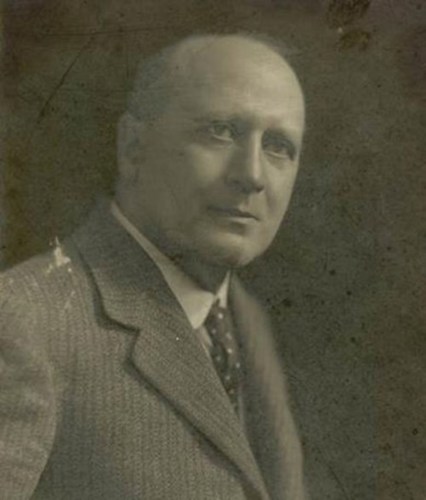
Portrait of John Haines, "friend of poets"
John Wilton Haines was born in 1875, the first of four sons born to Caroline Haines (formerly of Bengal, India) and the Gloucester solicitor, John Pleydell Wilton Haines. Several generations of the family had pursued a law career and after leaving school, Haines also chose to train as a solicitor. After qualification he joined the family law firm, Haines & Sumner based in Bastion House, Brunswick Road, Gloucester. Although happy in his choice of career, Haines was passionately interested in classical and modern literature and verse and an avid collector of books. Through this interest he acquired contacts in the publishing world, which led him to meet and become friendly with many contemporary poets, authors and composers. By happy chance, many of the leading poets of the early 20th century were Gloucestershire residents, among them the ‘Dymock Poets’ – Lascelles Abercrombie, Rupert Brooke, John Drinkwater, Wilfrid Gibson, Edward Thomas, and the American Robert Frost. Haines was able to mix with these on a local, social basis and they, in turn, recognised his interest in poetry and writing and would routinely ask him for his opinion on any new work produced. The bulk of the Haines archive which is held at Gloucestershire Archives consists of letters written to John Haines from an array of well-known poets, writers, and composers. However, the archive also contains poetry, notebooks, writings, and lectures by or belonging to John Wilton Haines, news cuttings, family papers and photographs of literary friends and family members.
Gloucestershire Archives reference D10828/7/7
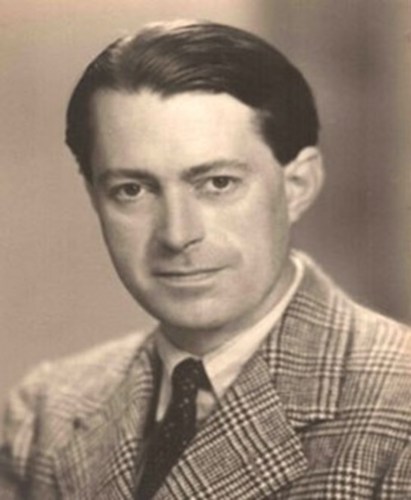
Portrait of John Moore, novelist, poet, broadcaster and countryside campaigner
John Moore was born on 10th November 1907, the only son of the serving Mayor of Tewkesbury, Cecil Moore and Ina Moore, elder daughter of Doctor John Moore of Moreton-in-Marsh. The family lived at Tudor House, Tewkesbury, until the early death of their father in 1918. From the age of 11, John was educated at Malvern College and at the age of 16 he left school to work as an auctioneer at Tewkesbury for the established family firm. While working he began to write novels in his office and his first work, 'Dixon's Cubs' was published in 1930. Buoyed by this early success, he abandoned his auctioneering career and moved to London, writing for newspapers and magazines as well as working on more novels. He joined the Fleet Air Arm on the outbreak of WW2 and during his service met and married his wife, Lucile Douglas Stephens in 1944. Post-war, Lucile encouraged John to continue writing and it was then that he achieved worldwide fame and recognition for three books in particular, 'Portrait of Elmbury', 'Brensham Village' and 'The Blue Field', collectively known as ‘The Brensham Trilogy’. These books are based upon his childhood experiences of living at Tudor House, which was opposite the notorious 'Double Alley' area of the town – now swept away as part of a shopping precinct. As well as writing novels, John was a prolific writer of short stories, poetry, plays, film scripts and radio broadcasts, which he sometimes also presented. Moore was a born naturalist and was passionately interested in countryside matters, being very much ahead of his time concerning issues such as wildlife conservation, the effects of pesticides and the benefits of organic farming and meat production. He also helped found the Cheltenham Literary Festival in 1949 and campaigned to preserve the architecture of Tewkesbury.
Courtesy John Moore Museum
Baptism of Laurie Lee, poet and author, 1915
Laurie Lee was born in Uplands, Stroud on 26 June 1914, but he was a sickly child – in February 1915 at 7 months old, he received a ‘private’ baptism as it was thought he was dying – but he survived to be ‘received into the church’ in a proper baptism on 9 May 1916. Lee had seven older siblings: six from his father's first marriage: Dorothy, Harold, Reggie, Phyllis, Frances (who died in 1915) and Marjorie, plus two brothers from his parents' marriage, Jack and a younger brother Tony. In 1917, the family moved to the village of Slad, although Lee’s father, Reginald Lee, who had been serving in the army did not return to the family after his discharge. This was the setting for Lee’s masterpiece, ‘Cider with Rosie’, a portrait of a rural idyll set in Gloucestershire, that is still loved and widely read today. Lee was able to tell – in words – what it felt like to live in the rural Slad valley, to track its passage through the seasons, the turning of the wheel of time and the impact on village life of the past giving way to the modern and the future.
Gloucestershire Archives reference P295/2/IN/1/1

Portrait of Frank Mansell, poet and cricketer
Frank Mansell was known as "The Cotswold Poet" following the success of his compilation of poetry entitled 'Cotswold Ballads', first published in 1969. Despite having been born in London, he came from a Cotswold family of farmers thought to date back to the 13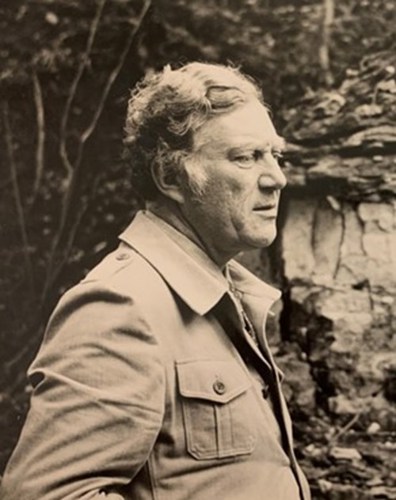 00s. He lived at a cottage called The Salt Box, at The Camp, between Sheepscombe and Miserden and worked in the engineering section of GPO Telephones, retiring in 1975. A close friend of Laurie Lee, in his spare time, Frank would write poetry, which was often published in the local press and gave readings of his work. He loved cricket and played for Sheepscombe – being renowned as a demon fast bowler. Although he didn’t reach the heights of fame with his work as did Lee, his work is still loved and admired by many.
Gloucestershire Archives reference D8296/3/5
Winifred Foley (nee Mason)- Admission register of Ruardean Woodside County Primary School
Winifred Foley was born in Brierley in the Forest of Dean on 25 July 1914, the fourth of eight children, five of whom (including herself) survived into adulthood: her older sister, Bess (4yrs older), two younger sisters and a brother. She was the daughter of  Charles Mason, a coal miner and his Welsh wife Margaret. She went to school at Ruardean Woodside County Primary School, and afterwards moved to London. She had political interests and met her like-minded husband Sid while on her way to a rally against Oswald Mosley and his British Union of Fascists 'Blackshirts' in the East End of London. Her first book, A Child in the Forest – which was not published until 1974 when she was 60 – is an account of her childhood in the Forest of Dean, but also includes her experiences as a young domestic servant in London. It has been compared with Laurie Lee's Cider with Rosie, but there are differences, notably that Foley makes clear references to the unending poverty of her childhood and included stories of fleas in the bed and poor sanitation. Subsequent works included No Pipe Dreams for Father, Back to the Forest and In and Out of the Forest. In her later years she moved to Cheltenham and died on 21 March 2009 – her humanist funeral was held at the Cheltenham Crematorium. She is commemorated with a bench dedicated to her and Sid on the summit of May Hill.
Gloucestershire Archives reference S109/2/3/2/1
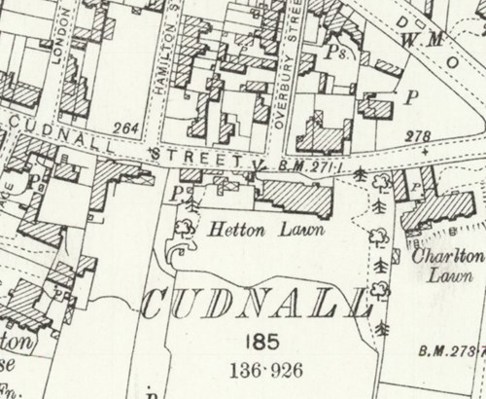
Hetton Lawn, Charlton Kings, Cheltenham
The story of a girl who falls down a rabbit hole and finds herself in a strange magical world is thought to be based on Alice Liddell, a girl who often visited her grandparents who lived in Charlton Kings. Her grandfather, Dr Henry Liddell, was Dean of Christ Church College in Oxford and was a friend of Charles Lutwidge Dodgson – who was better known under his pen name Lewis Carroll. Carroll was a maths teacher at Oxford and one day in July 1862 he took Alice and her sisters on a boat trip along the Thames from Folley Bridge to Godstow. On the journey, Alice asked him to tell them a story to keep them amused and so Carroll invented a story about Alice and a white rabbit. Alice asked him to write it down and three years later, it was published as Alice’s Adventures in Wonderland. The Liddell’s lived in Hetton Lawn, Cudnall Street and Carroll often visited and took photos of the family and the children – although the latter were always taken with a parent in attendance. Many of the pictures were taken in the Liddell’s garden because it faced south and was good for natural sunlight.
Courtesy OS 1902 Know Your Place
"Adelstrop"
This poem – shown here in the handwriting of John Haines – was based on a railway journey from Paddington to Malvern that Thomas took on 24 June 1914, during which his train halted briefly at Adlestrop station. Thomas was new to writing but recorded the occasion on the day of the journey, noting down the mai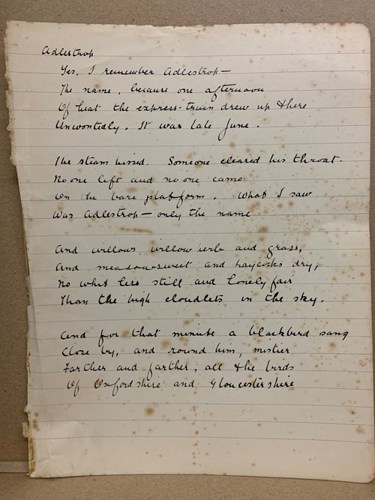 n details such as the vegetation, the blackbirds and the hiss of steam. Although not a war poem, it has become popular in anthologies because of its reference to a peaceful time and place, only a short time before the outbreak of the First World War. Thomas enlisted the following year, and was killed in 1917, just three weeks before the poem was published.
Gloucestershire Archives reference D10828/8/13/10
Farmer Maggot’s memorial
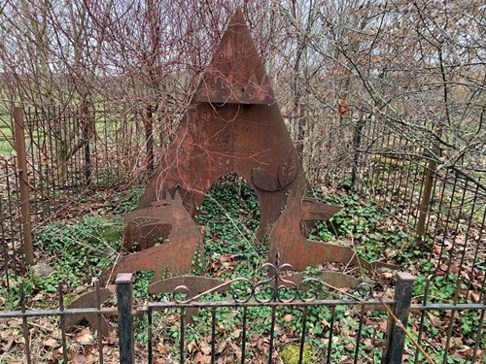
Gloucestershire has several Tolkien connections, including the Romano-British temple at Lydney, where a lead curse tablet may have provided the inspiration for the One Ring and its curse. Also, in the Lord of the Rings: The Fellowship of the Ring – there is a Hobbit called Farmer Maggot, who lived at Bamfurlong, a farm in the boggy region of in the Marish in the Eastfarthing of the Shire. Farmer Maggot's farm was well-known in the area for his mushrooms, which he protected fiercely against trespassers with his fearsome dogs. In 2015, Chris Evans of Dundry Nurseries in Bamfurlong Lane built a memorial to Farmer Maggot in the Butterfly Garden adjacent to his nurseries. He did this not only because of the name, ‘Bamfurlong’, but because the fields surrounding the nursery are boggy, wet and are locally known as ‘the mushroom fields’. Finally, at one time, these fields were owned by the Buckland Family – another name that is found in Lord of the Rings!
Photograph courtesy J.Putley