
Display 5 of 19
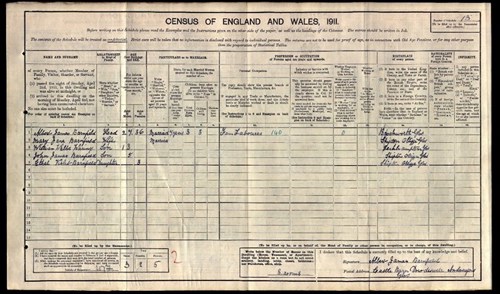
1911 census – Castle Barn, Dowdeswell
The 1911 Census of England and Wales was taken on the night of Sunday, 2 April 1911. Every census tended to ask for more information than the previous one and in the 70 years since the 1841 census, this had expanded greatly. The 1911 census asked for the following details: name, relationship to head of family, age at last birthday, sex, marriage details (including number of children), occupation (for people aged 10 and over), birthplace, nationality, infirmity (deaf, blind, lunatic, etc.), postal address and military rank and unit if applicable. It also included so-called ‘fertility’ questions. These asked how long a present marriage had lasted, the number of children born alive to the present marriage (including children no longer living in the household) and number of children who had died. More detailed questions about employment were also asked, which were intended to give the government an idea of which industries were in decline, and which were growing. Interestingly, many respondents provided much more information than was needed with people giving the name and sometimes address of their employer in addition to the industry that employed them. These questions were later incorporated in the 1921 census. There are three other points of interest in the 1911 census. Firstly, the enumerators tried to approximate the homeless population, albeit with little success. Secondly, some women’s details are missing. This was due to the campaign for women’s suffrage, as many suffragettes protested by refusing to be counted in the census. Finally, for the first time, the original census forms (in the handwriting of the householders) were preserved, and it is these that you see when looking at the census online.
Last reviewed: