
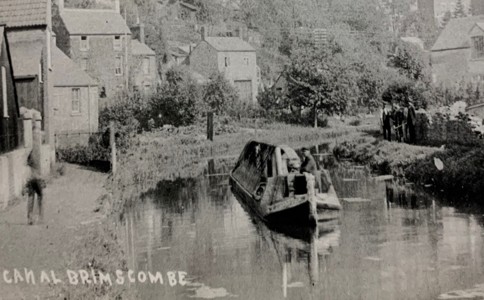
Narrowboat approaching Brimscombe, Thames & Severn Canal
D9746/2/314/1
This idyllic scene captures the essence of our glorious Gloucestershire canals. It shows a laden narrowboat heading towards Brimscombe Port on the Thames & Severn canal. On the right, on the towpath, you can see the towing horse together with two men, one of whom was presumably leading the horse, although many horse plodded along quite happily on their own! Visible on the side of the boat above the gunwales are the side-cloths – these were canvas tarpaulins that ran along the length of the boat’s hold and prevented water sloping inboard and cargo (especially coal) rolling out. They were fastened in place by ropes that ran over a horizontal top plank which was supported on vertical uprights called stands (which can be made out here). Brightly coloured decoration – for which canal craft became famous for – can be made out on the stern. Taken some time around 1920, the canal was by this date in its twilight days and within a few years would be abandoned as uneconomic. Already a few patches of algae can be seen starting to clog the surface.
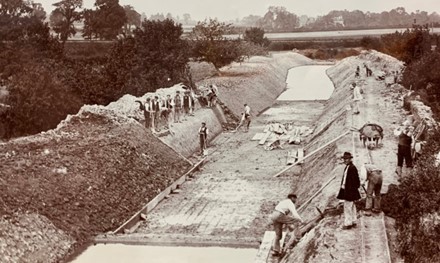
Repairs at Blue House Reach, Thames & Severn Canal
C/CTS/16/4
This magnificent photograph, taken from the parapet of the Blue House Bridge, shows repairs being undertaken on a drained section of the Thames & Severn Canal at Blue House Reach, near Siddington. Canal profiles were usually a shallow U- or V-shape with gently sloping sides – seen clearly here. The canal bed and sides were made watertight by lining or ‘puddling’. This involved making a thick clay mix of loam, clay and coarse sand, which was worked in and trodden into the canal bed and sides. A layer of soil was then usually added on top of the clay to help the profile. This photograph clearly shows the clay puddling layer and the extra soil layer. The canal here was drained to facilitate the work, although water leakage was always a problem on the summit levels in this area and many photographs of this part of the canal show low levels. Note the narrow-gauge rail tracks on the right – these would have been used to bring in materials for the work being undertaken, possibly from the canal on the other side of the bridge which was probably in water.
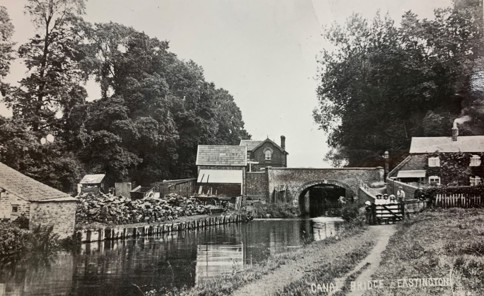
Pike Bridge & Pike Lock, Eastington. Stroudwater Navigation
D9746/2/301/6
Many types of bridge evolved for use on the canals – most used local stone or bricks made with sourced locally to cut down on costs. In Gloucestershire, there were three main types of bridge: road, roving and swing. This is a road bridge at Eastington – which has now been rebuilt as a much less attractive concrete bridge – which was built to carry a busy road over the canal. Roving bridges were smaller, usually humpbacked bridges built to carry the towpath over the canal. Several can be seen on the Stroudwater Canal (one nice example is at Newtown Bridge, Stonehouse). Swing bridges existed on the Thames & Severn (Siddington), Stroudwater (Ryeford) and the Gloucester & Sharpness Canal (i.e. Fretherne). Whereas the Thames & Severn and Stroudwater swing bridges were small single span types, those on the much wider Gloucester & Sharpness comprised two wooden half-spans which could be swung open to let vessels pass. Today all the latter have been replaced by steel single span swing bridges.
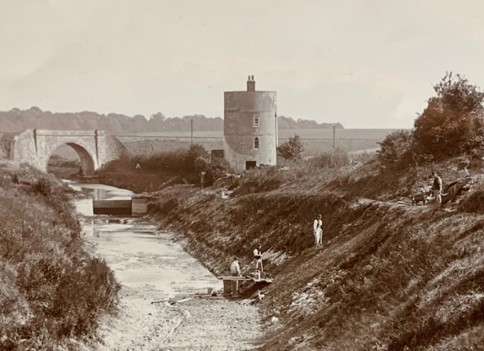
Roundhouse, near Coates, Thames & Severn Canal
C/CTS/16/4/5
Lengthsmen were canal employees responsible for set lengths of a canal, and their duties included management of the towpath, locks and lock-keeping, bridge and bridge keeping, management and monitoring of water levels, plus repair and maintenance of banks on their ‘length’ (including cutting reeds and vegetation). Lengthsmen generally lived in company-built (often isolated) stone or brick cottages placed at or close to the length they were responsible for. On the Thames & Severn, the Lengthsmens’ cottages were unusual, being circular stone roundhouses with a plaster or stucco finish. Built in 1790, the year following the canal's opening, they came in two basic forms: one with a conventional pitched conical roof, the other with an inverted (upside-down) conical roof. Five were built in total, with two being conventual pitched roofs (Chalford and Cerney Wick) and three being inverted roof structures (Coates – seen here - Marston Meysey and Inglesham). With the latter, the inverted cone was used to collect rainwater that was channelled down to an underground cistern, which was then used to supply the round house. All were three floor structures, with a single room on each floor. Originally the lowest room was used as a stable or storeroom and was only accessible from outside – on some this was an underground basement room. The upper floor living quarters were linked by an internal staircase. Sadly, despite their attractive appearance, in use they proved quite cramped and unpracticable for day-to-day living. As a result, those at Cerney Wick and Marston Meysey were abandoned and rebuilt standard rectangular cottages built nearby. Today all the roundhouses survive with most in private ownership.
Balingers Lock, Chalford, Thames & Severn Canal
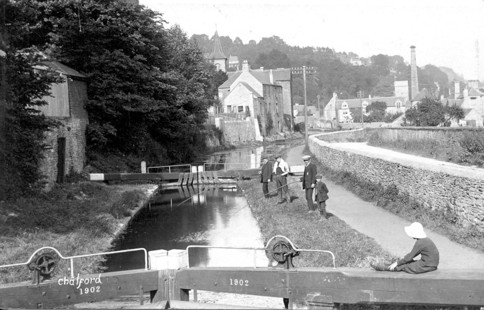
D4693/21
This is Balingers Lock on the Thames & Severn at Chalford. On the left, is the spire of Christ Church, while on the right is the chimney of Bliss Mills – William Dangerfields walking stick and umbrella factory. Below the chimney, the roof of Chalford Round House can be seen – this was the site of Chalford Round House Wharf and Smart’s Wharf. Locks are used for raising and lowering boats between stretches of water of different levels, enabling canals to climb and descend hills. There are several types of lock, but in Gloucestershire, all are pound locks – so called because they have a ‘pound’ of water at each end and an internal lock chamber, that can be filled or emptied with water. Most are made of local stone although brick can be used. The lock gates are made of timber, usually oak or elm (today, western African hardwoods such as Opepe, Ekki and Greenheart are also used). To make a watertight seal when the gates are closed the ends are mitred to provide a flush fit. The gates are opened/closed by arms or ‘balance beams’ enabling easy movement when the water levels on either side match. Water enters and leaves the lock via gate paddles in the bottom gate or ground paddles in the upper gate – these are used as they prevent water falling onto boats rising in the lock. Each paddle is raised by individual windlasses – the bottom (nearest) gates on this lock have unusual circular windlasses. Of the Gloucestershire canals, the one with the most locks was the Thames & Severn, which had 44 locks, followed by the Herefordshire & Gloucestershire Canal with 22 and then the Stroudwater Navigation with 12.
Bristol Road Wharf, Whitminster, Stroudwater Navigation
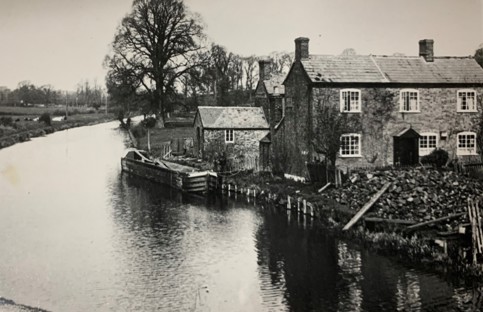
D9746/2/301/4
Once a canal had been built most of the canal companies put great efforts into making facilities to attract users. The most common facility was the construction of wharves on the canal side to load/unload cargoes. While some wharfs were built of stone, especially in towns, many were constructed of timber revetments. Many were associated with houses and the whole wharf site would be rented out or sold to a local coal or aggregates merchant. This example is the Bristol Road Wharf at Whitminster on the Stroudwater Navigation. A large pile of coal can be seen on the canal side – possibly having been unloaded from the empty barge tied up alongside.
Sapperton Tunnel, Coates, Thames & Severn Canal
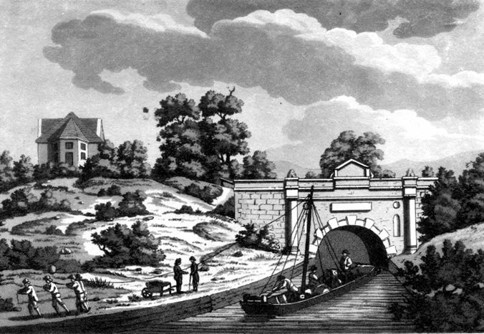
A/282/1
Gloucestershire had two long canal tunnels, the Oxenhall Tunnel on the Herefordshire & Gloucestershire Canal at 2,192-yards (2,004m) long and the Sapperton Tunnel on the Thames & Severn Canal, which was longer at 3,817 yards (3,490 m) long. Both were big engineering challenges. The Sapperton Tunnel carried the Thames & Severn through the Cotswold escarpment, starting at Sapperton and ending at Coates. Construction began in 1784, with Charles Jones being the initial contractor, although he was later replaced for numerous reasons including his love of the bottle! The tunnel was 15 feet (4.6 m) high and wide and was 213ft (65m) below ground at its deepest point. It took five years to complete, and 26 vertical shafts were dug along its length to allow allowed simultaneous working, the deepest of which was 244 feet (74 m). A mix of manual labour and explosives were used to excavate the rock, and a small railway was also built to take workers into the tunnel and remove waste materials before the tunnel was put in water. The main problem was the geology through which the tunnel passed. This Great Oolite (solid limestone), Inferior Oolite (friable limestone) and Fuller's Earth clay (essentially unrefined cat litter!). The oolite rock had water permeable fissures which caused rock falls and allowed the formation of springs and these often broke through into the tunnel, causing water leakage. In areas where the tunnel went through Fuller's Earth it had to be lined with expensive brick. The tunnel opened in 1789 but from the start it required frequent maintenance. It was also too narrow for any kind of towpath, so boats passed through by using poles or by ‘legging’. This required two men, and they would lie on a plank across the bows of the boat, and holding the plank with their hands, would propel the boat with their feet against the tunnel wall. A typical transit took about 3½ hours. However, it was the longest tunnel of any kind in England for 22 years until surpassed in 1811 by the Huddersfield Narrow Canal's Standedge Tunnel.
Brimscombe Port, Thames & Severn Canal
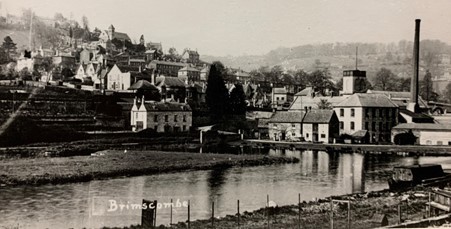
D9746/2/313/6
Brimscombe Port was the headquarters of the Thames & Severn company, and it had every facility essential for the transfer of goods – cranes, wharves and warehouses. It permitted the easy transhipment of cargoes from the beamy Severn trows to the smaller Thames barges which could then proceed up along the canal eastwards towards Lechlade, the Thames and London. The main basin was 700 ft (213m) long 250 feet (76 metres) wide and could accommodate around 100 vessels at a time. It also boasted two important features – an island storage site and a weighing machine. Both were measures to improve the port’s business efficiency, the former by protecting valuable stores of coal from theft and the latter by ensuring the correct fees were paid for goods carried. In the 1960s the site was redeveloped for light industrial use, which included infilling the basin and demolishing former Thames and Severn Canal company buildings. Today just two original buildings survive - the Salt Warehouse and East Wharf Cottage. As its name suggests, the Salt Warehouse was used for storing salt shipped down by barges from Droitwich. Droitwich salt came from evaporating brine in large pans positioned over fires and in Stroud it was used to fix the dye to the woollen fabrics that were produced in the cloth mills along the valley. Once the textile had been dyed it was then soaked in a salt solution to make sure that the dye didn’t run or leach out at a later stage. Brimscombe Port was due to be redeveloped again in the early 2000's as part of the Cotswold Canal Trust’s Phase 1A restoration programme, but development has since been delayed.
Barge weighbridge, Brimscombe Port, Thames & Severn Canal
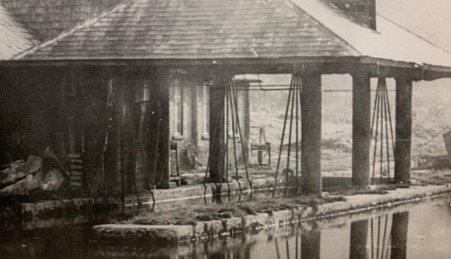
D9746/2/313/1
One of the most remarkable structures in the port was a weighing machine. It was one of just four in the country – the others being at Newport, Cardiff, and Midford (on the Somerset Coal Canal). It was introduced to prevent fraud over payment of tolls for goods carried on the canal and it could accurately find the weight of a boat so that the gauging system used to determine the weight of the cargo could be found – meaning the canal company didn’t lose any money! It was located close to the warehouses on the north side of the basin, in an open sided building standing over a one-ended lock chamber. Boats entered the lock and were weighed on a platform after the gate had been closed and the water drained away. It used a system of levers so that comparatively small weights could be used to measure the boat weight, so the weigh clerk didn't have to lug one-ton weights on and off the scales!
Windmill pump at Thames Head Bridge, Thames & Severn Canal, c.1790
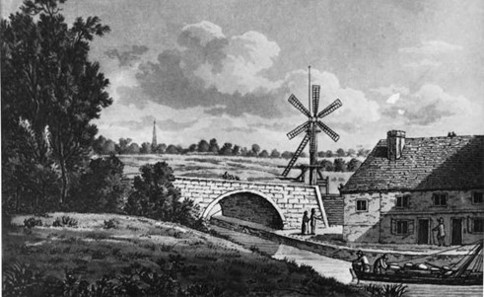
GPS 609/8
Until the summit level was completed, little thought seems to have been given by the Thames & Severn Canal Company to the supply of water to the canal. It was probably assumed that the River Frome (to the west of the Sapperton Tunnel), the River Churn which flowed through Cirencester, and the River Coln, together with springs at Boxwell and a well near the source of the River Thames at Thames Head, would be sufficient. As a result, no reservoirs were built which proved a mistake. Initially a horse pump was installed at Thames Head, but this proved inadequate, so it was replaced by a windmill, seen here in this 1790 sketch by the famous English author and engraver, Samuel Ireland. This could pump much more water from the Thames Head well but even then, it proved insufficient, primarily because – thanks to the underlying geology of the porous limestone – leakage on the canal could not be stopped. It was later calculated that the summit level was losing around 1.1 million gallons a day! In 1794 a Boulton & Watt Cornish-beam steam engine was installed, which ran from June to October (the ‘dry-season’) and could pump 3 million gallons of water a day…but even this could barely keep up and in 1854 it was replaced by a newer engine, which ran until 1912. After the abandonment of the canal, it was removed for scrap metal during WW2 and today nothing remains.
Letter from John Denyer, Brimscombe Port, Thames & Severn Canal, 25 November 1842
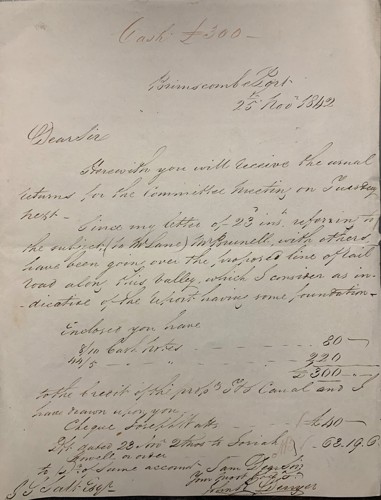
This letter from a manager called John Denyer at Brimscombe Port on 25 November 1842 heralds the beginning of the end for the Thames & Severn and the Stroudwater canals. It notes that Isambard Kingdom Brunel with others had been seen walking along the Golden Valley presumably undertaking an initial visual survey of the route for the intended Cheltenham and Great Western Union Railway. The letter states that:
‘Since my letter of 23rd inst. referring to the subject (to Mr Lane) Mr Brunel with others have been seen going over the line of proposed rail road along this valley, which I consider as indicative of the report having some foundation.’
The railway to Swindon eventually opened in 1845 and although the two canals cut tolls to try and stay competitive, revenue on the Thames & Severn fell from £11,000 in 1841 to just £2,874 by 1855. Faced with ongoing water problems and the railway taking massive amounts of business from it, the Thames & Severn declined rapidly and in 1927, it was abandoned. The Stroudwater Navigation faired better and it continued but ultimately declined and eventually closed in 1941.
Plan section of road accommodation bridge over the canal at Chalford, Thames & Severn Canal
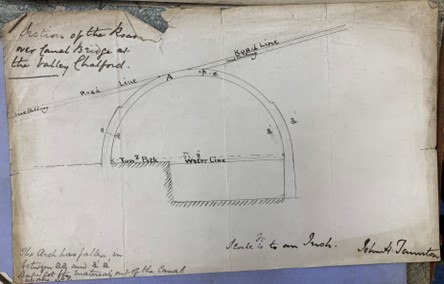
TS/164
The Thames & Severn has left a huge archive of over 1,000 items – including Ledgers, Journals, Imports & Exports, Tonnage Books, Cash books, Work books, Arrival of Vessels, Works, London Wharf Accounts, Dockage of Vessels, Repair books, Monthly Returns, Cash Books, Weekly Accounts, Memorandum books, Letter books, Coal Books, Accounts, Arrivals and departures of boats at Brimscombe Port and Payments received from boat owners for freights. This document – a sketch drawing of the profile of one of the road bridges over the canal that required repairs is from a Register of the Committee of Proprietors.
Pidcock’s Canal, Lydney, 1810
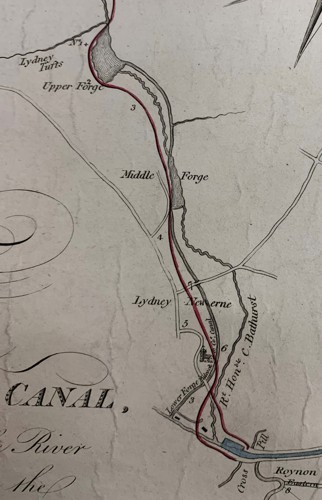
Q/RUM/37/1
Taken from an 1810 plan of the Severn and Wye railway (Tramroad) and canal deposited at the county Quarter Sessions, this map shows Pidcock’s Canal. The origins of this short canal – less than 2 miles long – goes back to 1775, when David Tanner of Tintern was granted a lease of the Upper Forge ironworks, north of Lydney. The lease he obtained included powers to dig a canal from there via Middle Forge to the Lower Forge ironworks (later the Lydney Tinplate Works), and then down to Lydney Pill. However, Tanner sold his lease in 1789 to members of the Pidcock family, who were glass masters from Staffordshire, and it seems that they built the canal. Locally known as ‘The Cut’ it had just three locks (all below Middle Forge) and, following the construction of the Lydney Canal in 1813, it connected to that, not the pill. It was disused by 1840 but can still be traced from Middle Forge, downstream via St. Mary’s Halt in Lydney to just above Lydney Junction.
Share certificate No.585 of Thomas Rothley esq of Bristol, for £100 share in the Herefordshire and Gloucestershire Canal Company
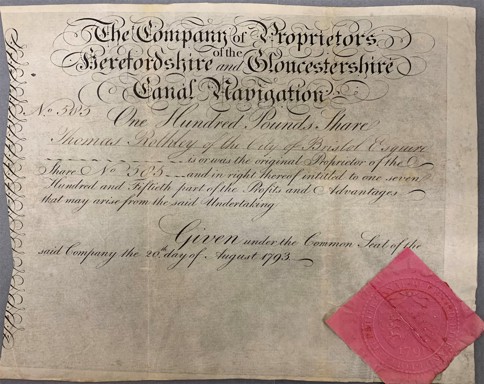
D9705/1/1
The first plan for a canal linking Hereford and Gloucester was made by Robert Whitworth in 1777 but it wasn’t until 1790 that promoters put it before Parliament. Josiah Clowes was appointed engineer, and his first route went through Ledbury, with a branch to Newent to access its small coalfields, but in 1792 an alteration was made to take the canal direct to Newent, which then required a tunnel at Oxenhall, and a new Act of Parliament approved this new route in 1793. When completed, the canal ran for 34 miles (55 km) from Hereford basin through Ledbury, Dymock and Newent to Over, where it locked out onto the West Channel of the River Severn- and a second cut then took it across Alney Island. It had 22 locks, and three tunnels, with a short coal branch to Gorsley. The tunnels were the Aylestone tunnel (440 yards, 402m), Ashperton tunnel (400 yards, 370 m) long) and the much longer Oxenhall tunnel (2,192-yards, 2,004m). The latter was a difficult engineering project and proved very costly, ultimately bringing the canal to the brink of unprofitability.
Tonnage book of Coombe Hill Canal, 1815-1816
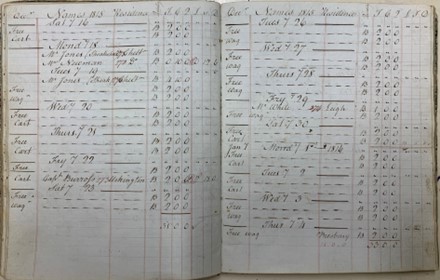
D1245/E19
The Coombe Hill Canal opened in 1796 primarily to allow Staffordshire and Forest of Dean coal to be moved as near as possible to the rapidly expanding town of Cheltenham. It cost about £5,000 and ran for just 2¾-miles (4.43 km) from a lock on the Severn (able to accommodate barges of 60-70 tons) above Wainlode Hill to Coombe Hill. The canal terminated at a basin at Coombe Hill, which had warehouses and the company headquarters. This photograph shows what it is thought to be a Tonnage Book, which recorded the amounts of coal that the canal handled. However, the main problem was that the canal stopped 5 miles short of Cheltenham – thanks to a 100ft (30m) high ridge of Triassic mudstone that would have required a flight to locks to pass over. Although plans were drawn up to extend the canal – or build a horse tram road – to Cheltenham, these came to nothing especially after the Gloucester & Cheltenham Tramroad opened in 1811. This took much of the canal’s coal traffic and despite the canal charging tolls as high as 2s 6d a ton it made little or no profit. In 1867, the company then asked the engineer of the Gloucester & Sharpness Canal to provide a report, and he suggested it would never be profitable and would best be turned into an oyster bed! Subsequently, the canal was sold twice more before, in 1876, it was abandoned under the Coombe Hill Canal Navigation (Abandonment) Act 1876 when the new owners were unable to afford repairs to the lock after flood damage. In 1954 the canal and certain fenland and flood meadow areas were designated as SSSI’s and in 2000 the Gloucestershire Wildlife Trust adopted the site turning it into a nature reserve.
Steamer loading coal on Lydney Canal
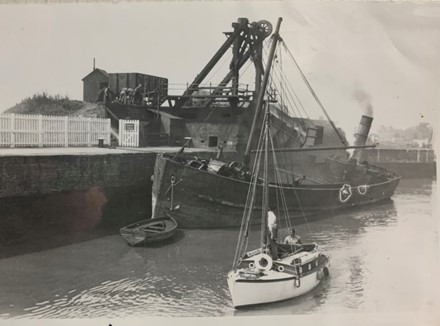
D8847/1/17
In 1810, the Severn & Wye Railway and Canal Company obtained an Act that authorised the building of a canal to the River Severn at Nass Point – linking to a tramway that ran from the Forest’s interior. The mile long canal opened in 1813 and by 1825, the outer harbour basin and locks were completed, and the north pier had been added. This allowed Lydney to become a major coal port – but as well as coal, other exports included pig iron, bark, timber and paving stone and over 200 vessels used the port with some 200,000 tons being handed in a single year. In 1897, the canal and harbour underwent a major expansion of its rail and transport infrastructure which saw new sidings, nine coal tips and three cranes added, which dramatically increased its cargo handling abilities, with 265,000 tons being exported that year. This wonderful photograph – from the collection of F Harris of Lydney, photographer – shows an unknown steamer, probably one owned by either Alfred Smith of Bristol or is one of Sully’s of Bridgwater, being loaded with coal. The coal (from Crump Meadow Collery – the name can be seen on the wagon) had just been tipped out of the wagon into the steamer’s hold and was in the process of being pushed back by the men. The coal in the hold would be levelled before sailing to ensure the streamer didn’t have a list. The canal continued in use until 1960, when the National Coal Board closed the last deep mine colliery in the Forest at Cannop. Soon afterwards the last coal was shipped from the harbour and in 1977 it closed as a commercial waterway.
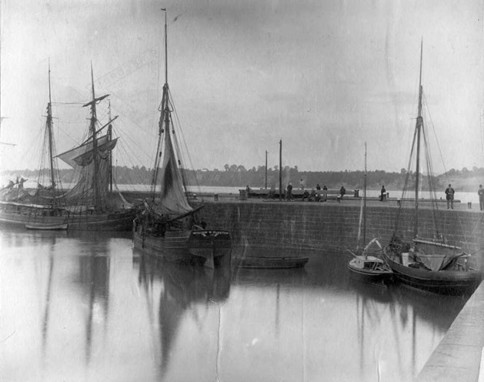
Sharpness Basin, Gloucester & Berkeley (Gloucester & Sharpness) Canal
GPS/287/02
In 1793, Midland industrialists, merchants and influential citizens of Gloucester obtained an Act of Parliament to construct a ship canal from Gloucester to Berkeley to bypass the difficult and dangerous tidal River Severn below Gloucester. Financial problems and the Napoleonic wars meant the canal took much longer to build than expected and it was not completed until 1827, 33 years after construction started! At 86ft 6in wide and 18ft deep, the canal could handle craft of 600 tons (with maximum dimensions 190ft long and 29ft wide) and for a time, it was the biggest canal in England. During the hiatus in construction (caused because as the company had run out of money) it was decided to take the canal to Sharpness, rather than Berkeley, as the former was judged to be a better place for an entrance from the River Severn. The canal had a sea lock and basin at Sharpness – seen here with some ships drying their sails - but there were no cargo handling facilities, so ships went to Gloucester, where a second basin with warehouses and cranes were built to discharge cargo.
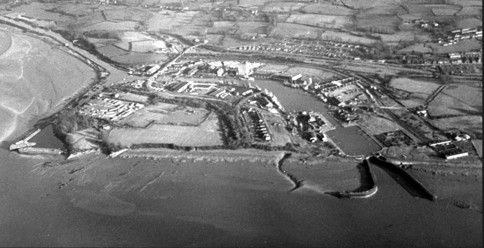
Sharpness Floating Harbour, Gloucester & Sharpness Canal
The Fred Rowbotham Photographic Collection on Coaley.Net / GlosDocs
By the late 1860s, the increasing size of ships made the original entrance at Sharpness too small, so a new ‘floating harbour’ was built at a cost of £400,000, which opened in 1874. This had several advantages over the Old Basin, namely that the entrance was via a large tidal basin with a lock, which meant that the water level could be maintained in the canal. This entrance was also below Sharpness Point, which gave incoming craft more room to manoeuvre in the strongly tidal estuary. Another plus was that the space around the new dock allowed new warehouses to be built and, before long a large rail network grew up around the port to facilitate moving cargo around the port. On the opening of the new docks, the Gloucester & Berkeley Canal company was renamed the Gloucester and Sharpness Canal Company. This wonderful photograph from The Fred Rowbotham Photographic Collection (which can be found at the excellent website Coaley.Net https://coaley.net/) shows the sheer size of the new basin compared to the old (visible far left). The sea-lock (320 ft long and 57 ft wide) and harbour entrance piers are clearly visible, as is the Gloucester & Sharpness canal, the dockside warehousing and the dock railway lines.
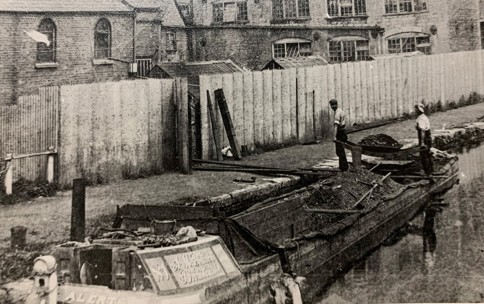
Narrowboat ‘Alert’ unloading coal at Brimscombe
D9746/2/312/13
The commonest cargo on most of the county canals was coal. Coal was in high demand by the various woollen mills in Stroud for powering their processes as steam engines were more efficient than the traditional water-powered mills Initially much of the coal came from the Staffordshire or Shropshire coalfields, but as time passed more and more came from the coalfields of South Gloucestershire and the Forest of Dean. Here, coal is being unloaded from the narrowboat Alert at Brimscombe by the crew using a stretcher hod – an arduous back-breaking task. Note the narrow gangway planks laid from the barge to the quay. The Alert was owned by A. M. Pearce of Brimscombe. The canvas side-cloths are easily seen here, even though they have been rolled back to allow easier access to the cargo.
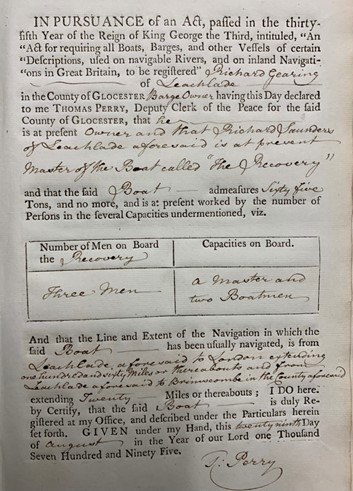
Entry of barge Recovery in Registry of Boats etc. Act 1795
Q/RR/1
The Registry of Boats etc. Act 1795 ordered that all vessels using navigable rivers and canals be registered with the Quarter Sessions. This is the entry for the barge Recovery, owner and Master Richard Saunders, which plied between Brimscombe, Lechlade and London. The Act came about because of the threat of invasion in the French Revolutionary Wars and Napoleonic Wars. The government had realised that there was a need to transport troops rapidly across the country in an emergency – but no-one knew how many available craft there were. The Registry act therefore was a census and allowed such vessels to be found and requisitioned as auxiliary troop transports if required.
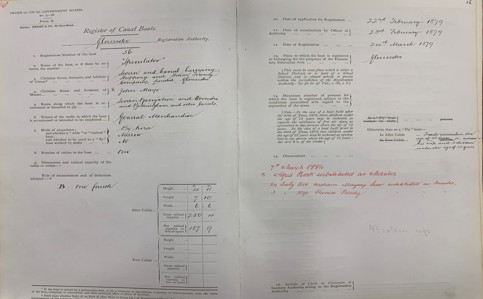
1877 Canal Boat Act registration for narrowboat Speculator, 24 March 1879
GBR/L6/13/3/1
In 1877 the Canal Boat Act was passed to improve living conditions on the canals for the watermen and their families. It came about largely due to Victorian concerns about cramped and poor-quality living space plus the moral welfare of women and girls due to sleeping arrangements onboard. Its aim was to improve conditions by specifying the number of adults and children allowed to live onboard and to bring the children of watermen – who worked on the boats from a nearly age - into the education system. Henceforth, all canal boats used as dwellings had to register with the local authority for the purposes of licencing and after passing inspection the vessel was registered and a certificate issued to the owner which had to be carried onboard the vessel and produced on demand. The registers complied under the Act by Gloucester Borough survive and as this example for the narrowboat Speculator, owned by the Severn and Canal Carrying Shipping & Steam Towing Company shows, they include a wealth of detail, including Registered date, registered number, registering town, name of vessel, owner’s name, owner’s residence, master’s name, class of boat (beam-wide or narrow), boat’s occupants and observations.
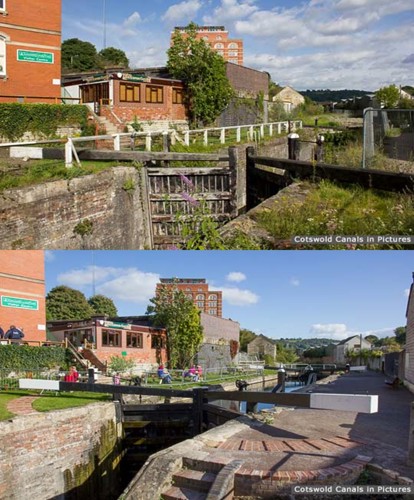
Wallbridge Upper Lock, Stroud, before & after restoration
Cotswold Canals in Pictures
By the 1930s, only the Gloucester & Sharpness Canal was still in use, and all the other Gloucestershire canals had been abandoned and were rapidly failing into disrepair. However today, a massive revival has begun, and thanks to work being undertaken by the Cotswold Canals Trust (the Stroudwater Navigation and the Thames & Severn), the Herefordshire & Gloucestershire Canal Trust, Canal & River Trust (Gloucester & Sharpness Canal) and the Lydney Dock Partnership, our county canals are being restored and returned to water. The one exception is the Coombe Hill canal, which is now a valuable wetland nature reserve run by the Gloucestershire Wildlife Trust. Restoring these priceless pieces of infrastructure to our county’s heritage is a long process however and all these organisations need as much help and support as possible, so if you like canals we would recommend that you visit their websites and consider joining these organisations.
Cotswold Canals Trust - https://cotswoldcanals.org/
Herefordshire & Gloucestershire Canal - https://h-g-canal.org.uk/
Canal & River Trust - https://canalrivertrust.org.uk/