
They Don't Make 'em Like They Used To!
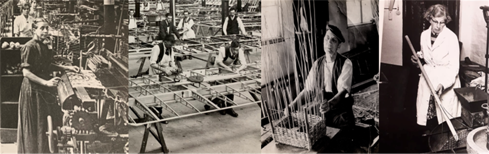
In the past Gloucestershire boasted a wonderfully wide range of manufacturing from large industries through to small artisanal cottage industry concerns. This exhibition will look at both ends of this scale through surviving records held at the archives. By default, most will be from the larger concerns whose records tend to survive but there are a few items from the smaller ones.
Victoria Steam Joinery, c. 1890
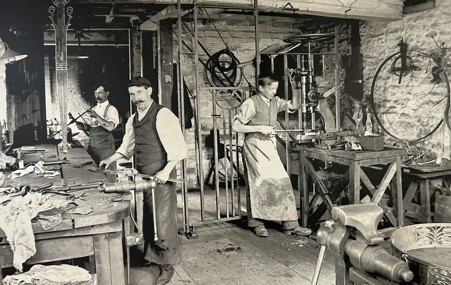
D9746/1/17/184
Of all the photographs that we hold in the archives, this one – a view of a workshop in the Victoria Steam Joinery in Chalford – best shows craftsmen at work. Although ‘joinery’ usually implies woodworking, these men are working in metal – as well as the gate or railings dead centre there is a decorative possibly ‘arts & crafts’ item on the bench on the left.
Smith Brothers poultry pens & pig cots, Cheltenham
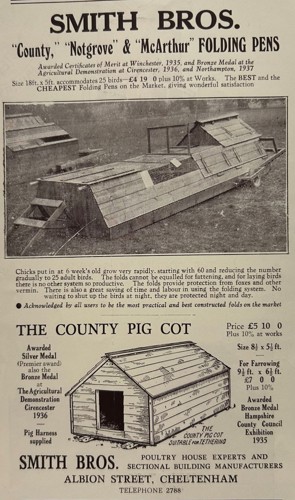
J20.2GS Farming in Gloucestershire
T W Smith & Sons began at Leckhampton in 1841 as timber and builders' merchants – and grew to be one of the largest joineries in the UK with over 400 employees, most of whom were woodworkers. In addition, they also made sectional buildings and factory equipment and moved into the agricultural sector making a range of products such as gates, hurdles, pig cots and chicken houses – including the first deep litter housing for poultry. In 1927 they opened a site in Worcester and although their Cheltenham base closed after WW2, the Worcester branch survived as a going concern until 2003.
Invitation to opening of Chipping Campden School of Arts and Crafts, 1905
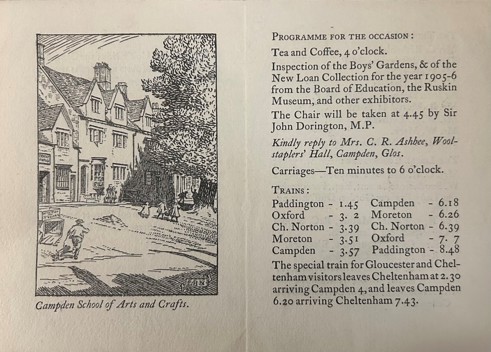
D2909/5
The ‘Arts & Crafts’ movement began in Britain in the 1880s and was associated with reform, ruralism, the garden city movement and the folk-song revival – all linked by the ideal of ‘the Simple Life’. Far from the polluted cities, the Cotswolds – with remote hills and valleys and quiet stone-built villages – was an attractive lure and in 1871, William Morris and Dante Gabriel Rossetti jointly leased Kelmscott Manor, near Lechlade, as a rural retreat. They were followed by Ernest Gimson and Sidney and Ernest Barnsley, who moved to the south Cotswolds in 1893, while C R Ashbee’s Guild of Handicraft moved to Chipping Campden from London’s East End in 1902. The Campden School of Arts and Crafts was the educational and vocational arm of the historic Guild and School of Handicraft and was opened by Ashbee in 1902. Although the guild dissolved in 1908, it’s legacy includes the Gloucestershire Guild of Craftsmen, known throughout the world for its high-quality workmanship and simple designs.
Design for a Candlesconce in pierced brass by Ernst Gimson, undated
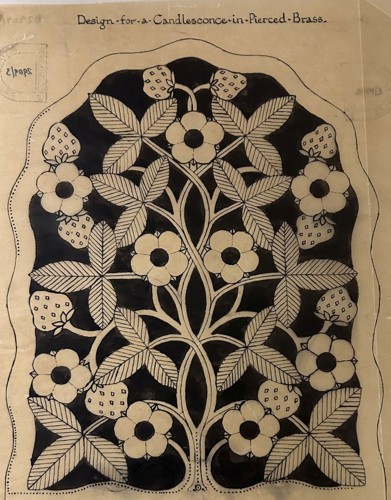
D2909/3
Ernest William Gimson (21 December 1864 – 12 August 1919) was an English furniture designer and architect – described as "the greatest of the English architect-designers". He moved to the Cotswolds in 1893 ‘to live near to nature’ and settled at Pinbury Park, near Sapperton, on the Cirencester estate, where he worked under the patronage of the Bathurst family. In 1900, he set up a furniture workshop first at Cirencester, then at Daneway House at Sapperton, making and designing all manner of things – this is a pen and ink design for a candle sconce made in pierced brass. He later built his own house in the village, where he stayed until his death in 1919.
Wrought-iron gates by Norman Jewson, undated
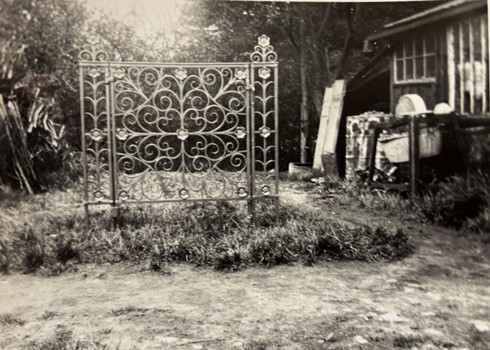
D2909/1/53
Norman Jewson (12 February 1884 – 28 August 1975) was an English architect-craftsman of the Arts and Crafts Movement. He was a distinguished, younger member of the group which had settled in Sapperton, under the influence of Ernest Gimson. He worked in wood, stone and metal – as seen in this wrought-iron gate – but his repair of the Tudor Owlpen Manor in 1925–26 is often regarded as his most representative and successful work. Surviving into old age, he brought their ideas and working methods into the second half of the twentieth century.
Mahogany grand piano by Peter Waals, undated
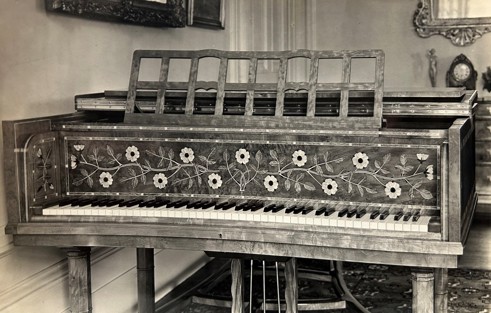
D2909/1/91
Peter Waals was a Dutch arts & crafts cabinet maker who became manager of Ernest Gimson’s workshop making furniture, turned chairs, and metalwork to Gimson’s, Jewson’s and his own designs. The furniture and craft work produced by this workshop under Waal’s day-to-day supervision – like this grand piano, designed by Norman Jewson but made by Waals in mahogany with inlays – is regarded as a supreme achievement of the Arts and Crafts movement of its period. Waals died in 1937 and is buried in the churchyard at Christ Church, Chalford.
Jack Cale, Basketmaker of Quedgeley
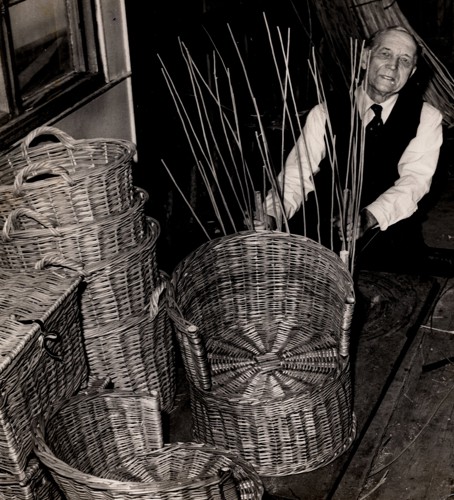
Gloucestershire Archives
Basketry was an enduring rural industry practised since prehistory. At the end of the process were the basket weavers – this photograph shows Jack Cale, of the Cale Family, basketmakers of Quedgeley. This view shows wicker baskets and chairs – but hampers, fish traps and many other items were crafted.
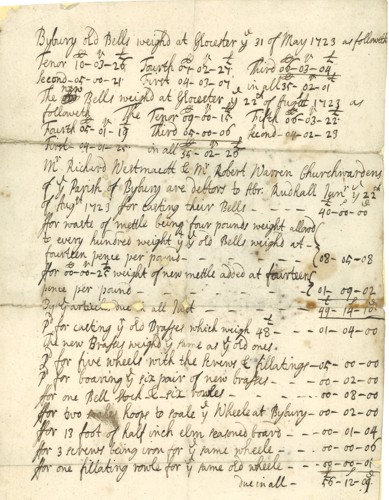
Receipt from Abraham Rudhall for casting 6 new bells for the parish of Bibury, 1723
D269b/F84
Bell founding has been an industry in Gloucester for over 1,000 years – the earliest known bell cast was in 890 AD in St. Oswald’s Priory. The most famous bell founders were the Rudhalls, a family concern, who between 1684 and 1835 cast more than 5,000 bells. The company was founded by Abraham Rudhall (1657–1736) who developed a method of tuning bells by turning on a lathe rather than the traditional chipping method with a chisel. Most of our records relating to Rudhall’s come from parish accounts – showing expenditure on their bells. This is typical – an itemised receipt from Abraham Rudhall for casting 6 new bells for the parish of Bibury in 1723 – the bill coming to £56 12s (about £6,500 today). When Abraham died in 1735, the business continued in the family line until it closed in 1828.
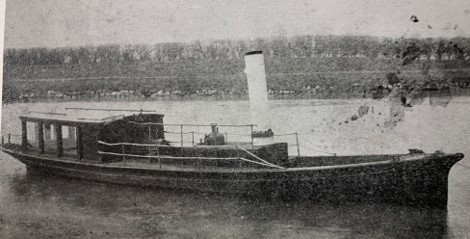
Lotus steam launch, Abdela & Mitchell Boatbuilders, 1904
D9746/2/354/1
In 1900, Isaac J. Abdela , a Manchester shipping broker, took over the business of Edwin Clark & Co. Clark had established an engineering and boatbuilding business at Hope Mill on the Thames & Severn Canal. The firm went on to specialise in prefabricated craft, making flat-packed steamboats that were sent around the world as well as more conventional craft – such as the still working Thames river steamer Henley. In 1896 Edwin Clark died and within 3 years the company had closed. However in 1900, Isaac J. Abdela , a Manchester shipping broker, took over the business and shortly afterwards effected a merger with Mitchell & Co, grey cloth merchants of Manchester. This highly unlikely partnership resulted in the largest shipbuilding concern in the county. Eventually the firm made over 100 vessels, mostly small steamers and launches, the bulk of them for overseas customers. This vessel, The Lotus, a 40ft, 5-ton steam launch built in 1904, was typical of their output.
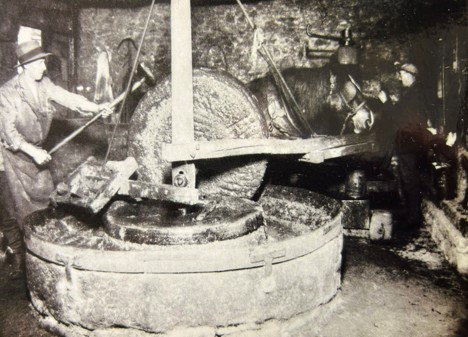
Horse-powered cider mill, Bottomley Farm, Woodmancote, c. 1937
D15345b/2
Cider making was brought to Britain by the Normans using a process based on olive oil pressing and the earliest production was in monasteries, who had the land, knowledge and time to produce it. Post-dissolution, many itinerant monks turned to farms to continue their craft, with farmers planting small orchards for the purpose. This picture shows apples being pressed in a horse-powered cider ‘horse-mill’ or ‘stone mill’ at Bottomley Farm, Woodmancote, c1937. After being pressed, the pulp would be pressed to fully extract the juice. The impetus for orchard planting and cider making was financial as well as for pleasure – an agricultural worker could receive up to one third of his wages in cider thus saving a farmer cash!
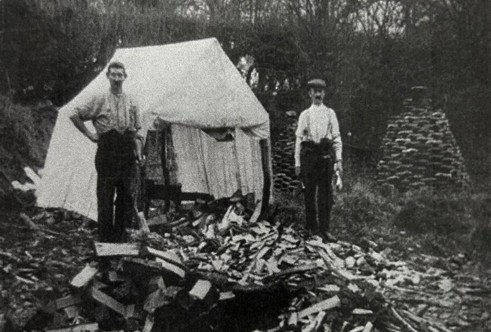
Clog makers, Colesbourne, 1908
Cheltenham Chronicle & Gloucestershire Graphic, December 1908
This shows an unusual trade for Gloucestershire: clog sole making on Colesbourne Park. The men were from Cheshire and were making clog soles that were ultimately bound for sale in Oldham, Lancashire – note the clog sole stacks in the background. Clog soles were made of soft, lightweight woods, such as alder – of which there was an abundance of on the valley woodlands on the Colesbourne Estate alongside the River Churn and the Hilcot Brook. Unlike Dutch clogs, which were all-wood, British clogs had wooden soles but leather uppers, which gave better comfort and a tighter fit for labourers.
Coppicing payment, Batsford Estate, 1770

D1447/7/3
Coppicing is a traditional craft for woodland management which relies on the ability of trees to regrow from their stump if cut down. In a coppiced wood (a copse), young trees are repeatedly cut down to near ground level, allowing new growth to form that, after a few years (typically 7-20 years), can be harvested. This page from the Batsford Estate accounts for 1770 shows John Phillips being paid 10s for ½ day’s coppicing. This may not seem like much today but at the time it was five times that of an agricultural labourer.
John Evans, ’bodger’, Amberley, 1865
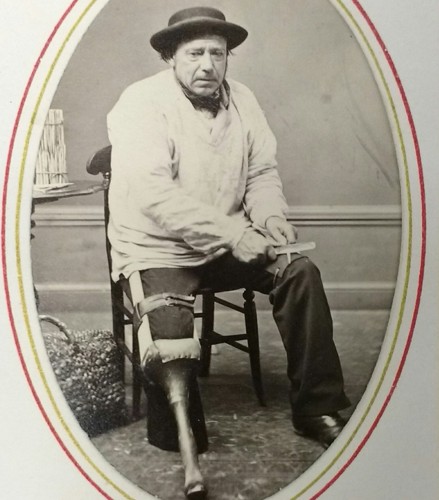
P13/IN/4/6
Coppicing provided raw material for fence staves/poles, firewood (sold in bundles or faggots), laths (for wattle), hurdles, pegs, thatching spars, tool handles, charcoal, besom brooms, and rough chairs and tables. These items were made by ‘bodgers’ – often itinerate craftsmen who specialised in working ‘green’ unseasoned wood and frequently lived in woodlands in small encampments. This is John Evans of Amberley, c1865 – a one-legged farmer who appears to have worked as a bodger. Sadly we do not know exactly what he is making – possibly large clothes pegs – but he is using a cut-throat razor with a leather leg pad for protection.
Loom workers, Champion and Hall Carpet Manufacturers, Dursley
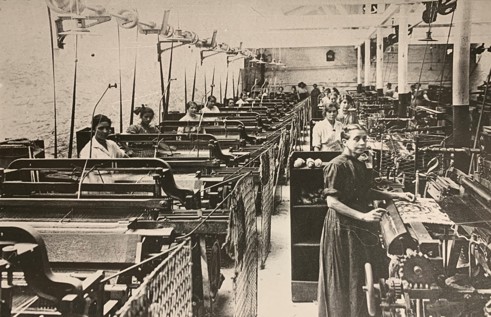
GPS/124/34
These views show mechanical carpet looms inside the mill of Champion and Hall Carpet Manufacturers in Dursley – this form was originally a saddlery business but expanded into rope making before moving into cloth and carpet production. These mechanical looms were powered by overhead belt drives powered by either water or steam power. Although these machines were powered, they still required a skilled workforce. These were mostly better off than the hand loom weavers, although they still worked long hours in noisy, dangerous conditions. The woollen trade was once the principal mechanised industry in the Stroud area, initially because of the availability of waterpower to drive mill machinery – though later steam power took over.
Boodle & Co. Ltd, dentists and denture manufacturers
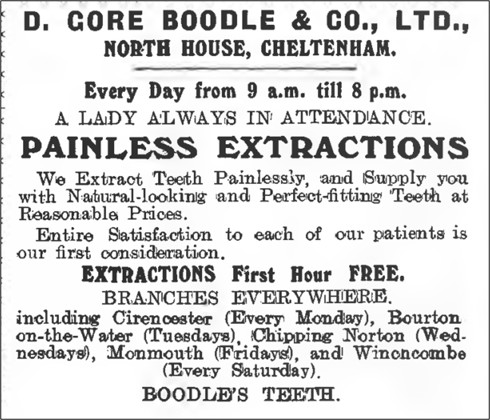
Cheltenham Chronicle & Gloucestershire Graphic May 1929
False teeth have a long history being made from human and animal teeth, wood, soapstone (pagodite), ivory, animal horn and porcelain – today they are made of acrylic resin and other synthetic polymer plastics. Initially dentists – like Boodle & Co here - made false teeth but as time passed denturists and specialist commercial dental laboratories took over the role. Denture usage has been declining as dental care improves – in the UK in 1968, 79% of those aged 65–74 had no natural teeth; by 1998, this had fallen to just 36%.
Edwinson Green & Sons, Gunsmiths
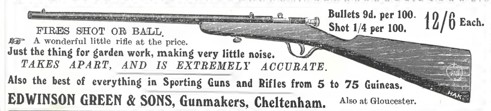
Cheltenham Chronicle & Gloucestershire Graphic May 1929
Although not a great gun centre like Birmingham, Gloucestershire had several gunsmiths, all of whom made guns and acted as agents for larger gun makers. As well as making and selling firearms, they also effected repairs and alterations. One of the best-known local gunsmiths was Edwinson Green & Sons, who had shops in Gloucester and Cheltenham.
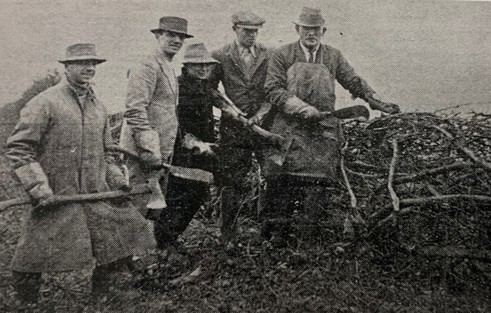
Hedgelayers, Bisley, 1936
D9746/1/9/384
After enclosure began dividing up the countryside, hedge laying became vital. Hedge laying was a skilled seasonal job that created solid livestock proof hedges which also promoted hedge growth. It declined after WW2 due to the availability & cost of labour, the introduction of tractor-powered chain flails for ‘cutting’ hedges and cheap wire fencing. This photograph shows a hedge laying instruction class at Bisley organised by Stroud District Young Farmers Club in November 1936. This shows a hedge laid in cross-section with (from left to right) Messrs V.J. Stephens, S.F. Stephens, Bramle, Andrews and Sykes (the instructor). Today hedge laying is making a comeback, but is expensive because it requires a skilled craftsperson, although hedges still define our countryside and are vitally important for wildlife as a refuge, a source of food, and as corridors along which they can move through the landscape.
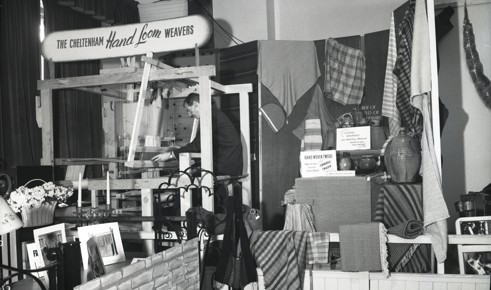
Cheltenham Hand Loom Weavers Exhibition, c. 1938
D8347/DGL/20/10/3/994
Prior to the late 1880s, hand loom weavers were the backbone of textile production, operating out of their homes and small workshops. Their skilled, manual craftsmanship defined local economies until the Industrial Revolution, when the rise of mechanised power looms began a transition to factory systems. Hand loom weavers worked long hours for little pay and employment was akin to ‘zero-hours’ working. Today, the hand loom weaving tradition is kept alive by hobbyist organisations such as the Cheltenham Hand Loom Weavers - seen here at an exhibition in pre-war times. This group formally wound up its affairs and disbanded in 1940 due to the outbreak of WW2, but it was a member of the Gloucestershire Guild of Weavers, Spinners and Dyers which is an organisation of regional artisans that is still active today.
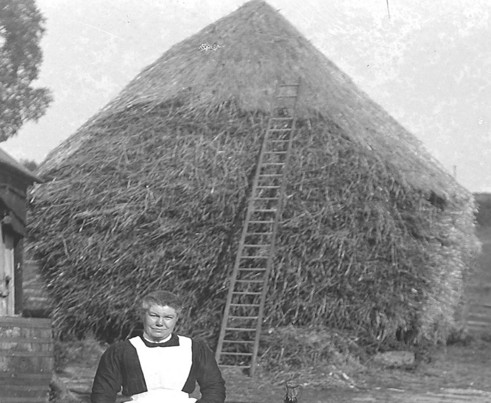
Straw/hay rick at Chase Farm, Charringworth, undated
D11554/1487
After haymaking and harvest, dried hay and cut straw were made into ricks for storage. Ricks were more than mere piles of dry vegetation; they were meticulously built round or rectangular structures that were stable and weather resistant. While farm labourers were used to stack the hay, thatchers were employed to manage the construction of the ricks and to cover the tops with thatch to make the ricks waterproof. Thatched ricks were designed to be opened by ‘slicing’ – literally where slices of the rick were cut off using a hay knife. Slicing in this way maintained the weather protection and structure of the rick. This is a photograph of a sliced rick in the yard of Chase Farm, Charringworth.
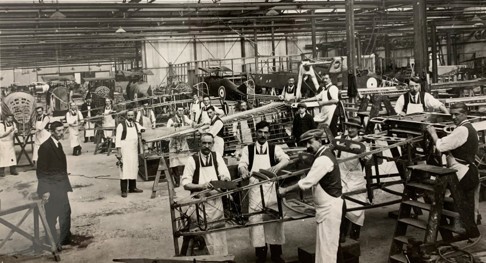
Aircraft shop, H H Martyn, Cheltenham, 1918
D5922/3/6/2
In 1888, Herbert Henry Martyn (1842-1937) founded a firm of stone, marble and wood carvers at the Sunningend Works in Lansdown, Cheltenham. In addition, it made bronze and gun metal castings, decorative plaster work, joinery, cabinet making and wrought iron work. In WW1, it diversified into aircraft production and was responsible for the creation of Gloster Aircraft Company. This all photograph shows woodworkers making aircraft fuselages and although those visible here are men, the factory also employed women, mostly in the fabric and dope sections, where they sewed the canvas coverings over the airframes. By 1920, it employed over 1,000 men and women and remained Cheltenham’s largest employer for many years.