
Display 17 of 22
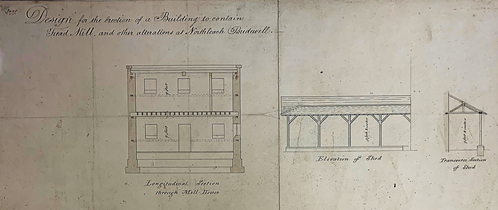
Design for the erection of a Building to contain Tread Mill, Northleach Bridewell, 1840
Q/AG/5
The treadmill – along with the hand-crank – was a method of punishing prisoners and for those sentenced to ‘hard labour’. Introduced into British prisons in 1818, they took the form of large paddle wheels some 20 feet in diameter with 24 steps around a six-foot cylinder. One was installed in Gloucester gaol in January 1823, primarily because it was difficult to find suitable work for prisoners sentenced to hard labour. Prisoners had to walk six or more hours a day, climbing the equivalent of 5,000 to 14,000 vertical feet (1500-4300m). While the purpose was mainly punitive, the mills were often used to grind grain, pump water, or operate a ventilation system. For the four smaller ‘Paul’ gaols in the county, there wasn’t any room for internal treadmills to be fitted – so these had to be accommodated externally. This image is part of the plans drawn up in 1840 for an external treadmill building for Northleach Gaol.
Last reviewed: