
Treading the Silver Screen
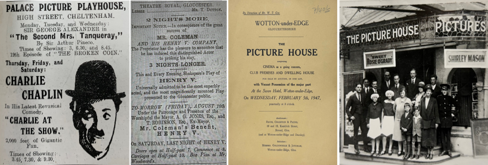
People love being entertained and from the 1600s onwards, theatres and playhouses – followed by music halls in the 1700s – were all popular. These remained entertainment stalwarts until the interwar years when cinema, radio, and the gramophone began to come to the fore. This exhibition looks at these entertainments using archive material, so grab your popcorn and settle down to a blockbuster matinee presentation!
The Quenes majesties Berward, Gloucester, 1570

GBR/F4/3
In the past, dog fighting, bear baiting and cock fighting were also all popular - this entry from the Gloucester Borough Stewards Accounts records the visit of the Queen’s ‘Bearward’ to the city. A bearward (or Master of the King's Bears) was a royal court official responsible for the care of the Monarch's bears, bulls, and mastiff dogs. In many cases, bearwards were the most prominent purveyors of entertainment in their area: arranging fights or ‘courses’ with their bears and travelling around the region during the year – this entry records the bearward ‘entertaining’ the mayor and borough officials – all for 6s 8d (about £77 today). They attracted both rich and poor and were renowned for feasting and fun as well as sport!
‘Alsoe geven in rewarde to the Quenes majesties Berward for bayting of his beers before mr maior and his bratherne the seconde of maie vis viiid’
Justice Trogmorton’s mynstrelles, Gloucester, 1560

GBR/F4/3
The earliest references to minstrels are contained within the Gloucester Borough Bailiffs’ Accounts for 1393-4. These comprises lines written upon one parchment sheet that is damaged and the text is sadly faded and almost unreadable. There are several entries, mostly written as ‘soluti pro diversis ministrallis’ – ‘Paid out for various minstrels’. Henceforth minstrels appear in the borough records at regular intervals – many were those of various noblemen; the Duke of Gloucester, the Earl of March and the Lord’s Steward – this entry in the Chamberlains’ Accounts for 1560 is typical:
‘Also given in rewarde to my Iustice Trogmerton his mynstrelles in redye moneye ijs’
These ‘mynstrelles’ belonged to Sir Nicholas Throckmorton of Coughton Court, a diplomat and politician, who was an ambassador to France and later Scotland. The minstrels were probably entertaining the Mayor and burgesses of the borough rather than the general population. The amount paid came to about £23 today.
Sir Anthony Kyngeston’s ‘abbott of Mysrule’, Christmas, 1552
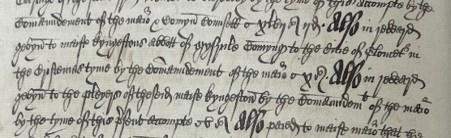
GBR/F4/3
Christmas plays were always popular with the borough and public alike. This entry in the Gloucester Borough Chamberlains Accounts for 1550 records Sir Anthony Kyngeston’s players performing an ‘abbott of Mysrule’ play at Christmas, for which he received 10s – about £137 – while the company got 5s (about £68).
‘Also in reward gevyn to maister kyngestons abbot of Mysrule Commyng to the Citie of Gloucester in the Cristemas tyme by the Commaundement of the maior x s. Also in reward gevyn to the players of the said maister kyngeston by the Commaundment of the maior by the tyme of this present accompte v s’
Tewkesbury Parish Churchwardens Accounts, 1574-1577
P329/1/CW/2/1
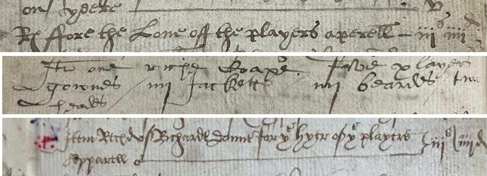
One set of very interesting records are contained within the Tewkesbury parish Churchwardens accounts. This parish purchased costumes for stage plays and visiting companies - the churchwardens accounts record these being purchased and then hired out when required. We’ve not come across other entries like this in other parish records and it was probably because Tewkesbury was a large and relatively well-off parish so it could afford to make these outlays, knowing that as it had a large population, it was a popular place for travelling companies of players to visit and so would probably recoup the money.
The top image, from 1574, reads ‘Reseved ffore the Lone off the players aperell……iijs iiijd’
The middle image, an unpriced entry from July 1576 reads: ‘Item one riche Coape / five players gownes / iiij Iacketts / iiij beardes / twoo heads’ – one can only wonder what the ‘heads’ were!
The bottom image from 1577 records ‘Item Receued of Richarde Donne for ye hyer of ye players Apparell….. iijs iiijd’ (3s 4d – about £36).
Constructing a stage in the Boothhall, Gloucester, 1559
GBR/F4/3
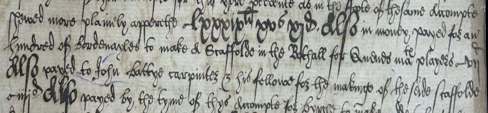
First recorded in 1230, the Boothall on lower Westgate Street and was the centre of civic administration for medieval Gloucester. By the 1300s, an inn – possibly called ‘The Bear’ but later known as ‘The Boothall Inn’– was part of the building. From the mid-1500s the Boothall was used by visiting companies of players and hosted concerts which became regular events until the early 1800s. Because the Boothall was a working building that acted as a court and office space for the Borough, when it was used to put on plays, a stage had to be built. This entry from the Chamberlain’s Accounts for 1559 records that:
‘Also in money payed for a hundred of bordenayles to make a Scaffolde in the Bothall for Quenes maiestes players – id. Also payed to John battye carpenter & he fellow for the making of the seide Scaffolde – iiijd’
In today’s money the nails cost £1.14 while the labour cost £4.58!
Geisters, Gloucester, 1552 & 1554
GBR/F4/3
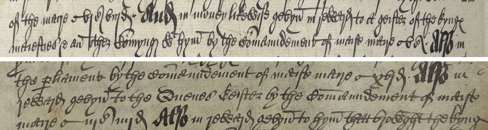
A jester was part of the household of a nobleman or monarch whose purpose was to entertain guests to their court – but these jesters often travelled around the country and entertained common folk at fairs and markets. These two entries in the Borough’s Chamberlains’ Accounts record two such visits to Gloucester;
‘And in money likewise gevyn in reward to a geister of the kynges maiesties & an other Commyng with him by Commaundement of maister maire vs’
‘Also in reward gevyn to the Quenes Geister by the Commaundement of maister maire iiis iiijd’
Companies of players, Gloucester, 1560
GBR/F4/3
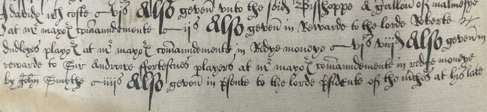
Throughout the 16th century there were frequent visits of companies of players to Gloucester. This entry from the Chamberlains’ Account for 1560 is typical:
‘Also geven in Rewarde to the lorde Roberte dudleyes playores at mr mayores commaundemente in Redye moneye vj s viij d. Also geven in rewarde to Sir Androwe ffortescues players at mr mayores commaundemente in redye moneye by Iohn Smythe iiij s’
Lord Chandos’ ‘poppett players’, Gloucester, 1589

GBR/F4/3
Punch and Judy has its roots in Italian commedia dell'arte of the 1500s – professional comedy theatre, often performed on the streets. Mr Punch comes from the character Pulcinella – anglicised to Punchinello and a variation on the Lord of Misrule/Boy Bishop. Though it took off after the Restoration when art and theatre reemerged after puritan rule, it was present before. This 1589 entry is from Gloucester’s Stewards Accounts shows a payment to a puppet company of Lord Chandos.
‘geven to the Lord Chandos poppett players the xxx of June Vs’
Originally, Punch and friends were marionettes but were reinvented as glove puppets to cope with the violent action without the obstruction of marionette strings. Punch & Judy was originally for adults, but it changed into a children's entertainment in the late Victorian era. One reason for the change was that other original members of the show's cast – the Devil, the Hangman and Punch's mistress ‘Pretty Polly’ – were seen as very inappropriate for young audiences!
Court of Aldermans’ Order Book, Gloucester, 1624
GBR/G3/SO1
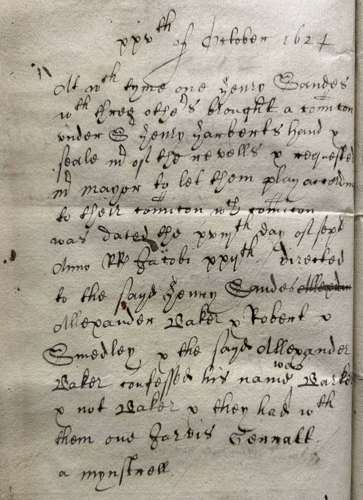
Wandering entertainers had to be wary not to fall foul of the Tudor anti-vagrancy laws – which could see them imprisoned and whipped out of towns. This entry from Gloucester Borough’s Court of Aldermans’ Order Book in 1624 relates to four entertainers who came to the city and had to show their commission from the Crown’s ‘Master of the Revels’ to get permission to perform in the city.
‘At which time one Henry Sandes with three others brought a commission under Sir Henry Harberts hand & seal, Master of the Revels & requested Mr Mayor to let them play according to their commission, which commission was dated the 18th day of September Anno Regni Regis 22nd year of James I directed to the said Henry Sandes, Alexander Baker & Robert Barker – confessed his name was Barker & not Baker - & they had with them one Jarvis Tennatt a minstrel.’
While Jarvis Tennatt was identified as a ‘mynstrell’, the other four men Henry Sandes, Alexander Baker, Robert Barker were probably the actors in the company.
Formal minutes of the Manor and Hundred court of Cheltenham, 1611
D855/M8
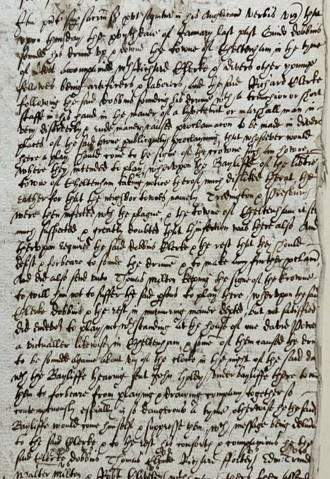
Plays and performances were often curtailed when plague about to prevent its spread. This account from the minutes of the Manor and Hundred court of Cheltenham records that on the 17 January 1611, Guido Dobbins, Richard Clerke and their fellow players marched through Cheltenham banging a drum and proclaiming, ‘that whosoever would heere a play should comme to the sign of crowne’, which was an inn in Charlton Kings. However, as there was plague in Tredington and Prestbury, Cheltenham’s town bailiff stopped them and prohibited the performance. However, when the men later tried to perform their play at The Crowne, they were arrested and subsequently fined by the manorial court.
Diary entry of Rev. Robert Gegg of Ashleworth, November 1763
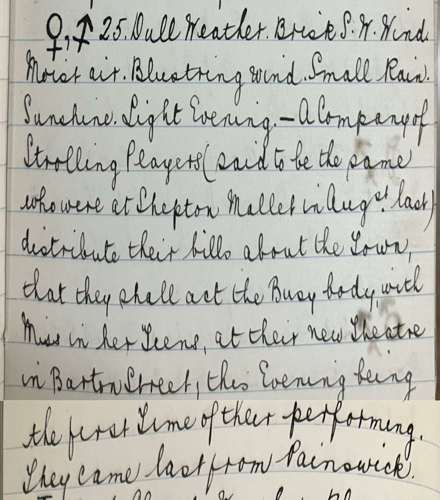
D9125/2/4681
From the 1700s onwards, theatres began to appear in most county towns. In Gloucester, as well as the Tolsey, the Boothall and The Bell, a new theatre – whose name isn’t recorded - opened in a building in Barton Street in 1763. The Rev. Robert Gegg of Ashleworth noted the opening and wrote in his diary about ‘a company of strolling players’ who came to the theatre and were distributing leaflets around the town. They had previously been reported at Shepton Mallet and at Painswick. However just 20 years later in 1784, the theatre manager, Samuel Ryley, described it as 'a melancholy, inconvenient place, which, when filled, would not hold more than thirty-five pounds’.
Theatre Royal playbill, Gloucester, 1802
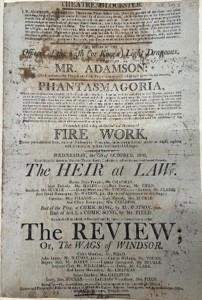
NR29.5
On 7 February 1791, the Gloucester Journal reported "We hear that Mr Watson has made a purchase of a convenient spot in Westgate Street now encumbered with old buildings which are to be taken down and a commodious Theatre is shortly to be erected.“ The man in question was actor and impresario John Boles Watson of Cheltenham and the theatre was Gloucester’s first purpose-built theatre. It was built by John Blinkhorne and opened as the Gloucester New Theatre on 6th June 1791. After Watson died in 1813 there were a series of unsuccessful managements until Blinkhorne bought it in 1857 for £450 at auction. He rebuilt it in the traditional horse-shoe shape redecorating it throughout and renaming it the Theatre Royal. Its most famous visitor was arguably Charles Dickens, who once performed the trial scene from The Pickwick Papers to a capacity audience. This 1802 playbill for the Theatre Royal advertises a ‘Phantasmagoria: this was a form of horror theatre that used magic lanterns to project frightening images – such as skeletons, demons, and ghosts – onto a semi-transparent screen to keep the lantern out of sight. Mobile or portable projectors were used, allowing the projected image to move and change size on the screen, while multiple projecting devices allowed for quick switching of different images. In many Phantasmagoria shows, the use of spooky decoration, total darkness, and sound effects were key elements while other special effects included sensory stimulation, such as smells, smoke and even electric shocks!
Cirencester Theatre playbill, July 1830
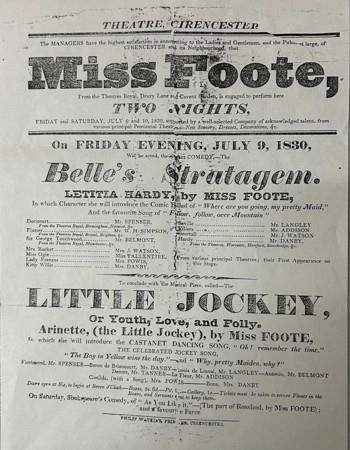
D10820/E1-1/aa courtesy Bingham Trust
Early entertainments in Cirencester were few, probably because the abbey exercised almost tyrannical control over the town. However, by the 1800s a theatre had opened in Gloucester Street – which was run by the impresario John Boles Watson and his family from Cheltenham. Over the years performers ranging from the Siddonses and the Kembles and Charlotte Charke to child stars Master Betty and Miss Fisher and tightrope walker John Richer all appeared. This 1830 playbill features ‘Miss Foote’ – aka Maria Foote (later Countess of Harrington), a prominent English actress (albeit of limited ability) – who was most famous for her sensational 1824 breach-of-promise trial against a wealthy suitor, when she won £3,000 damages!
Kings Hall Picture House, Gloucester
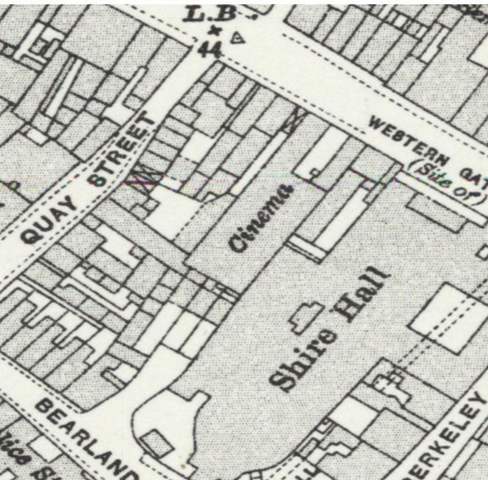
1924 2nd Edition OS map, reproduced with the acknowledgement of the Ordnance Survey
Cinema was called ‘the pictures’ as a shortened version of the phrase "moving pictures“, while early films were also known as ‘the flicks’ because early film projectors had a large advance time between frames making the screen appear to flicker. In 1907 The King’s Theatre & Opera House (the old Boothall) got a new lease of life as it was converted into a cinema being renamed The King's Hall Picture House. In this guise it presented ‘cine-variety’ until it closed in 1914. ‘Cine variety’ was a form of entertainment between 1900-1930 which combined live stage acts and the screening of silent or early talkies for a single admission price - the acts included comedy routines, acrobats, singers, entertainers and magicians and very often stars of film, radio, or variety theatre would be among the cast. This cinema reopened in 1918 being known as The King's Picture House showing mostly films but also the occasional variety show. By 1922, it had been taken over by the Cheltenham Original Brewery Company. It ceased to be a cinema in the 1930s and remained empty for some time until finally being demolished to make way for an extension to Shire Hall.
Palmer’s Picturedrome, Gloucester, 1923
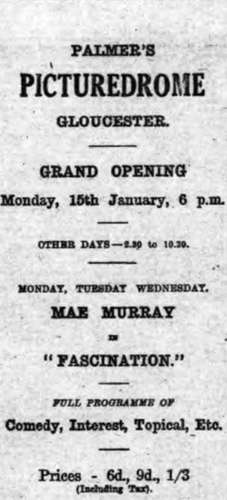
Gloucester Citizen, January 1923
Situated on Barton Street this cinema was opened in January 1923, for E. C. J. Palmer aka ‘Picturedrome Palmer’ of the Gloucester Cinema Company. The Theatre had seating for 700 people on two levels when it first opened, it had stalls and one circle. It has a long history that in many ways is typical of the fate of most cinemas and theatre houses. By 1934 it was operated by Cinema House Ltd and had been renamed The Picturedrome. Ten years later, in 1943, it was bought by Associated British Cinemas (ABC) and underwent modernisation – which included fitting of new projection equipment for screening CinemaScope films. In May 1955 it was re-named The Ritz Cinema, but when ABC opened their new Regal Cinema in King’s Square in March 1956, The Ritz went over to playing mainly re-runs of ABC releases. In April 1961 ABC closed it – but when the Gaumont Cinema in the city closed two weeks later, the city council persuaded ABC to re-open it. Business was initially good but soon tailed off and in March 1962, it closed for a final time. It then became a bingo venue but in 1986 was purchased by the Gloucester Operatic & Dramatic Society who reopened as a theatre venue. Since then, it has undergone a series of ‘yo-yo’ openings and is currently closed.
Programme advert for The Daffodil, Cheltenham, June 1938
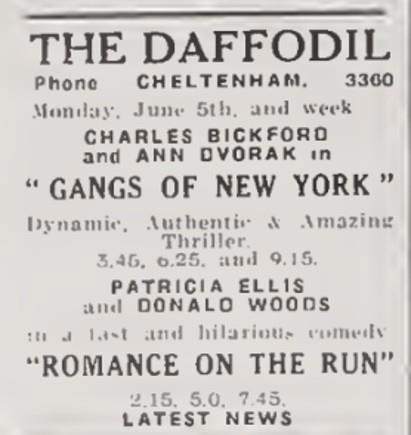
Cheltenham Chronicle & Gloucestershire Graphic, June 1938
Designed by local architect Leonard William Barnard, the Art Deco building opened in October 1922 as Cheltenham's first purpose-built cinema. It seated 750 patrons – including 'kissing seats' designed for courting couples. The cinema screened its last film in 1963 and over the next few decades, was a bingo hall, a furniture showroom, an antiques store and from 1988 a posh restaurant – using the original name. However, the latter closed permanently in 2023 and today it is being converted into four residential homes. The film on the programme, Gangs of New York is a crime drama film starring Charles Bickford, Ann Dvorak, and Alan Baxter. Directed by James Cruze it was released on May 23, 1938, and was notable because Bickford undertook a dual role, playing a mob boss and an undercover police officer who takes his place.
The Picture House, Stroud, 1926
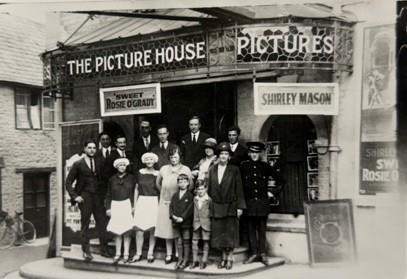
D9746/2/96/21
The Picture House in Stroud opened in August 1914 – it was converted from The George Hotel, and it was just one of 5 cinemas that were once in Stroud! It was a small cinema, with a cafe for its patrons, but it was equipped with an organ of unknown make. It was later taken over by the Albany Ward Circuit, an early 20th-century chain of 29 film theatres across the south-west of England, operated by the pioneer Albany Ward. By 1914, his chain was the largest cinema network in England, with a head office located in Salisbury. The Picture House remained under its control until 1927 when, with the rest of the circuit, Albany Ward sold the entire chain to Provincial Cinematograph Theatres (PCT), which itself was taken over by Gaumont British Theatres (GB) in February 1929. At this time, The Picture House was still a silent cinema but in 1932 it closed for a rebuild, during which time film and sound projection equipment was installed. It reopened in 1934 but by this time the larger Gaumont Palace was being built. When the latter opened, the writing was on the wall for the smaller cinema and it closed, being demolished and replaced by shops. The advert for the feature film seen here, ‘Sweet Rosie O’Grady’ was a 1926 American silent comedy drama film starring Shirley Mason that was directed by Frank R. Strayer from a screenplay by Harry O. Hoyt. With no prints of Sweet Rosie O'Grady located in any film archives, it is a lost film.
The Popular Corinium Picturedrome programme, May 1912
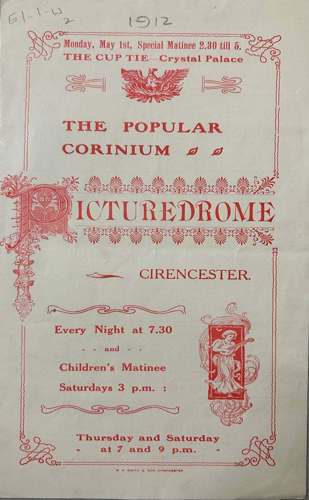
D10820/E1-1-w courtesy Bingham Trust
The Popular Corinium Picturedrome was one of the town's pioneering early cinemas, officially opening its doors in 1911. As well as films, it provided local entertainment featuring early dramatic readings, stage presentations, and the revolutionary moving picture shows of the era. As this programme shows, it also showed football matches – in this instance a recording of the 1912 Cup Final! This was played between Barnsley and West Bromwich Albion at Crystal Palace on 20th April. However, this was a nil-nil draw and so the game was replayed at Bramhall Lane in Sheffield on 24th April when Barnsley won 1-nil!
Seating plan, The Picture House, Cirencester, 1913
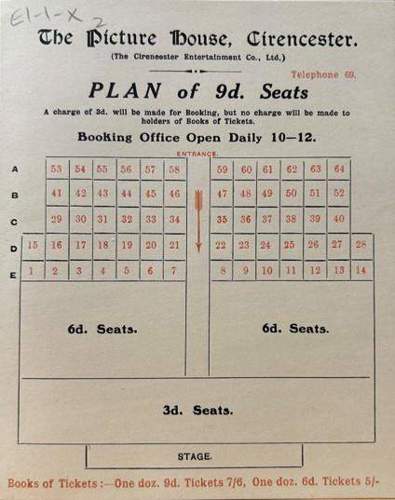
D10820/E1-1-x courtesy Bingham Trust
This shows the seating plan of The Popular Corinium Picturedrome in Cirencester after it had been renamed The Picture House cinema. The price of the numbered seats cost 9d (about £3 today) – while the other stalls seating cost 6d (£1.95) and 3d (98p) respectively. Interestingly all seats were subject to a 3d booking surcharge….rather like online ticket sites today!
The Electric Picture House, Wotton-Under-Edge, 1947
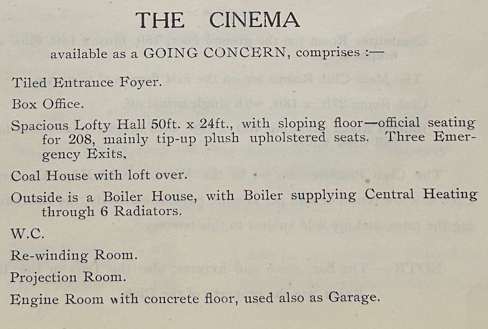
D1405/4/392
The Electric Picture House in Wotton-Under-Edge began life in 1911 as an upstairs room of the delicensed Crown Inn. Initially it showed only silent films but by 1920, demand had outstripped its capacity so in 1921, a new auditorium was constructed following the demolishing of old stables which allowed an increase in seating so that it could hold 220 people. In 1930 it installed sound equipment – notably before cinemas in Dursley and Thornbury. In 1947 the owners Mr & Mrs. Coe put the cinema on the market, and it was sold the cinema to Mr. C. M. Jenner, a retired farmer, who continued to run it with his daughter and son-in-law for over a decade. In 1960, it closed and although it briefly reopened, it couldn’t be made to pay and so it became a boxing club with the auditorium repurposed for bingo. However, after some yo-yoing regarding opening and closing, it eventually reopened as a cinema in 2005 and remains a cinema today.
Projection equipment & electrical plant, The Electric Picture House, Wotton-Under-Edge, 1947
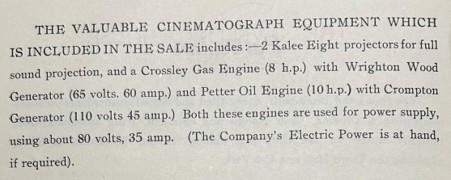
D1405/4/392
When The Electric Picture House cinema was put up on the market in 1947, a set of sales particulars were created by the sales agents, Davis, Champion and Payne of Stroud. As well as its public spaces, these sales particulars also provided details of the projection set-up and the electrical generating plant equipment. The cinema had two Kalee Eight projectors which were 35mm cinema film projectors manufactured by Kalee Limited during the late 1920s and 1930s. They became an iconic piece of British projection history that were widely used in local cinemas across the UK. The cinema’s electrical plant consisted of one 8hp Crossley Gas engine and one 10hp Petter oil engine, powering Wrighton Wood and Crompton electric generators.