
St. John Ambulance Association Gloucester
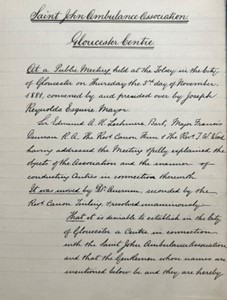
GBR/box 10266/1901C
Gloucester’s St. John’s Ambulance Association was established on 3rd November 1881. It formed after a public meeting at The Tolsey that was convened by the Mayor, Joseph Reynolds. The main resolution stated, “That it is desirable to establish in the City of Gloucester a Centre in connection with the Saint John Ambulance Association.” It elected a committee of 10 to run the centre under the auspices of the St. John’s Ambulance Association and appointed a President, Chairman, Treasurer and secretary.
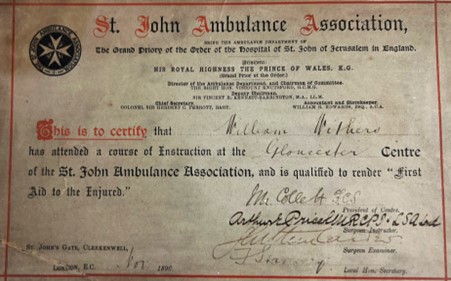
St. John Ambulance Association First Aid Certificate for William Withers, 1896
D4548/2
Just like today, the St John’s Ambulance Association ran training courses to teach people first aid. This first aid certificate was issued to William Withers by the Gloucester St. John's Ambulance Association in 1896.
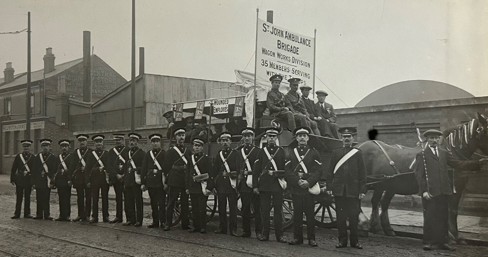
Gloucester Railway Carriage & Wagon Company’s St John Ambulance Brigade, 1914
D4791/17/3
Many local companies had St John Ambulance Brigade units in their strength. This photograph shows the Wagon Works Division of the St John Ambulance Brigade on a recruiting procession for war munitions workers on 2 October 1915. Of interest is the banner on the wagon which proudly states that 35 members of the wagon works unit were already ‘serving with the troops’.
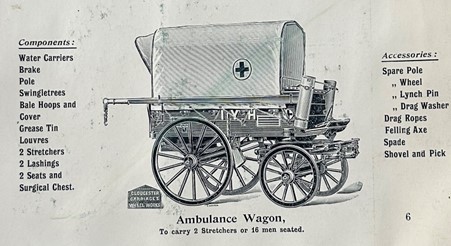
Gloucester Railway Carriage & Wagon Company Ambulance Wagon, 1900
D4791/49/3
The Gloucester Railway Carriage and Wagon Company built ambulances for military and civilian use alongside their other horse-drawn wagons. This ambulance is taken from their 1900 catalogue and was one of three in the company’s products.
Gloucester Railway Carriage & Wagon Company Ambulances, George Street, Gloucester, 1900
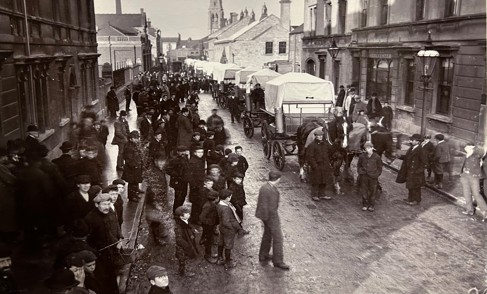
D4791/17/2
In the Second Boer War, mounting British army casualties forced the government to place an order with the Gloucester Railway Carriage & Wagon Company for a number of the company’s ambulance wagons. This photograph taken in 1900, shows a column of new ambulance wagons travelling through George Street in Gloucester probably heading to the railway station. The company maintained a showroom on the street (which was later demolished and replaced by a newer building, which today survives as the architects Robert Limbricks) and it seems likely that these ambulances passed it on their way from the company’s Southgate Street factory. It is also possible that there was a temporary Voluntary Aid Detachment hospital in the building on the right (this building still survives and is currently occupied by the Gap Personnel recruitment agency).
Motor-ambulance cars, Cirencester 1914
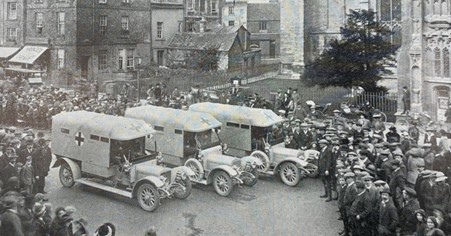
Cheltenham Chronicle & Gloucestershire Graphic November 1914
The outbreak of WW1 saw the introduction of motor-ambulance cars, although these were only initially used in Britain as the Army command distrusted them – primarily because they were uncertain of their reliability – and initially the bulk of army ambulance services on the frontline were so wounded soldiers overseas had to endure horse-drawn ambulance wagon journeys. At home however, fundraising from donations and public subscription provided many motor ambulances – such as these new vehicles seen in Cirencester in 1914.
Minchinhampton Fire Brigade, c1900
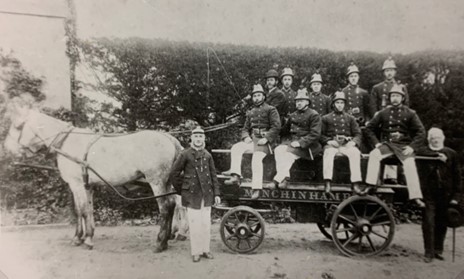
D9746/1/2/91
Prior to the 1600s, firefighting was generally based on the local community, where ‘public-spirited citizens’ would be alerted to a fire by muffled peals on the church bells. These volunteers would congregate hastily to fight the fire, using whatever equipment was available ladders, leather buckets, axes, and ‘firehooks’ for pulling down buildings (usually the most effective method). Most towns organised their own fire brigades by the 1800s – this is the Minchinhampton Fire Brigade with their fire engine. As early as 1755, Minchinhampton purchased a fire-engine by public subscription and built a house for it. A committee maintained the engine and in 1831 a new engine-house was built – but it was still worked by volunteers until 1864, when a fire brigade was created.
Minchinhampton Fire Brigade scale of charges, July 1913
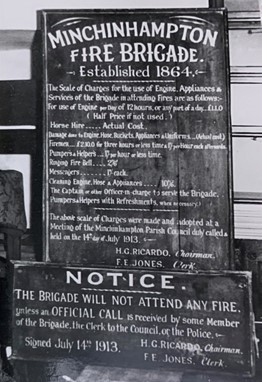
D9746/1/2/90
Like other towns, the Minchinhampton Brigade imposed charges for use of the engine. This fascinating notice board shows the scale of charges in 1913:
Use of engine per day for 12 hours: £1 1s 0d - this is about £100 today, but interestingly it doesn't include horses to pull it!
Firemen for 3 hours: £2 10s 0d (around £250 per 3 hrs today)
Pumpers & Helpers: 1s per hour
Ringing the Fire Bell: 2s 6d
Interestingly it also states that ‘The Captain or other officer-in-charge’ were ‘to serve the Brigade, Pumpers and helpers with Refreshments (where necessary).’
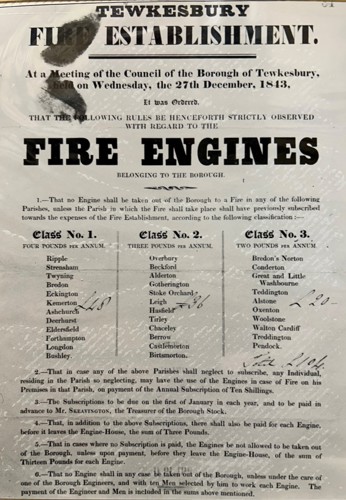
Tewkesbury Fire Establishment Rules, 27 December 1843
D13386
Most town fire brigades had rigid rules for the use of their fire engines. These are the rules in force for Tewkesbury Borough Council’s fire engines in 1843. The main rule was that fire engines could only fight a fire if the parish to which it was going had subscribed – a side effect of this was that it created a local hierarchy that rated certain places above others – here, Twyning was classed above Gotherington which in turn was classed as higher than Conderton! These classes were probably based on the number of buildings and dwellings in each parish. In 1843, a Class No.1 parish was required to pay £48 per annum, a Class No.2 £36 and a Class No.3 £20. All told these fire subscriptions brought in a total of £104 to the borough – around £8,300 today. In addition, each call out was charged at £3 per engine – about £240 today. The rules also give some insight into how the brigade worked, as each engine was dispatched under the guidance of a Borough Engineer and 10 firemen.
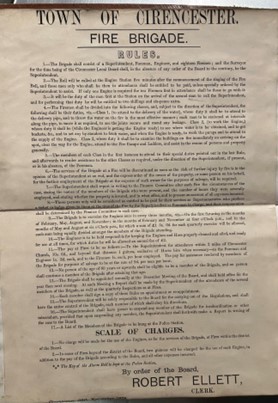
Cirencester Fire Brigade Rules, 1878
DA4/212
The rules for the Cirencester Fire Brigade show other aspects of working – firstly the brigade comprised a Superintendent, Foreman, Engineer and 18 firemen. When the alarm had been raised, the roll was called 5 minutes later and only men who were present were paid (1s per hour). The first man to arrive would – on the arrival of a second man – call the superintendent….receiving a 2s 6d bonus (£8 today) for doing so! The firemen were also divided into the following classes:
Class 1: these could deliver water (i.e. use the hoses), move the hoses, and check the hose joints.
Class 2: These could work the engine and seek out any available water supplies.
Class 3: These would clear the way for the movement of the engine, check buildings, organise by-standers, erect ladders and rescue people.
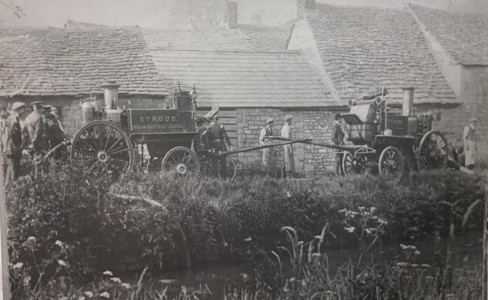
Stroud UDC fire-engines on a training exercise, c1900
D9746/1/2/175
A major advance in firefighting came with the introduction of the steam-powered fire pump in 1829. These horse-drawn vehicles used an onboard steam-engine which powered a water pump. Steam for the pump could be raised to working pressure from cold water in around 10 minutes, which was usually done while the engine was travelling to the fire. Coal for the boiler was kept in a bunker below the front axle. This picture shows two of Stroud Urban District Council’s Merryweather & Sons horse-drawn double-vertical boiler fire appliances on a training exercise at Matthew Grist’s Merrets Mill in Inchbrook (bottom). The only water these appliances had was for the engine’s boiler to power the pump and so for water to fight a fire, they had to use an alternate water source, such as a hydrant, pond or stream – hoses leading to an adjacent pond can be seen here. The hose end had a filter to ensure that debris, frogs and fish didn’t reach the pump. If the water supply for the boiler ran out this would also be taken from the water source.
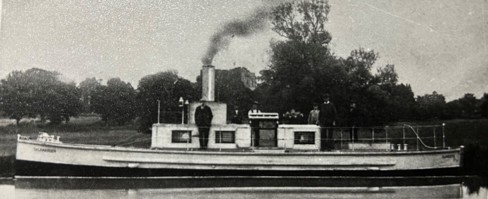
Fire Float Salamander, 1906
D9746/2/355/1
With ships bringing wood from the Baltic and Canada to Gloucester, the banks of the canal to the south of the city were a vast timber yard. Add in the dock warehouses, many of which were full of cereals and/or flour – which could spontaneously combust – and the docks were a major fire hazard. As a precaution, in 1906 the Gloucester City fire brigade took delivery of the fire float Salamander, which was funded by local merchants (through the Chamber of Commerce), the Dock Company and the Gloucester Corporation. Built by local shipbuilders Abdella and Mitchell at Brimscombe and fitted with fire pumps by Merryweather & Sons of London, the Salamander was a state-of-the-art vessel. She was fitted with water pump-jets for propulsion and carried enough hoses to enable her to fight fires up to ½ mile (800m) from the canal! Her first major firefighting incident took place not long after her commissioning, when she fought three fires in one night after an arsonist set fires in Nick’s Timber, then Joseph Griggs’ timber yard and finally Price Walker’s yard. All the fires were eventually extinguished and the Gloucester Journal newspaper reported “The fire float shook and shuddered with her tremendous exertions and tongues of fire shot three or four feet out from her funnel.” Police investigating the fires later arrested an employee of one of the yards, who admitted he'd started the blazes as he wanted to see Salamander in action – he was subsequently sentenced to six months in prison and on release was provided with an assisted passage to Canada. Salamander remained in operation as the dock’s fire float until 1955, when she was sold.
Gloucester City Police Station & City Gaol, 1844
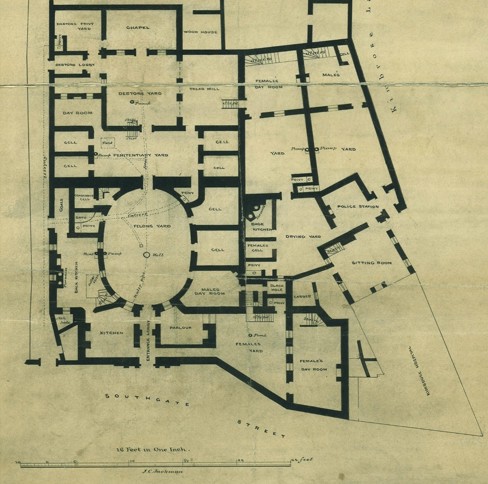
GBR/G3/AG1 1844
Arguably, watchmen were the first police force – in Gloucester they are known from 1295 when the borough appointed watchmen and gave them powers to arrest and detain strangers they encountered at night. The borough also appointed serjeants-at-mace and bellmen to keep law and order, and these were supported by a body of constables – by 1690 there were two constables each in the east and south wards of the city and four each in the west and north wards. While the constables patrolled in the day, the watchmen would patrol between the hours of 9 pm to 6 am. From 1769 one of the serjeants-at-mace became high constable, effectively the head of the city police. Little changed until 1836, when a full-time uniformed police force was formed by the borough watch committee under the 1835 Municipal Corporations Act. This force comprised a Superintendent, 3 Sergeants and 12 constables. Corporation officers and four watchmen of the Gloucester & Berkeley Canal Company were also sworn in as constables to enable them to assist if required. One of the sergeants lived at the city lock-up in the City Gaol on Southgate Street which subsequently became the police station.
Officers at Northleach Police Station 1860
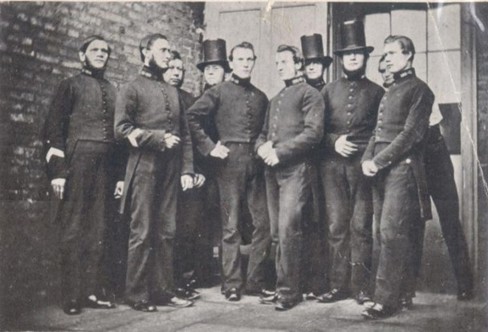
Gloucestershire Police Archive URN 11
By 1836, police forces had been established in Cheltenham, Tewkesbury, Dursley, Winchcombe and Stow-on-the-Wold. On 27 August 1839, the County Police Act was passed by Parliament, which allowed Justices of the Peace to establish police forces in their counties, paid for out of the rates. Following this, at a meeting of the County Quarter Sessions on 15 October 1839 it was proposed that the Act should be adopted for Gloucestershire. The Clerk of the Peace was then given instructions to raise a force of 250 men, and at one o’clock on Tuesday 15 October 1839 Gloucestershire Constabulary come into being – just before the Wiltshire force, making the Gloucestershire Police the oldest county force in the UK.
PC Stafford & Family outside Withington Police Station, 1906
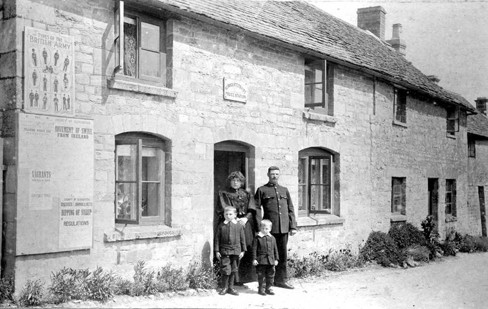
Q/Y/6/2/4
Many police officers lived with their families at their country stations. This is P.C. Stafford with his family standing in doorway of Withington police station in 1906. Note the notice board on the left, promoting Dipping of Sheep, Movement of Swine from Ireland and Vagrancy regulations. A recruiting advert for the Army is above the notice board
Issue of horse shoes to Stroud Division, June 1910
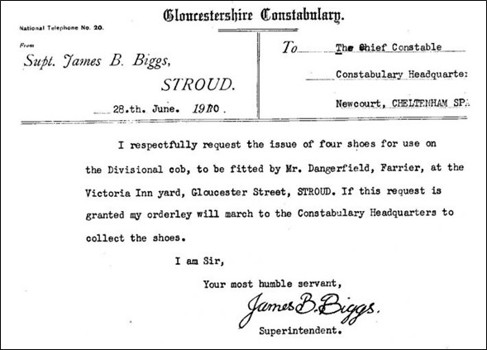
Gloucestershire Police Archives URN 61
The Bow Street Horse Patrol, founded in 1763, are the oldest police force in the world and merged with the Metropolitan Police in 1836. Gloucestershire Police have probably been using horses since the force’s inception in the 1840s. Horses however need a lot of maintenance – this is a request for the issue of horseshoes for Stroud’s ‘Divisional cob’!
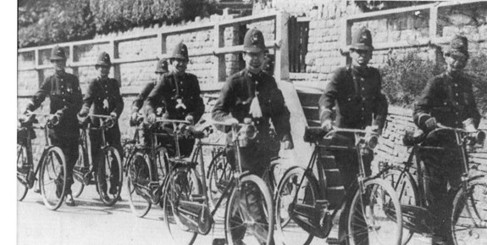
Bicycle Mounted Police Officers, c1920
Gloucestershire Police Archives URN 1570
Bicycles came into policing in the 1870s with the introduction of ‘safety bicycles’. They enabled policemen to patrol larger areas, especially in towns and cities. As they had to be able to be used at night the bicycles in this photograph have oil lamps. They are also fitted with a small rear-mounted saddle bag. After a period of neglect, bikes have come back into vogue with the police thanks to their manoeuvrability on crowded pavements and their ability to navigate narrow gaps in congested roads
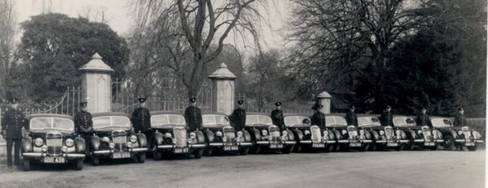
Cheltenham Division Patrol Cars, c1946/7
Gloucestershire Police Archives URN 178
On 15 October 1912, the Chief Constable of Gloucestershire asked the Standing Joint Committee for permission for the Superintendent at Northleach to use a car instead of a horse & carriage. Initially police cars were used only by senior offices but gradually they became an integral part of policing. This picture shows the fleet of Riley patrol cars at Pittville Park in Cheltenham with their drivers in 1946/7.
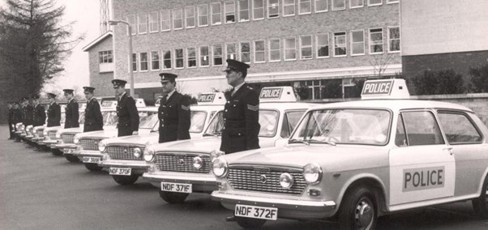
Panda Cars, Cheltenham Division 1968
Gloucestershire Police Archives URN 226
The ‘panda car’ refers to small, economical cars often featuring a distinctive black and white livery, that were used for neighbourhood or area policing duties from the 1960s. The name originated because these vehicles, particularly in their early iterations, resembled the giant panda with their black and white body and door markings – though light blue soon replaced black paint. This photograph shows Cheltenham Police Division’s first 'Pandas' outside Talbot House, Cheltenham in 1968.
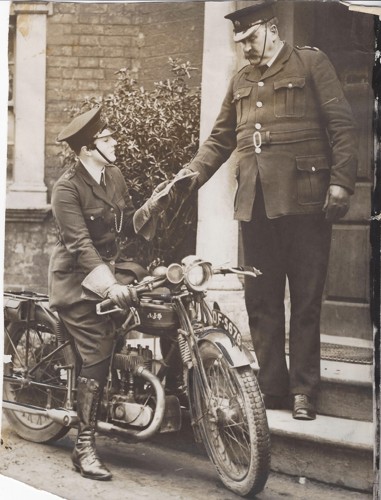
WPC Gray on motorbike, Lydney 1929
Gloucestershire Police Archives URN 9895
Motorbikes were first used in the early 1920s. This photograph shows Woman Police Constable Janet Gray on her motorcycle receiving instructions from Superintendent Shellswell at Lydney Police Station 1929.
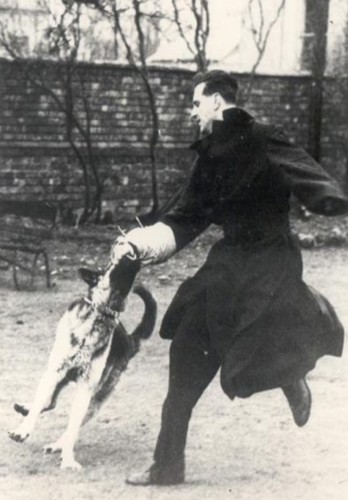
Constable Deacon and police dog, 1959
Gloucestershire Police Archives URN 176
Gloucestershire Constabulary introduced the first dog unit and dog handlers in 1959. When it formed, the unit consisted of eight dog handlers and a Sergeant-in-charge. This photograph shows Constable Deacon with an unknown police dog in training. The dog may possibly be ‘Prince’, Gloucestershire Constabulary’s first police dog.
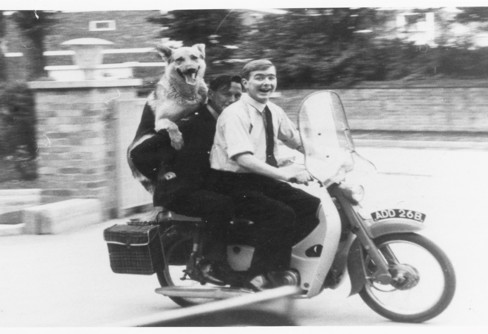
Two police men and a police dog riding on a motorbike
Q/Y/2/27/2/12
Don’t even ask about how many laws are being broken here! It’s clearly a non-rulebook way of transporting a police dog! The motorbike here is not a Police machine and it is thought to have belonged to the officer driving it. One or both the men may be dog handlers - they are both in uniform. They are all smiling for the camera, dog included, and appear to be on a driveway.