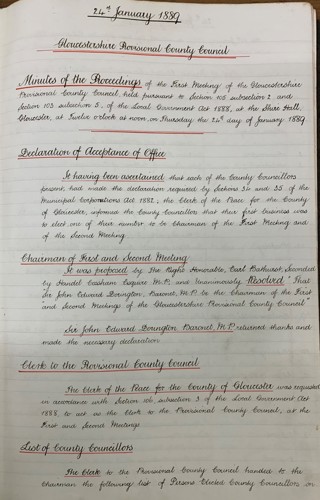
Provisional County Council, 24 January 1889
Gloucestershire’s Provisional County Council first met on 24 January 1889. It consisted of 62 councillors, who’d been elected, and the first item of business was the ‘Declaration of acceptance of Office’ to serve as County Councillors and County Aldermen. It was followed by the election of a temporary Chairman. The Quarter Sessions’ Clerk of the Peace was then requested to serve as a temporary Clerk to the Council. Next on the list were councillors’ expenses! It was to be another two months before the County Council officially formed on 1 April 1889.
Gloucestershire Archives reference GCC/COU/1/1/1
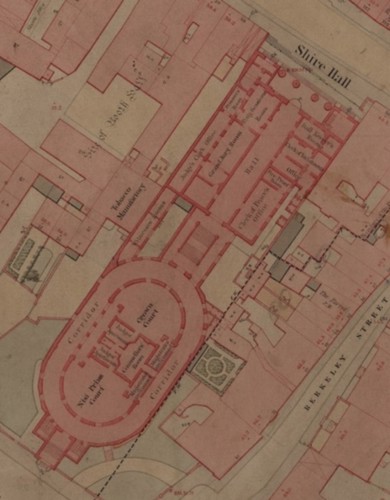
Board of Health 1852 map - Shire Hall
A council needed somewhere to meet and to run its business! The answer was Shire Hall, which was built in 1815 as a new court complex for the Quarter Sessions and Assizes. Designed by Robert Smirke (famous for the British Museum), the frontage consisted of a tall Ionic portico said to be inspired by the temple on the river Ilissus in Greece. In 1889, after the formation of the Provisional County Council, it was agreed that it should became the County Hall though no-one changed the name! The original building included a grand jury room, two courtrooms, the office of the clerk of the peace and a large public room which was used for concerts in the Three Choirs festival – which were initially used by the council.
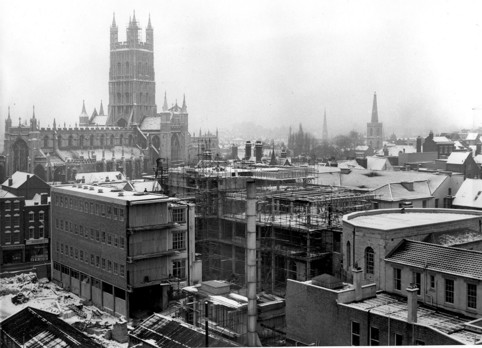
Rebuilding of Shire Hall complex, 1962
In 1896, the front part of the building was altered internally to create a council chamber, where the elected councillors could meet and at the same time, new offices for the clerk of the council, county treasurer, and county surveyor were created. In 1961-2, the council had expanded to the point where it had outgrown the existing building and so a major rebuild took place. The whole front of the building was rebuilt (except for the portico), and the entire complex enlarged by the addition of office blocks on the west and south sides, the latter extending over Bearland to connect to another new block – which also incorporated the county police headquarters. This picture is a snapshot of this transformation showing a view across the new blocks, looking towards the Cathedral. It was taken on 28 December 1962 by Dormar Productions Ltd for Messrs. Terson Ltd (the council contractors) via Alan Russell, architect.
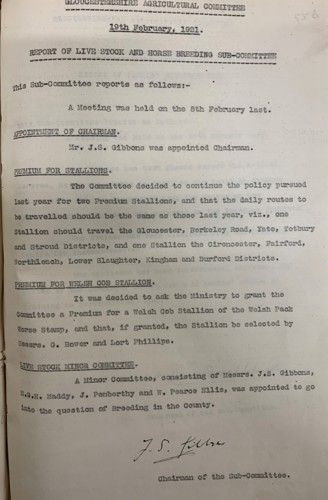
Agricultural Committee Minutes, 19 February 1921
Comprised of 51 members – 17 appointed by the Ministry of Agriculture – the remit of the agricultural committee was broad. It included animal diseases, destructive insects and pests, destruction of rats & mice, fertilisers and feed stuffs, land drainage, small holdings & allotments, milk & diary, animal pharmacy and poisons, and livestock and horse breeding. To oversee these, as well as the main executive committee, several sub committees were formed, including the Live stock & Horse Breeding Sub-Committee (seen here), the Diseases of Animals Sub-Committee, the Urban Pest Sub-Committee, the Rats and Mice Destruction Sub-Committee and several more. Much of its work was responding to notices and orders from the Ministry of Agriculture such as routine animal inspections for animal diseases (notably swine fever, sheep scab and cattle tuberculosis), transfer of infected animals, regulations concerning the sale of milk; milk regulations, reports and actions about sheep dipping, veterinary inspectors' fees, and oddities such as the American Gooseberry Mildew Order, 1907.
Gloucestershire Archives reference GCC/ENV/3/3/1
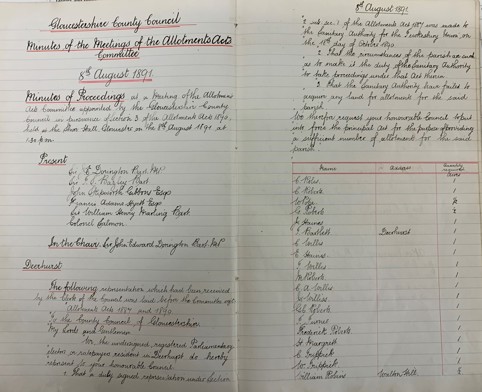
Allotments Acts Committee Minutes, 8 August 1891
The Allotments Act Committee first met in August 1891 and had less than 10 members. The main role of the committee was – under the Allotments Act 1890 – to investigate Urban or Rural Sanitary Districts if they failed to provide smallholdings and allotments, hold inquiries into the reasons and if required, force the sanitary district (and their successors, the Urban and Rural District Councils) to provide them. They also ensured that the letting rates of smallholdings and allotments were set at no more than that for local farmland.
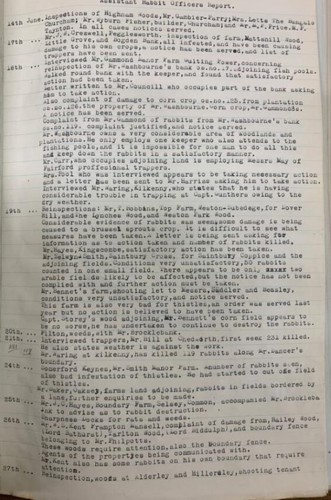
Assistant Rabbit Officers Report, June 1943
One of the most important sub-committees on the Agricultural Committee – especially during wartime – was the Rats, Rabbits & Weeds (Destruction) Sub-Committee. It appointed four main officers, comprising a County Pests Officer, a County Rats Rabbits & Weeds (Destruction) Officer, a County Rabbit Officer and an Assistant Rabbit Officer. It also hired various gamekeepers when required and its remit was to try to control the numbers of ‘vermin’ – especially rats, rabbits and a little later, Grey Squirrels. One of the tasks of the Assistant Rabbit Officer produced were regular reports on farm inspections – such as this one – infestation notices served and ongoing rabbit infestations around the county. Rabbit trappers were employed at £2 10s (1941) a week (£148 today) and were required to use snares, traps and ferrets rather than shooting. Typical bounty was 3d a rabbit (80 rabbits for £1) and numbers killed were upwards of 100-250 a week.
Architect's drawing showing proposed enlargement of St. Lawrence’s County Primary, n.d. [1873];
The Education Committee was the second biggest spender in the County Council; in 1938 its expenditure was £650,000; today as part of the Children and Families Directorate it is £177.9 million. It had 60 members – 40 councillors and 20 others representing educational bodies, voluntary schools and other education specialists. Except for matters relating to closing schools, new school buildings, land purchase and appointment of members, the committee delegated all its duties to nine education sub committees, comprising: Agricultural education, Finance, Higher education, Juvenile unemployment, College of Domestic Science, elementary school management, County library, School attendance and Buildings. As a guide, in 1903 there were 52,870 children who had an average attendance of 82.5%. One of the main committee’s tasks was planning, funding and building new or replacement schools or, extensions to schools to increase capacity. These drawings show proposed alterations to St. Lawrence’s County Primary, needed because the old school building was too small.
![Architect's drawing showing proposed enlargement of St. Lawrence’s County Primary, n.d. [1873];](/media/1cmnrpoo/sm197-v1-st-lawrence-county-primary-school-plan.jpg?rmode=max&width=482&height=316)
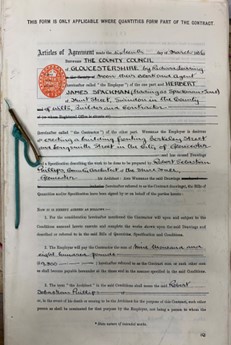
Contract with Spackman & Sons for a new county library and office, Gloucester, March 1936
Public libraries – as opposed to subscription libraries and village reading rooms – only began to appear in after the Public Libraries Act of 1850. However, few were created because many of the upper class thought educating the lower classes was a bad thing as it would only increase political awareness and increase social agitation! Despite this opposition, more and more libraries began to appear, primarily because the government knew that Britain as falling behind in education provision compared to Europe and so gradually promoted the idea of education for all. Subsequently the Public Libraries Act 1919 enabled County Councils to become library authorities so the Education Committee drew up the Rural Library Scheme, establishing a Central Library based in Shire Hall in Gloucester from which books would be distributed to towns and villages in the county. Over time, the council acquired other pre-existing libraries – Stroud Public Library in 1930 – but also built new libraries. This is the contract with Spackman & Sons for a new county library and offices that was built on the corner of Berkeley Street and Longsmith Street in March 1936. It was later demolished to make way for the new Telephone Exchange and so the library moved to a new home in Brunswick Road, where it has remained.
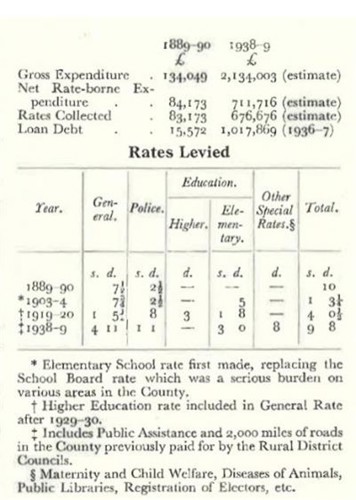
Finance Committee Table of Rates levied, 1889/90 and 1938/9
The Finance Committee was considered the most important of the Council although it only consisted of 22 members. Its main duties were to raise rates, collect revenues, borrow of money and levy precepts and to advise elected members and other committees on financial aspects of proposals submitted to the council. The county council’s first return of expenditure for the year 1889-90 was £134,049, while today it is £609.6 million!
County Valuation Committee Minutes 1889-1906
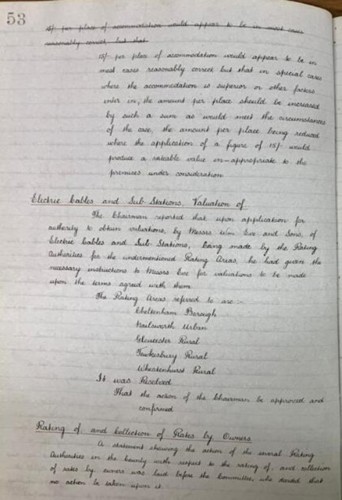
Inextricably linked to the Finance Committee was the County Valuation Committee, who assessed properties to determine what rateable values they should be given. As well as homes, industrial settings and commercial properties, they looked at woodlands, market gardens, schools; fisheries; farms; railways; voluntary hospitals; village halls & parish rooms; sewers and sewage disposal works; electric cables and sub-stations; playing fields; coal mines, Police stations, docks and canals, etc, etc.
Highways and General Purposes Committee minutes, 30 June 1894
With a committee made up of 55 members, the Highways Committee was the largest spender in the County Council. Even in 1889-90 its initial expenditure was £48,025 – 36% of the council’s budget. It typically met with the General Purposes Committee, probably because so much of its business impinged on other council committees. In 1889 there were around 900 miles of main roads in the county administered by no fewer than 66 authorities (23 being local Highways Boards) with the largest district having 63 miles and the smallest just ¼-mile! When the council formed it took over control of roads, bridges, culverts, private streets, roadside ribbon development, pavements, footpaths, telephone poles, adverts, regulations and petrol station by-laws.
Gloucestershire Archives reference GCC/ENV/1/1/3
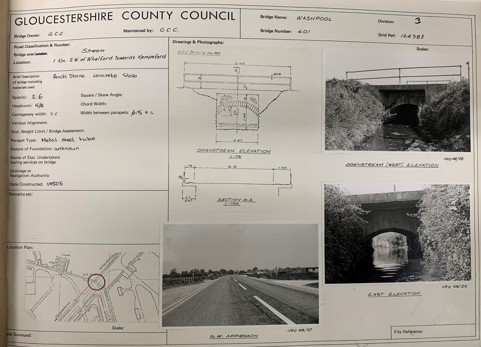
Cotswold Division bridge register 401-800, c.1980-1990
Between 1980-1990, the Highways Committee created registers of all the county’s road and rail bridges with technical data, details of repairs needed and carried out, drawings and photographs. This is the entry for Bridge 401, Washpool Bridge, near Whelford – a county-owned bridge. They are invaluable sources of data re bridges….if you’re interested in them!
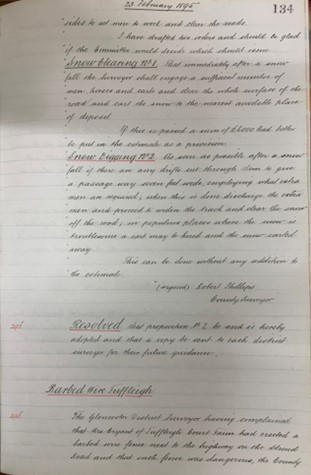
Highways and General Purposes Committee minutes, 23 February 1895
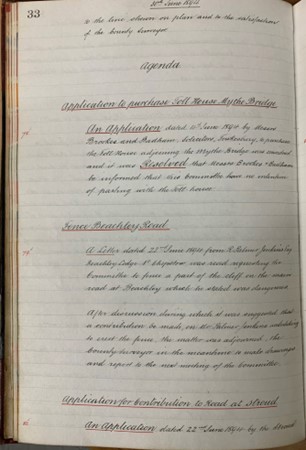
Like today, the Highways & General Purposes Committee was responsible for road clearing after snow and in February 1895, the committee considered two options proposed by the County Surveyor. ‘Snow Clearing No.1’ – after heavy snowfall, the County Surveyor would ‘engage sufficient numbers of men, horses and carts and clear the surface of the road’ and a provision of £6000 was to be made available to cover the expense. ‘Snow Digging No.2’ – here, only drifts that blocked roads would be cleared ‘to give a passage way seven feet wide, employing what extra men are required and when this is done to discharge them and widen the track and clear the snow off the road’ and no extra money was required. We can all guess which one the council decided upon…Option 2!
Gloucestershire Archives reference GCC/ENV/1/1/3
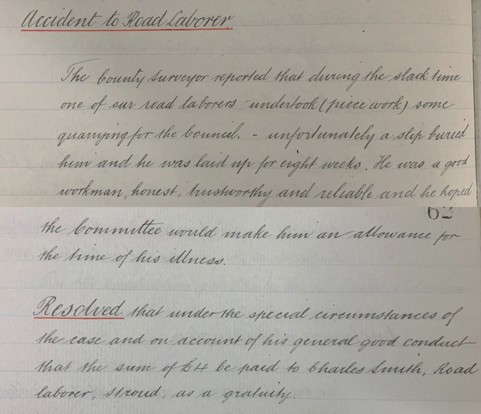
Accident to Road Labourer, Highways and General Purposes Committee minutes, September 1894
On occasion the Committee discussed accidents at work. In September 1894, Charles Smith, a piece-work road worker suffered a quarry accident when a landslip buried him, causing injuries that took him 8 weeks to recover from. Obviously worried he’d lose his job, Smith wrote to the council while recuperating asking if they would make allowance for his time off! The County Surveyor noted he showed ‘general good conduct’ and ‘due to the special circumstances of the case’ the council agreed and paid him £4 as a gratuity.
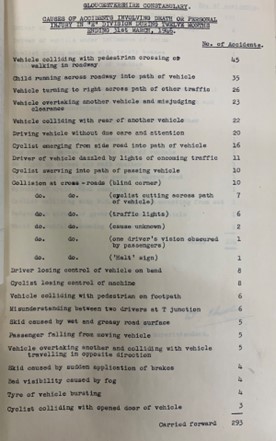
County Road Safety Committee minutes – Causes of Accidents causing death or personal injury in ‘E’ Division, during twelve months, year ending 31 March 1946
The Road Safety Committee was formed in 1946 with three members of each of the following committees: highways, education and standing joint. Its routine business included: business relating to national discussions, circulars and acts; road accident statistics; expenditure; Road Safety Organiser's reports and minutes of local road safety committees. Annual road accident statistics were received from the Police, this being April 1945 to March 1946, which had a total of 293 road accidents. It had seven local Road Safety Sub-Committees for the county districts - Cirencester & Tetbury; Forest of Dean; Cheltenham rural (later Cheltenham rural, Tewkesbury & Charlton Kings); Gloucester & Newent rural; North Cotswold; Stroud & Dursley and Thornbury, Sodbury & Warmley.
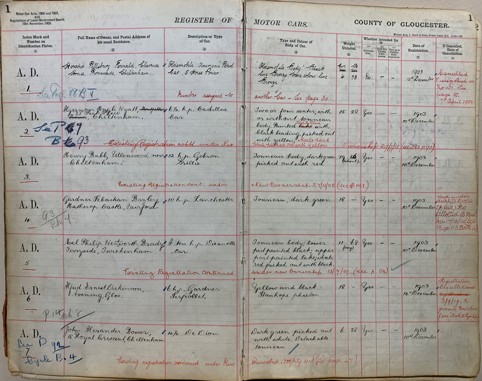
Register of vehicles under 3 tons: December 1903 - May 1908: Numbers to AD 1132
The task of issuing local taxation licences and collecting revenues arising from them was transferred to the council under the Finance Act 1908. The Motor Car Act of 1903 signified the beginning of vehicle registration for all vehicles other than heavy locomotives and tramcars, and saw the introduction of a scheme which, through various transformations, continued in use until 2001. The Act required all County and County Borough Councils to have a vehicle registration scheme in operation by 1 January 1904 and councils began to allocate numbers under this scheme from November 1903. Each council was allocated one or more index marks; these marks consisted of either one or two letters. A number was issued alongside the index mark for each vehicle, these starting at 1 and running through to 9999. The unique combination of the index mark and the digits formed what we now know as the registration number. A typical registration number of this period would therefore have been of the form AD 1234. This is the first vehicle register for the county and runs from December 1903 to May 1908. It contains the details of vehicles from AD 1 through to AD 1132 and gives the index mark and number, the name and the address of the owner, the description or type of vehicle, its type and colour of the body, its weight, its intended use and date of registration. Eventually the registrations for Gloucestershire vehicles would ultimately end at SDG 410 N.
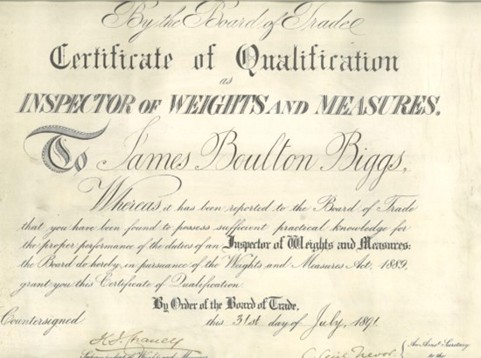
Certificate of qualification as an inspector of James Boulton Biggs, 1891
Legal adoptions of weights and measures began in 1707 - British Imperial units were first introduced into law in the Weights and Measures Act of 1824 – while the Metric system was officially enshrined into law in the Weights and Measures (Metric System) Act 1897. To oversee this in the county was the remit of the Weights and Measures, Food and Drugs Committee. It heard reports of the chief inspector of weights and measures; reports of the county analyst for food and drugs act. It also examined and testing weighing and measuring apparatus in the county (from pharmaceuticals to lorries!); fixed methods of checking food, livestock, animal feed, coal, sand and ballast; examined notes of prosecutions and dealing with legal proceedings. The committee also appointed the chief inspector and inspectors of weights and measures who were tasked with going out into the community to check standards and prosecute offenders. All the inspectors in the department of weights and measures had to be certified. This is the Certificate of qualification as an inspector of Weights and Measures of James Boulton Biggs. He had passed an examination in weights and measures in July 1891 at the Board of Trade in Westminster. Although employed by the county council, he appears to have been based in Saint George’s Parish in Bristol.
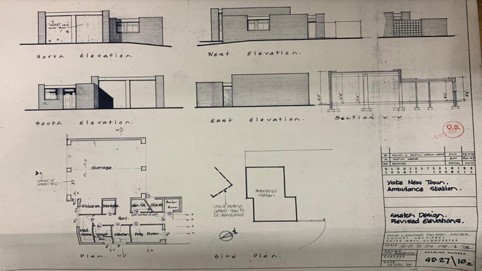
Plan and elevations of Yate Ambulance Station, 1966
The National Health Service Act 1946 gave county and borough councils a statutory responsibility to provide an emergency ambulance service. Many opted to contract a voluntary ambulance service to provide this, such as the British Red Cross or St John Ambulance. The councils however did have to build ambulance stations, such as this one at Yate, built in 1966.
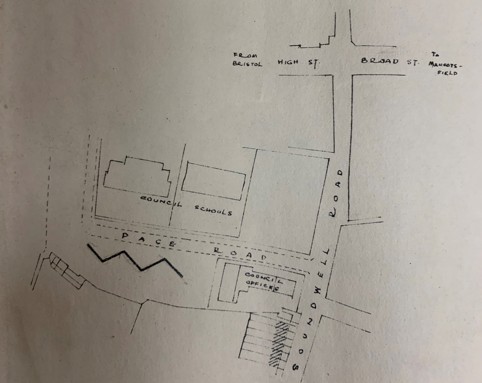
Mangotsfield Public Air Raid Shelter, 1939
The County Council's ARP arrangements began in November 1936 with the establishment of the Air Raid Precautions Organisation Committee, which in September 1939 was renamed the Air Raid Precautions Emergency Committee. It was made up of 12 members of the county council (all from the Standing Joint Committee) and six from the city council and its first meeting was on 23 April 1937 when a County Organiser, Deputy Organiser and four Divisional Officers for Gloucester, Cheltenham, Stroud and Bristol (Warmley) were appointed. Its remit was all matters relating to air raid precautions and civil defence, from strategic planning and organisation, recruitment and administration. It met weekly and largely dealt with the same or similar issues at every meeting. The Air Raid Precautions Emergency Committee was responsible for the provision of public air raid shelters – such as these trench shelters in Mangotsfield. They were sited on waste land, in parks and in the middle of wide public roads and were strong enough to provide protection from the blasts of exploding bombs (more people died from bomb blast than from direct hits). Trench shelters like these were built in a zigzag so that if a bomb scored a direct hit, the shrapnel would only reach a small area and the blast effects would be mitigated. They were far less common than private air raid shelters.
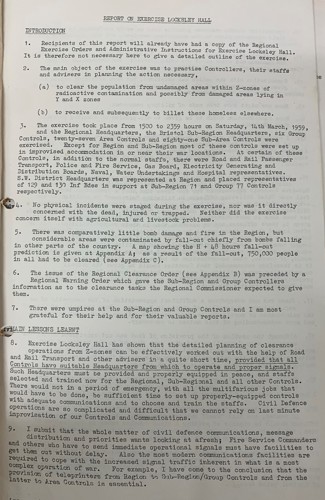
Report of Exercise Locksley Hall, March 1959
Post-WW2 the threat of nuclear war grew with the Cold War and with government encouragement, the ARP Committee was renamed the County Civil Defence Committee. It was tasked with planning for the event of a nuclear attack, working with the new Civil Defence Corps (CDC). In March 1959, the county council took part in Exercise Locksley Hall – a large regional exercise designed to simulate the response to a nuclear attack on south-west England. It involved all the main authorities in the south-west plus the Civil Defence Corps, the Police, and the Emergency Services, as well as military bodies, utility companies and transport services. It was largely intended to be a practise for controllers, their staffs and advisors to mobilise and take local control of the area response in the aftermath of a nuclear attack elsewhere – Wales. In a massive understatement, the compiler of the main report noted that ‘the whole matter of civil defence communications, message distribution and priorities wants looking at afresh…’ and recommended more ‘teleprinters’. The name of the exercise came from the poem Locksley Hall by Alfred, Lord Tennyson:
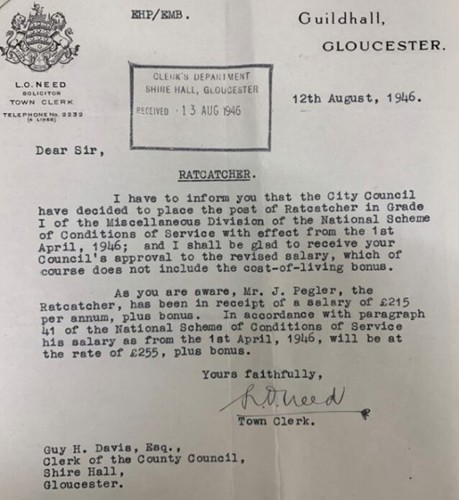
Agreement for employment of rat-catcher at Sharpness Dock, 12 August 1946
Mr J Peglar, the Council rat catcher must have been very pleased when the Clerk of the Council wrote to him in August 1946 to tell him that his post had been placed into the National Scheme of Conditions and Service. This resulted in a pay increase from £215 pa plus rat bonus to £255 pa plus rat bonus, although without a cost-of-living bonus. Sadly, Mr Peglar’s joy was short lived for just a month later he was told that his employment was to be terminated because the Council was going to replace him with one of a number of trained operators.