
'Slave song'
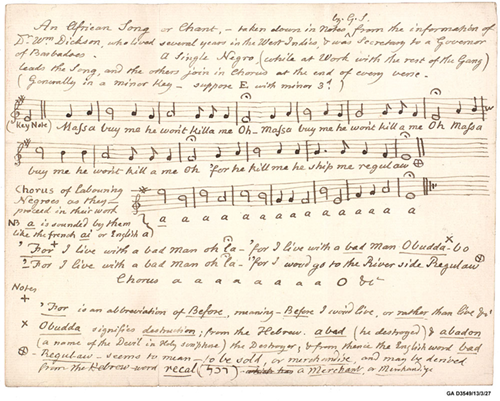
A project reflecting on the significance of the ‘African song or chant’ from Barbados (reference D3549/13/3/27)
Find out more….
A rare, internationally significant manuscript held in Gloucestershire Archives forms the basis for a new project funded by Arts Council England. The 18th century song is the world’s oldest surviving notated music from Barbados and unusually captures the voices of enslaved people working in the sugar plantations.
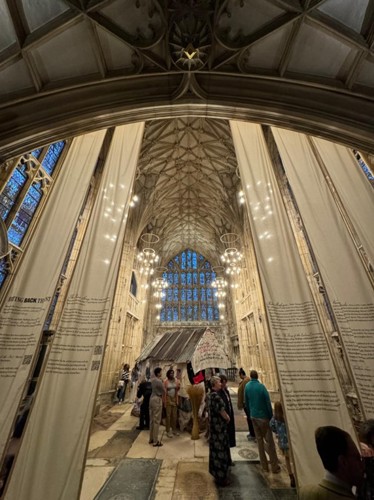
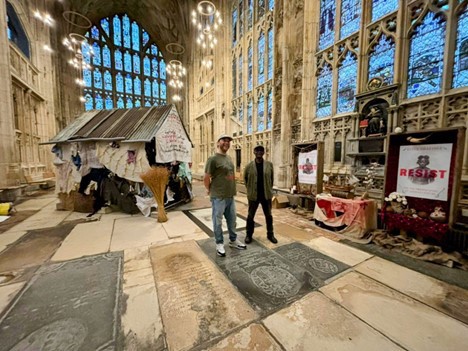
Rider Shafique (Gloucester musician and artist of Bajan descent) and Vanley Burke (the ‘Godfather of Black British Photography’) have created an installation in the Lady Chapel at Gloucester Cathedral in September 2024 which explores the impact of the transatlantic slave trade from their viewpoint as descendants of Caribbean enslaved people. The project will also involve the Sew Jamaica sewing group who will stitch clothes into the textile element of the installation, an immersive audio-visual installation by local film-maker Callum Chaplin and a series of talks.
The project is delivered in partnership with Voices Gloucester led by project curators Jacqui Grange and Georgia Williams.
Further information
The survival of the ‘African song or chant from Barbados’ is remarkable as it was heard by William Dickson, Secretary to the Governor of Barbados, then notated by his friend the prominent abolitionist, Granville Sharp, who was also a good musician and record keeper. His papers later formed part of the Lloyd-Baker family archives which were transferred to Gloucestershire Archives for safekeeping in the 1970s. We are delighted to promote this important archive to wider audiences across the world.
It's great to see that a document held in Gloucestershire Archives has made it into the UNESCO Memory of the World Internatlonal Register and is being celebrated on the front page of Wikipedia today (3rd February 2025). The African song of chant from Barbados was originally sung by enslaved West Africans in sugar-cane plantations in Barbados. It was found by Roger Gibbs who nominated it in an online exhibition. The song subsequently inspired an exhibition at Gloucester Cathedral:
The song was written down in the mid-18th century by anti-slavery campaigner Granville Sharp 'from the information of Dr William Dickson who lived several years in the West Indies and was secretary to a Governor of Barbados'. As such it was a European interpretation of a call and response chant heard in the fields.
Opportunities to see the originals
The song manuscript will feature in a major exhibition at the Wellcome Collection, 183 Euston Road, London NW1 2BE from 19th September 2024 to 27 April 2025.
More information:
https://wellcomecollection.org/exhibitions/ZpE1ghAAACQAgRSg
The manuscript final draft of the song will also feature in a major exhibition at the Fitzwilliam Museum in Cambridge CB2 1RB from 21 February 2025 to1 June 2025: Resistance, Revolution and Reform.