
Environmental Policy
Gloucestershire Archives @ The Hub
Environmental Policy
You can view a Word version of this policy here
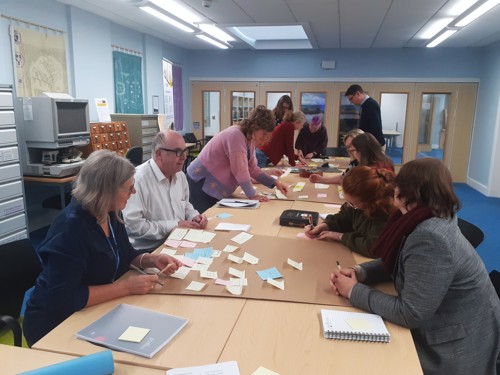
Developing our environmental policy was a collaborative process. We started by undertaking a workshop in 2024 to draw up an environmental action plan in an hour.
1. Policy statement and purpose
Gloucestershire Archives is committed to embedding environmental sustainability across all aspects of our work and continuing to reduce our carbon impact. This is in line with Gloucestershire County Council’s and South Gloucestershire Council’s declarations of climate emergencies in May and July 2019 respectively and their associated policies and strategies to reduce emissions and work towards net zero. This policy provides a framework for action.
2. Scope
This policy applies to all aspects of our service which is run from Gloucestershire Heritage Hub in Gloucester. It applies to staff, volunteers, partners and contractors and is published on our website so it is available to those engaging with our service: https://www.gloucestershire.gov.uk/archives/policies/environmental-policy/
3. Terminology
Archives are the record of everyday activities of governments, organisations, businesses and individuals. Archives may take many different forms – handwritten, typed, printed, photographic or electronic – and include audio-visual material such as video and sound recordings. As authentic and reliable records, they are preserved permanently because of their evidential and historical value.
4. Background
We are an accredited archive service recognised by The National Archives as the place of deposit for public records relating to Gloucestershire and South Gloucestershire.
Gloucestershire Archives gathers archive collections and local and family history resources to ensure they are kept secure and made accessible.
We are a Gloucestershire County Council service. By agreement, we also provide an archive service for South Gloucestershire Council and are the appointed Record Office for the Diocese of Gloucester.
We are a lead partner in the Gloucestershire Heritage Hub, a network of local people and organisations with a common interest in our historic county's documented heritage.
5. Guiding principles
- To care for our collections by implementing sustainable environmental measures that preserve their integrity while minimising energy consumption
- To promote sustainable practices in all aspects of our work to reduce the resources we use, waste less of what we use, use resources for longer, and reuse or recycle resources we no longer need to reduce our carbon footprint
- To deliver a programme of actions, monitor and review our environmental performance to identify areas for improvement
- To encourage our staff, volunteers, partners, visitors, and suppliers to participate in our environmental efforts and promote environmental awareness
6. Actions and Focus Areas
6.1 Archives building including strongrooms
- Monitor performance of predominantly passive strongrooms against BS/E16893: 2017 Conservation of Cultural Heritage and ethical guidelines of Icon and the Archives and Records Association. This follows the removal of air conditioning and associated chiller unit from remaining two strongrooms and installation of low-cost ‘dry air’ circulation system in lieu of individual portable dehumidifiers
- Monitor performance of chilled photographic strongroom and use of freezers for additional photographic storage against the same conservation standards. This follows replacement of full air conditioning and chilling system with a domestic ‘wine cellar’ system
- Work with property colleagues to trial grey water recycling for flushing toilets
- Work with property colleagues to replace elderly heating system with air/ground source heat pumps when existing equipment reaches end of life
6.2 Collections
- Collect archives and publications that document the environmental history of our two counties and provide evidence for tackling environmental issues over long timescales.
- Ensure sustainable use of storage space though focused collecting, appraisal (to reduce unnecessary keeping), and appropriate packaging of archives
6.3 Community garden and wider site
- Continue using compost produced on site, water butts and re-use of grey water scheme to support maintenance and success of the garden
- Commission and maintain work to ‘green up’ our carpark to encourage biodiversity
- Work in partnership with charities, volunteers and community groups to maintain our community garden to protect and enhance habitats and wildflowers, and support low-carbon food production and beekeeping
6.4 Digital
- Keep all aspects of our e-preservation work (an essential core activity) under review as we recognise this activity has an environmental impact, particularly with the need for redundancy to ensure reliable ongoing accessibility
- Undertake periodic digital clean-up days to reduce unnecessary digital clutter
- Reduce printing and use double sided printing where feasible
- Consider business case (including environmental impact) prior to digitisation projects
- Take a responsible approach to use of Artificial Intelligence (AI)
6.5 Energy and water usage
Work with council property colleagues to actively monitor use of electricity, gas and water and follow up any unusual peaks to improve efficiency and further reduce usage
- Periodically review opportunities to build on existing measures (LED lights, solar panels, removal of air conditioning) and explore additional renewable options, such as use of rainwater to flush toilets and water the garden.
6.6 Engagement
- Continue sharing information on environmental collections with environmental professionals (e.g. weather, flooding etc) to inform current practice and planning
- Continue holding environmentally themed events
- Continue providing online exhibitions to avoid bespoke use of physical exhibition materials and enable reuse of images and research, whilst reaching wider audiences.
- Plan full lifecycle of any physical exhibitions and engagement materials, building in re-use where feasible, and use of sustainable materials such as reusable (non-plastic) pull-up banners or recycled products wherever practicable
- Build on legacy of Green Pledge Project to provide ‘green’ guidance on events/exhibitions for potential co-creators and community collaborators
6.7 Procurement and project management
- Consider the environmental impact when planning new projects
- Consider ‘eliminate, reduce, reuse and recycle’ before purchasing
- Consider whole lifecycle of purchases, choosing sustainably sourced, environmentally friendly products which use less packaging wherever practicable, aligning with any relevant council procurement carbon reporting requirements.
- Work with council colleagues to encourage contractors to demonstrate their shared commitment to the delivery of the council’s environmental objectives.
6.8 Research and training
- Offer environmental sustainability training to all staff and incorporate overview into inductions for new staff
- Stay abreast of best practice in heritage and other sectors
- Share learning from Green Pledge Project (2023-2025)
6.9 Transport and travel
- Encourage staff and visitors to travel sustainably
- Promote staff and visitor use of our electric vehicle charging points
- Promote proximity to rail and bus stations on our website and onsite
- Support sustainable travel initiatives such as ‘Cycle September’
- Support home working as appropriate providing the needs of the service are met (with public service and working with unique archives)
6.10 Waste management
- Keep to principle ‘eliminate, reduce, reuse, recycle’ across all areas of our work
- Provide clearly marked recycling and organic waste bins for staff and visitors to reduce waste going to landfill and ensure proper disposal of specialist waste such as batteries and electronics.
- Continue undertaking periodic waste audits to measure impact of activities
- Continue reducing ‘waste’ received from donors and depositors by offering files, folders and plastic wallets for re-use to Hub visitors
- Recycle creatively where possible
Progress on actions will be recorded on our website at The Green Pledge Project | Gloucestershire Archives. Energy Performance Certificates (EPC) will be displayed at the Heritage Hub.
7. Roles and responsibilities
The Head of Service is responsible for developing and leading the implementation of this policy.
The Hub Green Team will build on the work undertaken during our Lottery funded Green Pledge Project (2023-2025). Team members are responsible for recording progress using Julie’s Bicycle tools (https://juliesbicycle.com/our-work/creative-green/creative-climate-tools/), for monitoring implementation of this policy and encouraging continuous improvement.
All staff are responsible for carrying out decisions and delivering services and activities in line with this policy.
8. Raising a complaint, concern or suggested improvement
Any complaint, concern or suggested improvement should be sent to archives@gloucestershire.gov.uk
9. References
This policy should be read alongside other related Archives policies, to be found at www.gloucestershire.gov.uk/archives/policies.
Gloucestershire County Council’s environmental strategy and related papers - https://www.gloucestershire.gov.uk/council-and-democracy/access-to-information/publication-scheme/our-priorities/economy-environment-and-infrastructure/environmental-strategies/
South Gloucestershire County Council environmental policy - Our environmental policy | BETA - South Gloucestershire Council
Case studies from the Archives and Records Association’s Environmental Sustainability Group: https://www.archives.org.uk/environment-case-studies
10. Review and revision
This policy will be reviewed at least every 3 years.
Please write to archives@gloucestershire.gov.uk if you wish to give feedback on this policy.
Document control
|
|
Author: |
Christina Wheeler Green Pledge project manager |
||||
|
|
Owner: |
Heather Forbes, Head of Archives Service |
||||
|
|
Approval Body: |
Gloucestershire Archives Management Team (GAMT); Gloucestershire County Council’s Director of Policy, Performance and Governance; South Gloucestershire Archives Liaison Group |
||||
|
|
Date Approved: |
7 November 2025 |
||||
|
|
Document Number: |
v.1.0 |
||||
|
Version history |
|
|
||||
|
|
Version |
Version date |
Summary of Changes |
|||
|
|
V0.1 |
October 2025 |
Comments from initial local and national consultation on draft incorporated. |
|||
Date of next revision: 2028