Adult Social Care Improvement
We’re making big changes to improve adult social care in Gloucestershire and have recently published our Improvement plan.

|
Activity |
Working Well |
Improvement |
|
4508 calls to Carers Hub Welcome Team (April 23 – Dec 23). Resulting in 848 people supported by peer support groups, 2916 people accessing short break respite, 748 referred for counselling and 458 full care act compliant assessments carried out (see IR 33.5) |
People supported into employment with a disability[1] (Q1 772, Q2 809, Q3 892). |
We want to co-design our Insights structure to close the loop of feedback e.g. from Partnership Boards, Surveys, Healthwatch etc. This will then provide us with key qualitative data to support our transformation and improvement journey. |
|
Our Home First organisations provide a discharge service supporting discharge of on average 100 people per month. They also provider a welfare call service to on average 750 people per month. |
The latest Warm and Well report shows that over 2021-22, for every £1 of Warm and Well funding, £11.43 more in capital investment is brought into the region. |
|
|
|
We conduct impact reports for example related to Thriving Communities, Know Your Patch (KYP). The biggest impact areas for the grants awarded over the last few years are in relation to reducing social isolation, supporting children and families and meaningful occupation (having things to do). |
|
[1] This is a corporate measure and relates to voluntary work as well as paid employment.
Our Partnership Boards have active representation from statutory partners, VCSE and people with lived experience across five Partnership Boards with enthusiastic and committed co-chairs. Co-chairs are people with lived experience and bring that knowledge and understanding into discussions and focus of the work of each Board.
For people with disabilities we have a long-standing relationship with Inclusion Gloucestershire, who support us with our quality assurance of care provision and with Kingfisher Treasure Seekers Association who we commission to deliver low level mental health support[i] and Building Circles who we commission to deliver Sexual Abuse Prevention training to people with a learning disability across the county, one of the many unique aspects about the training is that it is peer led. We also commission the Gloucestershire Deaf Association to deliver the Deaf and Hard of Hearing Equipment Assessment Service and Q-Care to provide a floating support 1:1 support and a drop-in service for people with a sensory impairment.
The VCS Alliance[ii] are key members of a number of our integrated transformation programmes of work and a Joint Memorandum of Understanding has been established to support working with people and communities across the integrated care system. How we capture insights from these organisations to inform our improvement work in Adult Social Care will form part of our improvement plan[iii] on how we can work in co-production consistently across the system.
Commissioning includes a range of opportunities to invest in local community infrastructure not limited only to formal procurement. Grants and investment in infrastructure agencies, user led organisations and specialist services such as Citizens Advice demonstrates commitment to local agencies who are more likely to understand local community needs and deliver social impact.
Gloucestershire has an established structure for bringing together housing, health and care services. Senior officers from the six District Councils, Public Health, NHS Gloucestershire, Gloucestershire Health & Care NHS Foundation Trust (GHC), Adult Social Care Integrated Commissioning, and social housing providers are all represented on the Gloucestershire Strategic Housing Partnership (see IR23.1 for more information).
GCC and GFirst LEP have worked together to develop a central resource around skills and employment with access to specialist coaches, tailored packages of support. This is called the Employment and skills hub.
The main Community Transport providers are Community Connexions, Lydney Dial-a-ride and Newent Dial-a-ride, and Cotswold Friends. Between them they cover the county of Gloucestershire. GCC invest £500k annually in community transport. The services are ‘door to door’ and provide transport to older, disabled or otherwise vulnerable people (this might be because they are rurally, socially, or financially isolated). However, stakeholders have reported access to accessible transport, especially in more rural areas to get to activities and fulfil daily living activities as well as social care workforce to be able to get to work is a real challenge. GCC has introduced a mini bus[iv] on demand service in Cotswolds and Forest of Dean as a pilot. However, this bus is not a wheelchair accessible one, further needs analysis is being undertaken by our Transport colleagues within GCC.
|
Activity |
Working Well |
Improvement |
|
4508 calls to Carers Hub Welcome Team (April 23 – Dec 23). Resulting in 848 people supported by peer support groups, 2916 people accessing short break respite, 748 referred for counselling and 458 full care act compliant assessments carried out (see IR 33.5) |
People supported into employment with a disability[1] (Q1 772, Q2 809, Q3 892). |
We want to co-design our Insights structure to close the loop of feedback e.g. from Partnership Boards, Surveys, Healthwatch etc. This will then provide us with key qualitative data to support our transformation and improvement journey. |
|
Our Home First organisations provide a discharge service supporting discharge of on average 100 people per month. They also provider a welfare call service to on average 750 people per month. |
The latest Warm and Well report shows that over 2021-22, for every £1 of Warm and Well funding, £11.43 more in capital investment is brought into the region. |
|
|
|
We conduct impact reports for example related to Thriving Communities, Know Your Patch (KYP). The biggest impact areas for the grants awarded over the last few years are in relation to reducing social isolation, supporting children and families and meaningful occupation (having things to do). |
|
[1] This is a corporate measure and relates to voluntary work as well as paid employment.
Our Partnership Boards have active representation from statutory partners, VCSE and people with lived experience across five Partnership Boards with enthusiastic and committed co-chairs. Co-chairs are people with lived experience and bring that knowledge and understanding into discussions and focus of the work of each Board.
For people with disabilities we have a long-standing relationship with Inclusion Gloucestershire, who support us with our quality assurance of care provision and with Kingfisher Treasure Seekers Association who we commission to deliver low level mental health support[i] and Building Circles who we commission to deliver Sexual Abuse Prevention training to people with a learning disability across the county, one of the many unique aspects about the training is that it is peer led. We also commission the Gloucestershire Deaf Association to deliver the Deaf and Hard of Hearing Equipment Assessment Service and Q-Care to provide a floating support 1:1 support and a drop-in service for people with a sensory impairment.
The VCS Alliance[ii] are key members of a number of our integrated transformation programmes of work and a Joint Memorandum of Understanding has been established to support working with people and communities across the integrated care system. How we capture insights from these organisations to inform our improvement work in Adult Social Care will form part of our improvement plan[iii] on how we can work in co-production consistently across the system.
Commissioning includes a range of opportunities to invest in local community infrastructure not limited only to formal procurement. Grants and investment in infrastructure agencies, user led organisations and specialist services such as Citizens Advice demonstrates commitment to local agencies who are more likely to understand local community needs and deliver social impact.
Gloucestershire has an established structure for bringing together housing, health and care services. Senior officers from the six District Councils, Public Health, NHS Gloucestershire, Gloucestershire Health & Care NHS Foundation Trust (GHC), Adult Social Care Integrated Commissioning, and social housing providers are all represented on the Gloucestershire Strategic Housing Partnership (see IR23.1 for more information).
GCC and GFirst LEP have worked together to develop a central resource around skills and employment with access to specialist coaches, tailored packages of support. This is called the Employment and skills hub.
The main Community Transport providers are Community Connexions, Lydney Dial-a-ride and Newent Dial-a-ride, and Cotswold Friends. Between them they cover the county of Gloucestershire. GCC invest £500k annually in community transport. The services are ‘door to door’ and provide transport to older, disabled or otherwise vulnerable people (this might be because they are rurally, socially, or financially isolated). However, stakeholders have reported access to accessible transport, especially in more rural areas to get to activities and fulfil daily living activities as well as social care workforce to be able to get to work is a real challenge. GCC has introduced a mini bus[iv] on demand service in Cotswolds and Forest of Dean as a pilot. However, this bus is not a wheelchair accessible one, further needs analysis is being undertaken by our Transport colleagues within GCC.
[i] One Gloucestershire, Joining up your information “JUYI”, https://www.onegloucestershire.net/programmes/joining-up-your-information/
Key Statistics
|
Activity |
Working Well |
Improvement |
|
Between April 23 to Feb 24, the Care Navigators received 252 new referrals of which only 10% (n=24) required onward referral to Adult Social Care locality teams for more intensive social care input. |
Our permanent admissions to care homes in the rolling year remain lower than the comparator group average (2022/2023). |
25% of calls to 999 from care homes in relation to Falls with 21% conveyance to ED. |
|
Fair Cost of Care exercise showed that the median cost per hour identified for domiciliary care in Gloucestershire is above our standard contract prices and is also more than the mean actual payment per hour made across the county. |
Low numbers of people placed out of area on average 10 placements a month. |
Our data tells us that 53% of people who waited over two weeks for a service lived in the four rural areas of Gloucestershire which points to the increased difficulty of recruiting in those areas. |
We have a good relationship with our care providers and utilise Gloucestershire Care Providers Association (GCPA), Provider Forum, monthly Provider Bulletin as well as our Provider Portal. In addition to this we have strong relationships with our community organisations through our Know Your Patch Networks[i] (KYPN) which bring together cross-sector partners to form a network for the needs of our communities and individuals.
Our Integrated Brokerage teams will work with individuals, family, care providers, safeguarding, social workers and CQC to ensure care provided meets the assessed needs and is delivered in line with contractual requirements and meeting regulatory requirements. We commission packages of care and contract on behalf of the ICB for Continuing Health Care through our Section 75 and Section 256 arrangements (see Appendix 6 for further information about our commissioning approach).
Our market position statement is out of date; the refreshed version is due to go to Cabinet Q2 2024-2025.
The opportunities have not yet been realised around our new bed-based contract (due to go to Cabinet for approval Spring 2024) which will build in greater assurance and escalation protocols, clarification of roles and responsibilities and the interdependencies across contract management, quality assurance concerns and safeguarding.
Gloucestershire have identified via electronic call monitoring the ability to re-commission care packages to providers who have a significant footprint in an area. By focussing providers in a specific locality, they have the ability to deliver care more efficiently, effectively and sustainably. This process enables providers to work more flexibly with their commissioned hours to provide a personalised approach based on individual’s needs.
Our Proud to Care[ii] team supports the external care market with the safe recruitment of care, works in collaboration with care providers around staffing resource requirements and works with Community Catalysts to support workforce. Our Proud to Learn platform supports the training, development, and retention of the external workforce.
We publish annually a Care and Support Guide directory[iii] which is available on Your Circle and provides written guidance (online or printed) on how to live well for longer, independently and in your own home as well as choices for when people choose to self-fund their care. The Guide explains how to access a wide range of services across Gloucestershire. Free copies of the guide are available from a range of venues inc Cares Hub, Hospitals, Libraries, GP surgeries, Age UK etc.
We have co-produced a comprehensive Falls Prevention and Response Programme[iv] with our independent care providers and this will be implemented with care homes for older people in the forthcoming year. We have plans to further develop the programme for domiciliary care providers and care homes for people with Learning Disability and/or Physical Disability during 2024.
Care navigators, employed by GCC, work as key members of the multidisciplinary teams of Complex Care at Home and the South Cotswolds Frailty Service to provide timely response to an appearance of social care need. Their role is to work with individuals and families to resolve and provide solutions to a range of social issues that help maintain people in their circumstances and prevent deterioration in their situation.
Gloucestershire has significantly invested in the Home First model; this has provided additional resources of front-line workers and by utilising a blended model we have made available additional community domiciliary care capacity to meet demand. This is via a partnership between GHC and private providers and facilitated by our Integrated Brokerage system. Our system control centre (SCC), Transfer of Care Bureau (TOCB) and System Flow dashboard provide us with the information and tools to systematically work together as partners to offer patients the most suitable care pathway for their needs.
Part of this approach has also been to develop further working with the VCSE to support people going home via Pathway 0 or simple Pathway 1 to alleviate pressure. We have also increased resource into our Age UK / British Red Cross partnership to support both discharge and admission avoidance with health and social care and wider community engagement.
The Out of Hospital service offers short term practical solutions to facilitate a return home from hospital. As well as supporting the individual to adjust and regain confidence as they recover, the service will also offer longer term support through relevant community networks and resources of the provider or by contact with VCS groups and networks.
We have eight hospital step down flats in general needs accommodation and extra care housing. The Lead Housing Officer supports Adult Social Care colleagues to make best use of eight flats secured and funded to support hospital discharge across Gloucestershire for people unable to return home due to housing related issues access to funds, for example, to resolve deep cleaning or basic furniture.
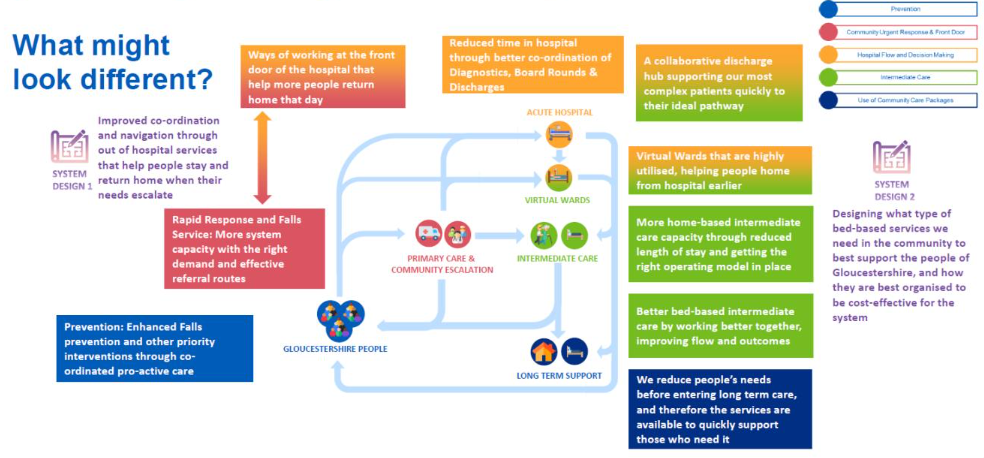
Newton Europe[i] has completed a diagnostic of our system as it supports urgent and emergency care. This has shown that our rapid response, frailty, falls, discharge to assess and reablement offers could improve efficiency and effectiveness in the way they work together to focus on prevention, independence, admission avoidance and system flow. A programme of improvements are planned until 2025 and this is outlined in Figure 4.
The LGA Peer Challenge Report noted that in relation to system flow:
“GCC has consistently shown its dedication to working creatively with voluntary and community groups in order to offer services designed to enable individuals to stay at home or return home safely”.
[i] Newton Europe, Review into our Urgent and Emergency Care Pathway, https://glostext.gloucestershire.gov.uk/documents/s86603/Improving Urgent and Emergency Care Services in Gloucestershire Report.pdf
[i] One Gloucestershire, Joining up your information “JUYI”, https://www.onegloucestershire.net/programmes/joining-up-your-information/
Key Statistics
|
Activity |
Working Well |
Improvement |
|
Between April 23 to Feb 24, the Care Navigators received 252 new referrals of which only 10% (n=24) required onward referral to Adult Social Care locality teams for more intensive social care input. |
Our permanent admissions to care homes in the rolling year remain lower than the comparator group average (2022/2023). |
25% of calls to 999 from care homes in relation to Falls with 21% conveyance to ED. |
|
Fair Cost of Care exercise showed that the median cost per hour identified for domiciliary care in Gloucestershire is above our standard contract prices and is also more than the mean actual payment per hour made across the county. |
Low numbers of people placed out of area on average 10 placements a month. |
Our data tells us that 53% of people who waited over two weeks for a service lived in the four rural areas of Gloucestershire which points to the increased difficulty of recruiting in those areas. |
We have a good relationship with our care providers and utilise Gloucestershire Care Providers Association (GCPA), Provider Forum, monthly Provider Bulletin as well as our Provider Portal. In addition to this we have strong relationships with our community organisations through our Know Your Patch Networks[i] (KYPN) which bring together cross-sector partners to form a network for the needs of our communities and individuals.
Our Integrated Brokerage teams will work with individuals, family, care providers, safeguarding, social workers and CQC to ensure care provided meets the assessed needs and is delivered in line with contractual requirements and meeting regulatory requirements. We commission packages of care and contract on behalf of the ICB for Continuing Health Care through our Section 75 and Section 256 arrangements (see Appendix 6 for further information about our commissioning approach).
Our market position statement is out of date; the refreshed version is due to go to Cabinet Q2 2024-2025.
The opportunities have not yet been realised around our new bed-based contract (due to go to Cabinet for approval Spring 2024) which will build in greater assurance and escalation protocols, clarification of roles and responsibilities and the interdependencies across contract management, quality assurance concerns and safeguarding.
Gloucestershire have identified via electronic call monitoring the ability to re-commission care packages to providers who have a significant footprint in an area. By focussing providers in a specific locality, they have the ability to deliver care more efficiently, effectively and sustainably. This process enables providers to work more flexibly with their commissioned hours to provide a personalised approach based on individual’s needs.
Our Proud to Care[ii] team supports the external care market with the safe recruitment of care, works in collaboration with care providers around staffing resource requirements and works with Community Catalysts to support workforce. Our Proud to Learn platform supports the training, development, and retention of the external workforce.
We publish annually a Care and Support Guide directory[iii] which is available on Your Circle and provides written guidance (online or printed) on how to live well for longer, independently and in your own home as well as choices for when people choose to self-fund their care. The Guide explains how to access a wide range of services across Gloucestershire. Free copies of the guide are available from a range of venues inc Cares Hub, Hospitals, Libraries, GP surgeries, Age UK etc.
We have co-produced a comprehensive Falls Prevention and Response Programme[iv] with our independent care providers and this will be implemented with care homes for older people in the forthcoming year. We have plans to further develop the programme for domiciliary care providers and care homes for people with Learning Disability and/or Physical Disability during 2024.
Care navigators, employed by GCC, work as key members of the multidisciplinary teams of Complex Care at Home and the South Cotswolds Frailty Service to provide timely response to an appearance of social care need. Their role is to work with individuals and families to resolve and provide solutions to a range of social issues that help maintain people in their circumstances and prevent deterioration in their situation.
Gloucestershire has significantly invested in the Home First model; this has provided additional resources of front-line workers and by utilising a blended model we have made available additional community domiciliary care capacity to meet demand. This is via a partnership between GHC and private providers and facilitated by our Integrated Brokerage system. Our system control centre (SCC), Transfer of Care Bureau (TOCB) and System Flow dashboard provide us with the information and tools to systematically work together as partners to offer patients the most suitable care pathway for their needs.
Part of this approach has also been to develop further working with the VCSE to support people going home via Pathway 0 or simple Pathway 1 to alleviate pressure. We have also increased resource into our Age UK / British Red Cross partnership to support both discharge and admission avoidance with health and social care and wider community engagement.
The Out of Hospital service offers short term practical solutions to facilitate a return home from hospital. As well as supporting the individual to adjust and regain confidence as they recover, the service will also offer longer term support through relevant community networks and resources of the provider or by contact with VCS groups and networks.
We have eight hospital step down flats in general needs accommodation and extra care housing. The Lead Housing Officer supports Adult Social Care colleagues to make best use of eight flats secured and funded to support hospital discharge across Gloucestershire for people unable to return home due to housing related issues access to funds, for example, to resolve deep cleaning or basic furniture.
Newton Europe[i] has completed a diagnostic of our system as it supports urgent and emergency care. This has shown that our rapid response, frailty, falls, discharge to assess and reablement offers could improve efficiency and effectiveness in the way they work together to focus on prevention, independence, admission avoidance and system flow. A programme of improvements are planned until 2025 and this is outlined in Figure 4.
The LGA Peer Challenge Report noted that in relation to system flow:
“GCC has consistently shown its dedication to working creatively with voluntary and community groups in order to offer services designed to enable individuals to stay at home or return home safely”.
[i] Newton Europe, Review into our Urgent and Emergency Care Pathway, https://glostext.gloucestershire.gov.uk/documents/s86603/Improving Urgent and Emergency Care Services in Gloucestershire Report.pdf