
Introduction
In January 2005 an exhibition was held in the Shire Hall, Gloucester, to commemorate Holocaust Memorial Day. Gloucestershire Archives' contribution was a display based on the archive of the Gloucestershire Association for Aiding Refugees (GAAR), telling the story of ten Jewish boys who had come to England on the Kindertransport programme and the hostel set up for them at 18 Alexandra Road, Gloucester.
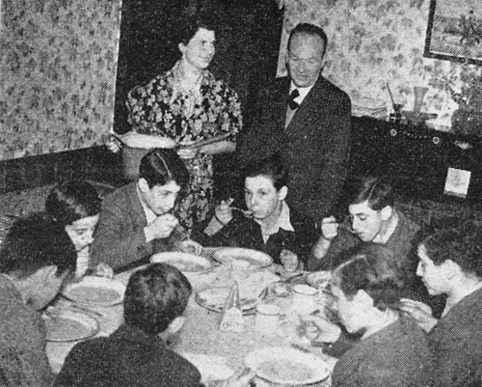
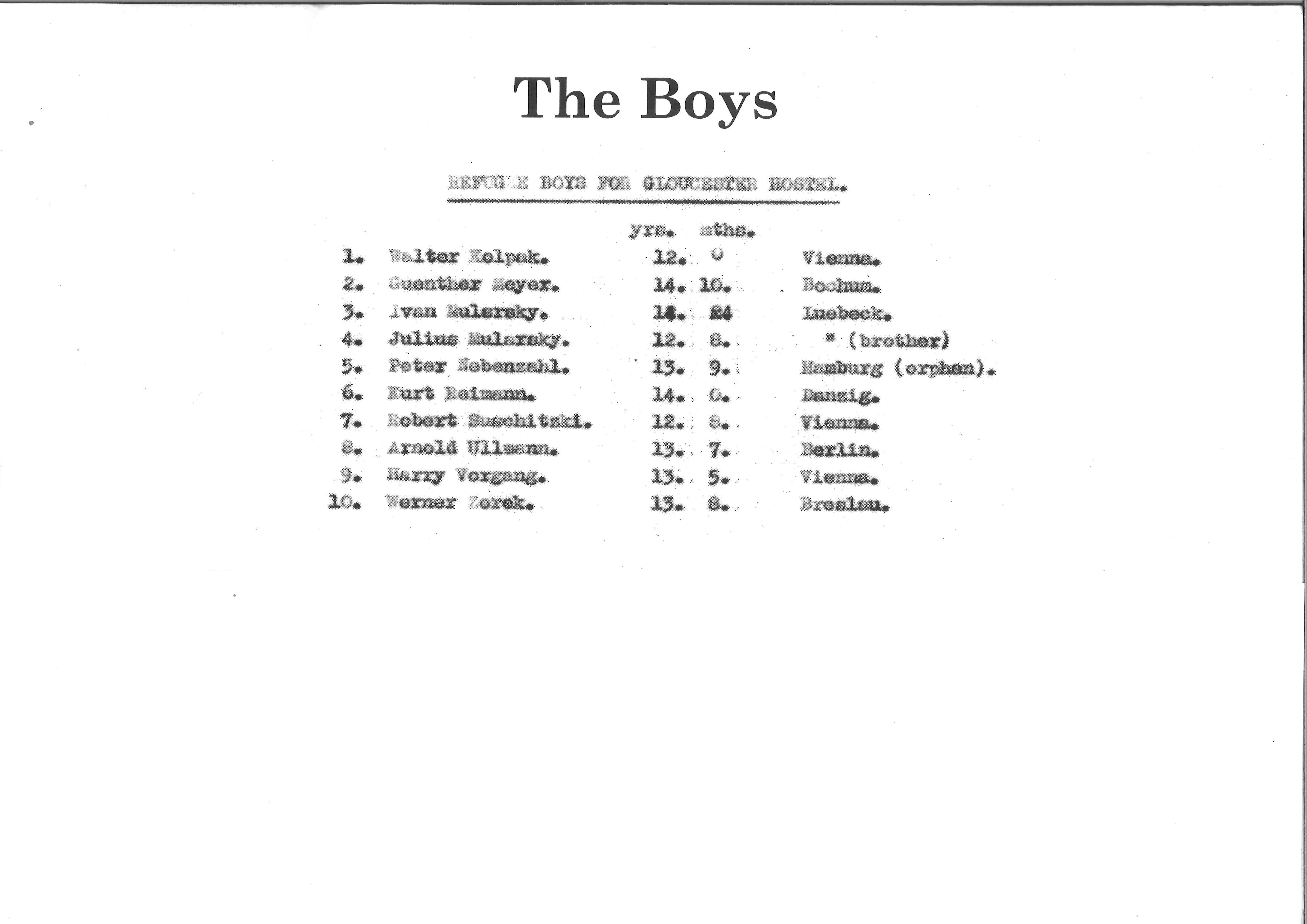
After the exhibition, it was felt that this story deserved a wider audience so a simple digital version of the display was added to the Gloucestershire Archives website. You can see it here.
Our attempts to find out what happened to the boys after they left the care of GAAR were not, at that time, successful.
But then....
Michael Zorek
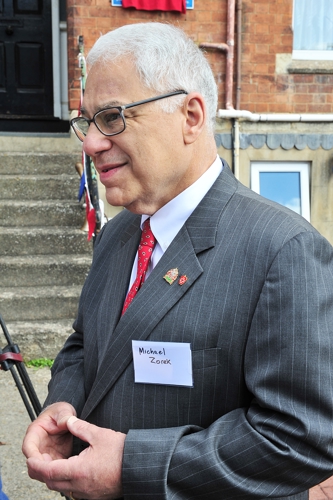
In 2016, we were contacted by Michael Zorek from New York. He had come across the on-line display and wanted to know more about the experiences of his late father, Werner Zorek, as a Kindertransport boy in Gloucester. Subsequently, Michael and his sister Jennifer travelled to Europe. Starting from the former family home in Breslau (now Wroclaw in Poland) they retraced their father’s journey, via the Hook of Holland and Harwich, to Gloucester where they were able to examine the GAAR archive.
In 2022, Michael led a successful campaign to mark the Alexandra Road hostel with an iconic blue plaque.
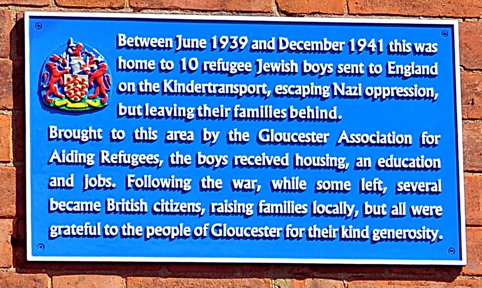
From information provided by family members on this memorable occasion, plus other research, we can now to add some details of what happened to the boys next.
Moving On
Once they were 14 years old, the boys were able to leave school although some stayed on until they were 15 to improve their English. Acting in loco parentis, GAAR helped them find jobs and, eventually, lodgings where they continued to support them until they were 18.
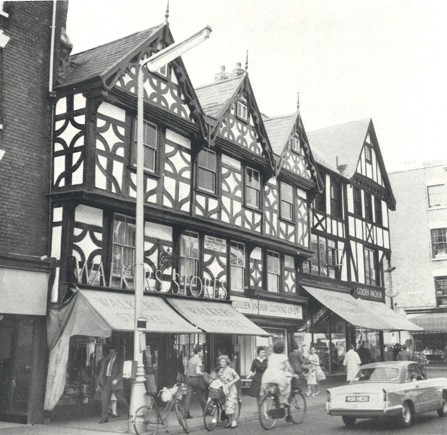
Part of helping the boys find employment involved vouching for them to the tribunal in Bristol which could exempt them from being interned as enemy aliens when they became 16.
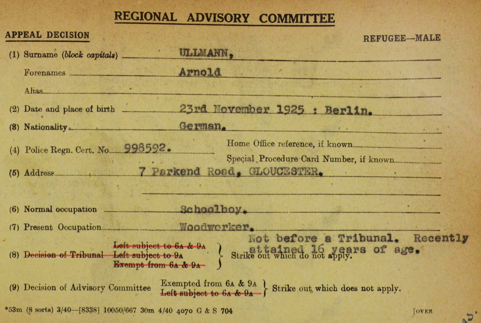
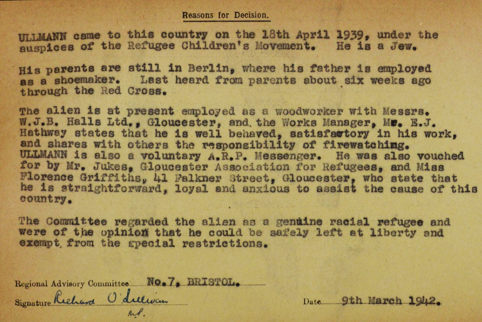
Arnold Ullman's clearance as an 'enemy alien' (Gloucestershire Archives reference D7801)
In December 1941 when all the boys had moved out of 18 Alexandra Road, Paul and Edith Arnstein resigned as Wardens and the hostel closed.
Families
Two of the boys, Robert Suschitski and Harry Vorgang, had mothers who had been able to come to England before September 1939 on the offer of employment, probably as domestic servants. Mrs Suschitski moved from Essex to Gloucester in November 1941 to a job at Denton’s department store and Robert was able to join her at 17 Oxford Street. He worked on the railways.
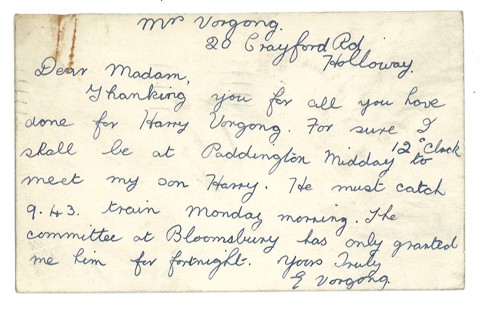
Harry Vorgang moved to Manchester in June 1942 to join his mother and his sister Ilsa, where he continued to work in an electronics business. Unfortunately, Mrs Irma Vorgang was already in poor health and died early the next year.
Walter Kolpak’s mother was in America. Plans that he might go there were postponed after the loss of 77 evacuee children when the SS City of Benares was torpedoed crossing the Atlantic in November 1940. He was eventually able to join her in May 1945.
Peter Nebenzahl was an orphan although he did have a brother who was working on a farm in Cornwall in September 1939 and with whom GAAR arranged for him to have contact.
For the other boys, there was very limited and indirect contact, via GAAR and the International Red Cross, with their families in Europe until such communication ceased in 1943.
Joining the Army
Six of the ten Kindertransport boys, as well as both the sons of the hostel's wardens, Paul and Edith Arnstein, joined the British Army. Enemy aliens could not be conscripted but could volunteer to serve in non-combatant units once they were 18 and had sworn an oath of allegiance to the Crown. One advantage of undertaking military service was that it qualified them to apply for British citizenship after the war.
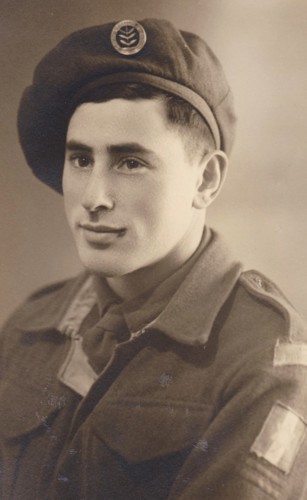
Harry Vorgang, Kurt Reiman and Julius Mularski served in the Pioneer Corps. Peter Nebenzahl joined the Intelligence Corps where his fluent German would have been an advantage. Gunther Meyer changed his name to James Mitchell, something not uncommon with Germans serving in the British Army. In his case it may have helped him to be accepted into the Army Air Corps.
Arnold Ullmann joined the Jewish Brigade of the Palestine Regiment after the end of the war in Europe. When it was disbanded in 1946, he took some trade tests and worked in an army workshop before being posted to a maintenance team in Belfast.
After the War
Five of the Kindertransport boys emigrated after the war.
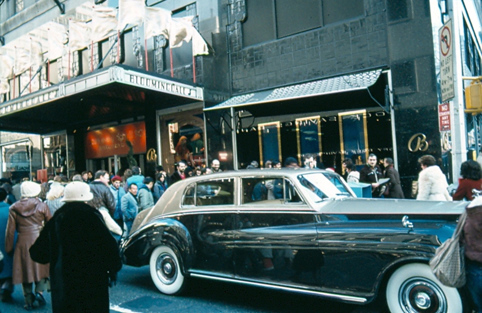
Walter Kolpak , Werner Zorek and Harry Vorgang went to the United States where Walter and Werner had relatives. Werner worked in his uncle’s tobacco business before joining the famous Bloomingdales department store in New York where he rose to be an executive. He was a volunteer with the Red Cross for more than 30 years. Walter also worked at Bloomingdales for a while as a security guard but their paths did not cross.
Robert Suschitski changed his name to Robert Smith and emigrated to Australia. Julius Mularski emigrated to Israel.
Ivan Mularski, Julius’s brother, became a fireman in Cheltenham before returning to the motor trade in Gloucester where he had a successful career selling cars.
Kurt Reiman also returned to Gloucestershire where he was known as John Reiman. He worked as a driver for British Railways and lived first in Hardwicke, then in Stroud and finally in Columbia Close in Gloucester within a few minutes walk of Alexandra Road. He died in 2011 at the age of 85.
Gunther Meyer (James Mitchell) stayed in the army after the war and made it his career, serving in Berlin and Hong Kong. He retired in 1965 with the rank of Staff Sergeant and was awarded the British Empire Medal.
Peter Nebenzahl changed his name to Peter Newman. According to his marriage certificate in 1958 he was an aircraft engineer living in Hackney, in the east end of London. He was only 53 when he died in 1978.
Arnold Ullmann left the Army in 1948, completed his apprenticeship in carpentry and subsequently qualified as a Clerk of Works. His work for the Air Ministry Work Directorate included a three-year posting at an RAF base in Malaya. When he retired from the Property Services Agency (PSA) in 1988, having been responsible for the staffing of multi-million pound contracts, he received an MBE for services to the construction industry. He retired to Horley, Surrey and died in 2020 aged 94 – the last of the Alexandra Road Kindertransport boys.
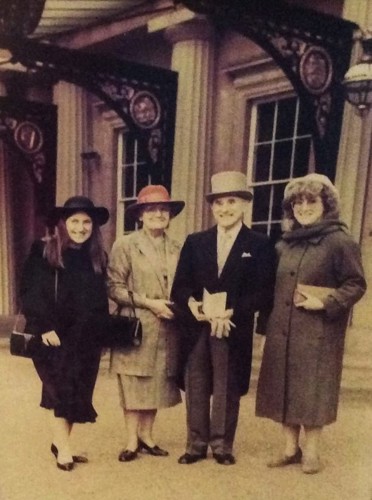
Paul and Edith Arnstein, the hostel Wardens, remained in Gloucester. After the hostel closed Paul, who was a lawyer, worked for a solicitor before joining the civil service at RAF Records Innsworth. In retirement in the 1960s they moved to south-west London to be closer to their family.
Recognition
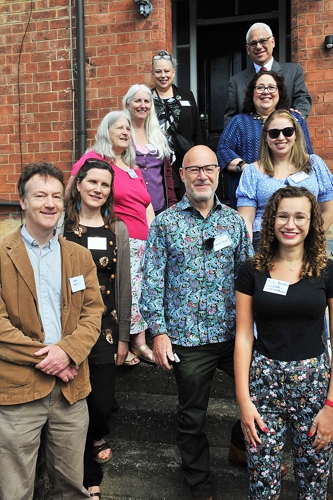
In June 2022, thanks largely to Michael Zorek’s efforts, a blue plaque was unveiled at 18 Alexandra Road commemorating the part the hostel had played in rescuing the Kindertransport boys.
The ceremony was attended not only by Michael with sister Jennifer and her daughter but also by Peter Nebenzahl’s daughter and both Arnold Ullmann’s daughters as well as a grandson and great-granddaughter of Dr and Mrs Arnstein who had been the Wardens at the hostel.
A film, The Boys at no. 18, was made by ourselves and Voices Gloucester to document the blue plaque ceremony and to tell the the story which lies behind it. You can watch it here.
Text: James Turtle with particular thanks to Michael Zorek, Jennifer Vallely, Tim Arnstein and Nick Burkitt