
A Taste of the Collection
Cataloguing Environmental Records
In October 2023 the Green Pledge Project embarked on a mission to catalogue approximately 13.2 cubic meters of inaccessible environmental records, unlocking a treasure trove of information for the public. Throughout the project we catalogued a massive 12,591 environmental records, and received 175 new accessions of environmental archives and publications.
Our main areas of focus were the Environment Agency collection (D7768), and the Severn Trent collection (D2826). Both collections contain thousands of records documenting the history of water management in Gloucestershire and the wider River Severn catchment area. Although deposited with us by these organisations, most of the records were created by their predecessors, so documents date back several hundred years and offer a fascinating opportunity to see how the landscape has changed, and how water management has developed.
You can read more about each collection in our blogs on the Environment Agency catalogue and the Severn Trent catalogue.
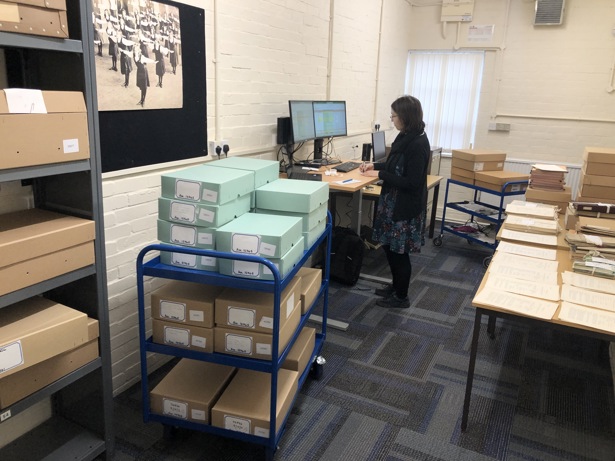
Taste of the Collection
Created by our very own Green Pledge apprentice, Ethan, please enjoy a 'Taste of the Collection' – a selection of the treasure trove of environmental historical records we hold that can help give insight into Gloucestershire and South Gloucestershire’s past.
No.1:
D12405/1, Mr Culley's exercise book from Church Street Boys Council School, containing drawings and stories of wildlife encounters and gardening.
Throughout our project we’ll cast a light on some of the discoveries we’ve made during our research, to help you to see some of the amazing items we have in Gloucestershire Archives!
Our first find is a little exercise book dated between 1914 and 1915 and details the gardening exploits of Charles C. Culley of Church Street Boys Council School. It is packed full of wonderful accounts, drawings and details into what he saw and got up to.
Let’s take a look at some extracts…
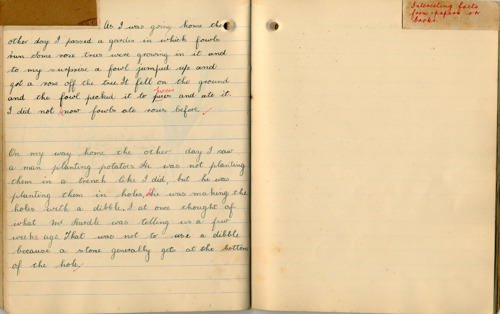
In an undated entry, but somewhere in late 1915, our author recalls passing by a man planting potatoes in a rather concerning way! The gentleman in question rather than digging trenches for his potatoes decided instead to use a dibber to plant them. Charles’ teacher Mr Hurdle had taught him otherwise, as Mr Hurdle knew use of dibber in planting would result in stones at the bottom of his holes, thereby obstructing the growth of the roots. If only the gentleman knew this! The lesson Charles was referring to in this entry can be found earlier on in the book, accompanied with some lovely hand drawn diagrams.
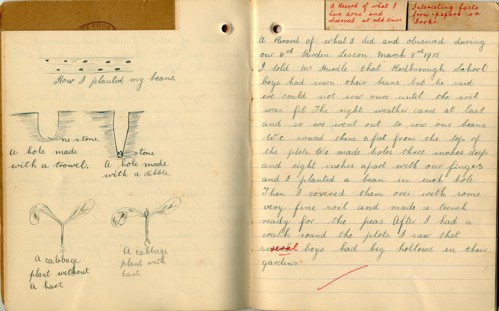
This page opposite this also highlights a conversation between Charles and Mr Hurdle surrounding the right time to sow their beans. Charles had noticed that the boys at Rodborough School had already sown theirs, but Mr Hurdle insisted patience in waiting for the correct weather and soil conditions, which eventually came and allowed them to start sowing. It’s a wonderful glimpse of the practices and methods that were being taught at this school.
What we love about the research for this project is we just never know exactly what we’re going to discover next! Turning pages of this journal we came across so many wonderful accounts and drawings, and our favourite is this starling below, captured on 12th February 1915. It’s a beautiful drawing that vividly captures what Charles was seeing and experiencing. Take a look yourself below!
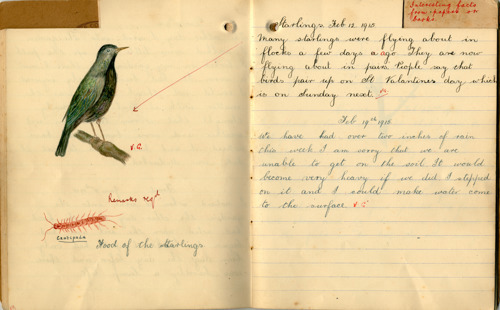
This exercise book will become a valuable part of our research at the Green Pledge Project and will help to show how our practices of gardening have developed over time. We think it will be a perfect resource for our younger audiences as we get them engaged with their local environments in a similar way, and perhaps this is something we can encourage our younger audiences to recreate in the future!
Thanks for reading and be sure to look out for more discoveries as we continue our delve into the archives.
If this has inspired you to want to dig further into our collection, click here to get started.
No. 2:
Research and extract created by Piper Holmes (placement student from Gloucestershire University) under the guidance of Ethan Langfield.
Historical weather records completed by the Severn Commission from 1881 to 1904 are being analysed and digitised, showing weather data from locations across the River Severn, including three sites in Gloucestershire – Upper Lode in Tewkesbury and Maisemore and Llanthony in Gloucester. Digitising this data allows us to create graphs to compare the average temperature and rainfall during the late 19th/early 20th century to today.
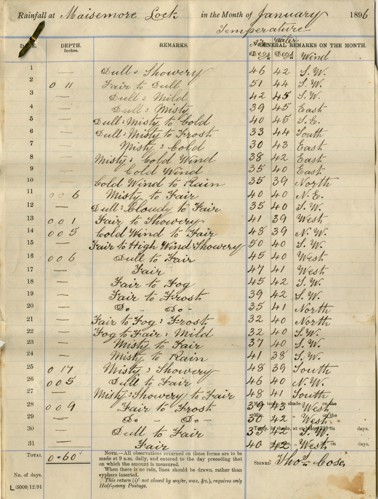
D2460/2/3/6/2/18, Maisemore Lock in January 1896
Excitingly, there is a period in the historical records where advanced record-taking took place, with many additional details about the weather recorded, including both water temperature and air temperature. This allows us to paint a clearer picture of the weather and climate patterns of the time and gain more accuracy with our averages.
These records are open access, so anyone who is interested can come and view them.
No. 3:
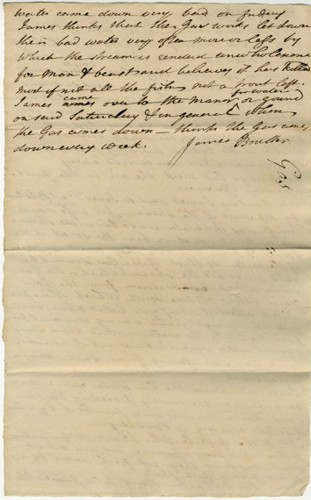
D2025/Box17/Bundle12, Correspondence about pollution of water at Boddington by the Gas, Light and Coke Company, Cheltenham, 1824
For our third taste of the collections, we travel back to 23rd September 1824 to a letter written by a James Boulter who was writing to complain of pollution at Boddington by the Gas, Light and Coke Company in Cheltenham. The significance of this rather ordinary looking letter? Well it appears to be one of the earliest records we can find of a written complaint of water pollution! Something that would become increasingly more apparent in the following decades and centuries.
So, what was the complaint? Apparently, gas had been leaking into the water supply at Boddington and turned the water black and smelly! James himself even tried some with his breakfast and noted that it ‘tasted so very bad’! The smell of the polluting matter was also noted, and rather suitably described as ‘offensive’. They end the letter by declaring that the stream is ‘rendered unwholesome for man and beast’, a statement which hopefully made a suitable impact on those who received it. Pollution has become an important topic for humanity in the last 200 years and is something we on the Green Pledge Project will be researching and documenting more on in the coming months, so make sure to check back with us soon!
No. 4:
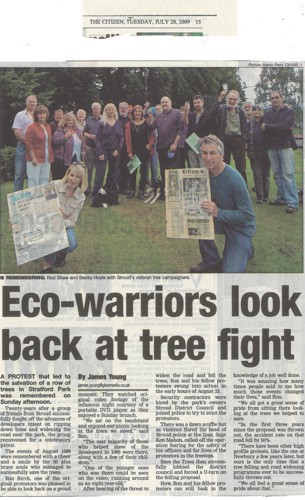
In this edition we’ll focus on item D12462/1/3, which are papers from the “Save Stratford Park Trees” campaign, that ran between 1988-1990. This campaign was fought to protect trees in Stratford Park in Stroud that were to be cut down to widen a road for a new Tesco supermarket that was set to open. It is believed to be one of the first instances of an occupation of trees to prevent them from being felled. The group were successful in achieving their goal, and to this day, all bar one of the trees still stand firmly in place. This collection was kindly donated to Gloucestershire Archives by Ron Birch, who was directly involved in the campaign.
The collection of materials here are wonderful and offer a rare glimpse of an inside view of environmental campaigning. One of our favourite images within the collection is this one below of Mark Cairns, occupying the trees from high above! You may have already seen this photo in our advertising for the project.
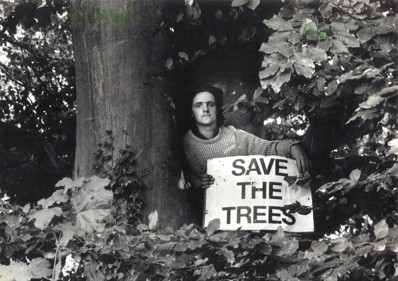
This photo, taken at the time, shows some of trees that were likely to have been lost forever had the group not formed. Can you imagine sitting up in those trees for hours on end as they did?
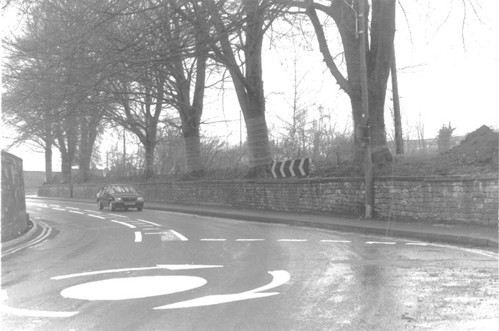
The groups action not only led to saving the trees, but also the abandonment of the road widening scheme. Instead, traffic calming measures were introduced, and in a newspaper interview from 2009, Ron Birch (a protester on this campaign) claimed that these measures had reduced the accident rate by 50% within three years. Saving lives and well as trees, now what could be better than that!
No. 5:
This Taste of the Collection brings us into South Gloucestershire, for a look at a long disused (and long lamented) passenger branch line railway. Railway branch lines offered a good and affordable alternative to road transport, at a time when villages and small towns were not as well connected or accessible by road and motorway networks as they are today.
The Yate to Thornbury line was just one of these lost branches, first opened by the Midland Railway Company on the 2nd September 1872, and served the towns and villages of Yate, Iron Acton, Tytherington and Thornbury. By 1944 however the last train had run to Thornbury, marking the end of regular passenger service on the line.
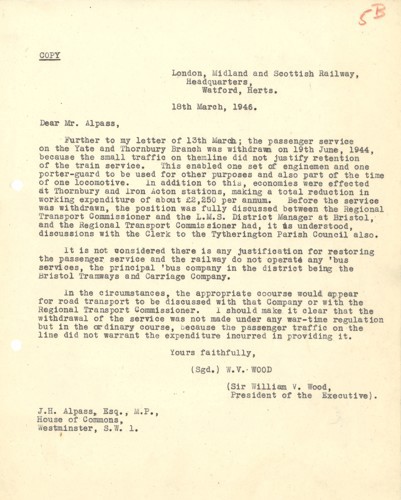
Below you can see a letter from the London Midland and Scottish Railway company (who absorbed the Midland Railway) replying to MP Joseph Alpass, who had been asked by members of his constituency to see passenger services restored to the line as early as 1946. The LMS were not to be persuaded however, and as can be seen in the letter, this is put down to lack of resources, and the fact the branch was losing money to operate. This probably was the case for its whole life in terms of passenger numbers, but in further letters in this document it is mentioned that the income from freight and goods services on the line probably more than made up for this.
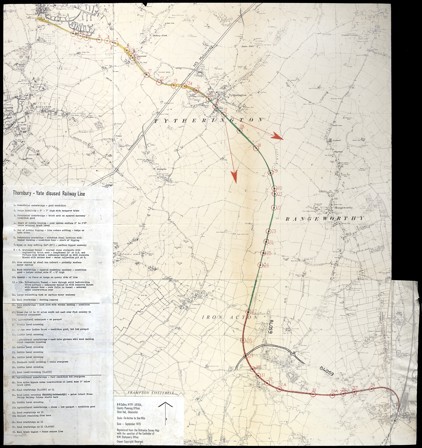
The section between Thornbury and Tytherington has since closed and new homes and developments now scatter the former track bed. However, the line remains intact between Yate and Tytherington Quarry, which now sees semi-regular freight use only on this section of the line. These lost lines provided key links for communities, offered affordable public transport, and reduced the transportation of freight on the roads. In this case, as there is no direct bus from Thornbury to Yate, car is now the only realistic method of transport between these two towns, pushing further pressure onto the roads, and resulting in the need of more private vehicles. The result is a greater contribution to greater traffic and pollution.
Want to know more?
Our apprentice has also created excellent Green Guides and Toolkits to assist you in navigating a flood of information swiftly and efficiently. Take a look at our Green Guides and Toolkit and then browse our online catalogue.
Permanent Preservation
Do you have environmental collections that you want to transfer to Gloucestershire Archives for permanent preservation? You can find out more about adding to our collections on our website Adding to our collections | Gloucestershire Archives