General requirements
10.1 Staff must:
- follow local procedures
- take all practicable precautions to prevent and control the spread of infection
- only assist with or administer medication to the person it was prescribed for or, in the case of an over-the-counter product, intended for
- understand what the person’s medications are and the reason why they are taking them. This information can be found in the person’s record.
10.2 Staff must administer medication only from the original:
- labelled container / packaging provided by the pharmacy. Staff must check with the pharmacist if a label is illegible or has been altered. Dispensing labels should be attached to smallest container, as a minimum patient name should be on all containers i.e. box and bottle/tub
- packaging as purchased for an over-the-counter medication and must administer it in accordance with the manufacturer’s instructions
10.3 Staff must not administer:
- medication from containers packed by the person or family, carers or those with parental responsibility, for example unlabelled dosette boxes
- any prescribed medication labelled as to be taken ‘as directed’. The pharmacy label must detail exactly how the medication is to be used
- any over the counter remedy to someone who lacks capacity unless this has been agreed by a health professional and recorded in the person’s plan
Pre-administration checks
10.4 Before dispensing medications, staff will wash their hands with soap and water, dry them and put on any Personal Protective Equipment (PPE) that is deemed necessary. After this, the staff will then check that:
- the medication has not already been given by someone else
- they have the right medication for the right person
- the medication is as expected, does not appear to have been tampered with, is within its expiry date and has been stored properly. Staff who have concerns about a medication will inform their line manages and seek advice from the person’s GP, pharmacist or the NHS 111 helpline before administering where appropriate.
10.5 Staff must check the MAR and:
- confirm the person’s identity, for example by asking their name or by photograph
- ensure that they have the right medication for the right person
- that the details on the prescribed medication label exactly match what is recorded on the MAR, in particular name, strength and dosage instructions. If medication is provided in manufacturer’s original packaging, check that the packaging information concurs with the attached dispensing label. If in doubt contact the dispensing pharmacy
- the sensitivity / allergy box
- that no-one else has already given the person their medication for the intended time
- whether any as and when required medication has been administered in the previous 24 hours
- the expiry date on the medication container to ensure that it is still in date.
- That they are in a space where they can be undisturbed, keeping full concentration and maintaining dignity and privacy of the individual
10.6 Staff must consult a pharmacist or the prescriber before administering the medication if they identify any discrepancies or have any concerns, for example if the medication looks different from expected or staff are unsure if they should administer an as and when required medication or its effect.
10.7 Before administering medication, staff will ensure the 6 R’s of medicine administration have been considered:
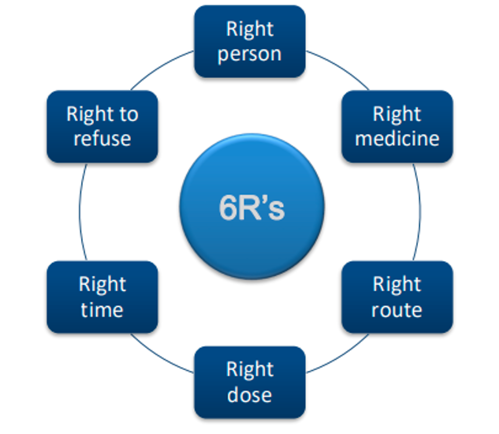
Respecting the person’s wishes and their right to refuse their medication
10.8 We will respect people’s rights to dignity, compassion and privacy when assisting with / administering medication.
10.9 Before unpackaging the medication, staff will explain to the person what they wish to do and check that the person agrees to take their medication.
10.10 We will not administer medication against the person’s wishes. If they do not wish to take it, staff must record this on the MAR and on the reverse of the MAR The reverse of the MAR/casenote must state the reason for refusal if the person gave a reason and any actions taken.
10.11 Staff will re-offer the medication after a short while. If the person still does not wish to take it, staff will check whether the plan has an instruction about what to do when medication is refused. If not, staff will seek advice from a relevant health professional.
10.12 Staff will raise concerns about any ongoing refusal with the person’s family / carer or a relevant health professional as appropriate and record all actions taken in the person’s record.
Prompting, assisting with, administering medication / monitoring
10.13 Staff will prompt people to take their medication as prescribed.
10.14 Staff who are assisting with / administering medication will prepare the correct dose and administer the medication as instructed on the label and the MAR. Staff will offer a drink of water for oral medicines or provide agreed swallowing aids as per the person’s needs and following assurance it does not interact with the medication.
10.15 When the person has taken their medication, staff must update the MAR and sign and date the record. Where the medication is a Schedule 2 controlled drug, staff must also update the controlled drugs register and a second staff member must check that all is correct and countersign the MAR and the controlled drugs register. Please see section 16 Controlled Drugs for detail.
10.16 Staff must also update any separate administration records, for example for warfarin or lithium where dosage is dependent on blood tests.
10.17 Staff must record any dose that is accidently wasted or spoiled on the MAR and record the reason for wastage.
Covert administration
10.18 When a person has mental capacity to make the decision about whether to take a medicine, they have the right to refuse that medicine - Covert administration means giving someone who lacks mental capacity to consent to having that medicine in a disguised format, without their knowledge, for example in food or drink. Administering medication in this way can affect how the medication works.
10.19 If a person requires medication in a swallowing aid (as per para 10.14, this does not constitute as covert administration. It is only when the person does not know they are having the medication does it become covert.
10.20 We will only administer medication covertly to anyone over 16 when:
- we have determined that the person lacks mental capacity to make decisions about their medication, and
- the health professional prescribing the medicine(s), care home staff and family members or an advocate have made an MCA compliant decision that administering medication covertly is in the person’s best interests and
- the responsible health professional has provided written instructions about how to administer the medication covertly
10.21 We will only administer medication covertly to a child under 16 in accordance with the child’s plan and as agreed with the relevant health professional and the person with parental responsibility.
10.22 We will record the decision in the person’s MAR and plan. We will keep the plan under review to ensure that covert administration is used only for as long as is necessary.
10.23 We will not administer medication covertly to anyone who has capacity to make their own decisions about their medication.
10.24 Administering covert medications should be kept under regular review, the frequency of each review is individual to each person down to their own circumstances. This review may be taken by a healthcare professional and information passed to social care.
